

The Software Factory Was Never the Finish Line
Agentic Coding got cheap. What keeps it running on Monday did not.
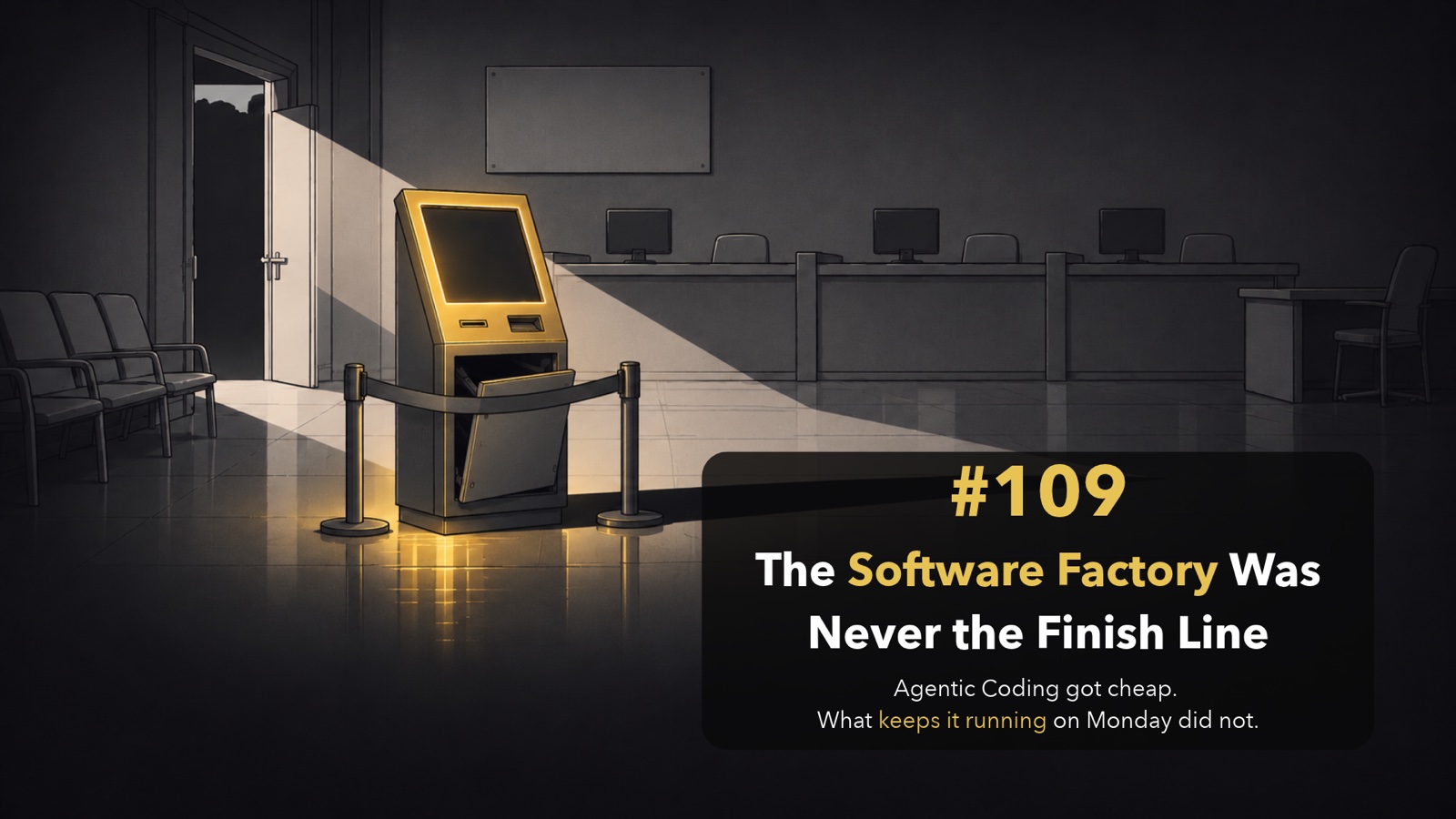
It was Monday, the thirteenth of January 2025, my brother’s birthday, and the traffic told me something was wrong long before I reached the building.
The purchase was done. What remained were checks and changes for the project of my workshop, a hundred and fifty square metres where all the equipment for my racing cars and bikes would finally live under one roof. I carried the documents and the drawings the way you carry something you believe is already half approved.
The hall was crowded. Inside, it felt like a post office the day three deadlines fell together and the pensioners came for their pay. But the strange thing was that everyone was agitated. In this country people are calm and measured as a rule. I had never seen them like that.
The doorman looked at me.
What are you here for?
I told him, naively. The papers, the drawings, the workshop. Then I said the thing that seemed to me the real problem. It was eight in the morning, and there were no tickets left.
He put a hand on my shoulder.
Go home, he said. There is no ticket for today, and there won’t be one for a good while. The national cadastre is down. The systems have been switched off until further notice. Only the desks for emergencies are open.
I stood there with my drawings in my hand. Behind him, the crowd kept moving, and nothing in that room was going to move with it.
Standing there, I thought about another cadastre. One I had built a long time ago.
Get every new episode in your inbox the day it ships. Free to join, yours to leave anytime.
We send one email per new episode, and nothing else. Your address goes to Brevo, our email provider, which sends you a confirmation link: you join the list only when you click it. We can see whether you open each email and which links you click. See our Privacy Policy.
It was just after the Y2K nightmare. My own job looked daunting. Take Italy’s national cadastre, a client and server application, and make it work on the web, under the rules of my region. Trentino Alto Adige is nothing like the rest of Italy. It is all mountains, bilingual with German, autonomous by statute, its valleys isolated for decades in the first half of the twentieth century, and its rules carry a long Austro-Hungarian inheritance that the national ones never knew. The rest of Italy kept its cadastres centralised. We kept ours in the valleys, one each, because in winter nobody goes to Trento or Bolzano, the two provincial capitals, for a land record when the valley holds a metre of snow. So by the early 2000s the whole region was already cabled and connected in one wide area network. The rest of Italy was still client and server. We had the wires. What we lacked was a way in.
Back then no AI agent opened a binary and explained it to you. Nobody did that for us. We took it apart by hand, one instruction at a time, because that was how we were trained, and I was good at it. The backend was an application compiled with C++ libraries. I had no door into it, so I made one. To me that was normal. I grew up with data centres and hackers, I had been running Linux since the nineties, and I did my entire university on SPARC machines running Solaris. Gutting a Windows system was a pleasure. I took SoftICE, the debugger reverse engineers loved in those days and went inside the libraries until I found the one place where I could get in. Through that seam I injected a new backend, written by me in C++, in Trojan horse mode. The old code kept doing its job, and from the outside it began to speak the language of the web.
What came out was a primitive web service, a CGI script by the standards of the time, protected by security that looks primitive today and was extreme for those years. In front of it, a graphical interface that was revolutionary for its time.
It went online and it stayed online for more than thirteen years. In all that time it never gave people a problem.
One day the phone rang. They were calling to tell me that the little one was retiring, after an incredible run without a single interruption or outage. The hardware under it had reached the end of its life. They gave me a piece of the Oracle cluster server, the one I had designed and installed, where my work had run for thirteen years while other people watched over it, day and night, without ever losing sleep.
In all those years nobody found the office closed because the system was down. People took a ticket, and within minutes their file was settled. And here I was, in a hall where nobody could think of anything else.
This is not a story about my software being better than theirs. I know nothing about how the system behind that hall was built, and the people still investigating it will tell us in time. It is a story about what rides on software like this. When it holds, it carries years of investment on its back and pays something back every day. When it is built without the engineering rigor a critical system demands, the same investment turns into damage, economic, reputational, social, and the damage is monstrous. Critical software built without that discipline stops being an asset and becomes an expensive and unpredictable liability.
Since that Monday the news has had a rhythm. A retailer whose apps went dark while its shops stayed open. A cloud provider taken down with hundreds of customers on it. Town halls on another continent, stopped by a single shared supplier. Almost every week something lands in the papers, and every time it seems to reach a little further into ordinary life. That is a feeling, not a statistic, and it comes from someone who has built critical software since 1998.
Then came Friday, the thirteenth of November. From Thursday evening, Microsoft 365 went down in more than seventy countries. Outlook, Teams, Copilot. Rail operators in Germany, Britain and Canada reported trouble with timetables and emailed tickets. The British health service reached for paper records. Microsoft said it was not an attack and had nothing to do with AI agents, and traced it to a network capacity upgrade. I take them at their word.
Thirteen. The thirteenth of January. Thirteen years online. Friday the thirteenth. I am not a superstitious man, but the number would not leave me alone.
I cannot prove that these outages share a cause. Microsoft says its own began with a network change, and I believe it. What I can tell you is what I see from where I stand. Every company that runs critical software is walking a razor’s edge. It cannot afford an outage like these, and it cannot afford to sit out the AI race. So it runs. And what it has put its money on, almost entirely, is speed.
Speed is what organisations bought, and speed is arriving. AI produces code at a pace no team could match by hand, and research finally sees it in delivery; throughput is up. Instability is up with it. The DORA researchers read that as systems that have not yet learned to carry AI-accelerated work safely. Accelerate had shown in 2018 that the best teams were faster and more stable at once, because their practices carried both. The industry is collecting the first half. Speed without quality is how situations like these are made; code arrives faster than the people who understand it, and what nobody understands cannot be tested, defended or repaired when it matters. And here is the paradox. Companies buy tools without training, while the people who maliciously target them invest in training and daily practice. Their tools are free and AI boosts them as much as anyone.
In the rooms where training budgets are decided, I keep hearing the same sentence, we cut headcount and training to buy the tools. I have seen this film. In the DevOps years, from inside large enterprises, I watched many companies buy the tools and skip the practices. Tools are tempting and tangible, now more than ever. The practices are difficult to touch, and more conveniently not required by anyone. No binding standard I could find tells a team how it must build software with AI, and the foundational courses are optional by design.
The reason is written in the curve. As software grew more complex, companies kept paying to teach people how to build it, and by the ATD benchmark training climbed from about 1.5 percent of payroll in the mid-1990s to above 3 percent by 2011. Complexity asked for craft, and craft had a price. As DevOps automated the repeatable work, the climb levelled off. Then AI arrived, training fell by about a third in a single year, and layoffs citing AI began to pile up. The money, it seems, is going to the tools, and I doubt anyone measures how much of it reaches engineering fundamentals. Speed has a budget line and a dashboard. Fundamentals have neither.
Which leaves a test any organization can run alone, in one look at its budget; if the budget holds AI as a tool but nothing for training on the fundamentals and for security, the exposure is already there.
Here is the arithmetic that keeps me awake. If a team can produce many times more software, the care that goes into it has to grow by the same factor, or the difference lands on someone else. A doorman. A patient. A traveller on a platform. Care does not come from tools. It comes from people who know the fundamentals well enough to doubt what the machine hands them, and that is built with training, practice and years. The speed curve points straight up. The care curve, as far as anyone can measure it, is flat at best, and only if we read the numbers in good faith.
Meanwhile organizations are growing uneasy about code written with AI, and they cannot send it back, because it already runs in their systems. So the policy walls go up. A second review on every AI-assisted change. Stricter rules on what the tools may touch. Locked codebases. Contractors who work on virtual machines with zero admin rights, who never see the code and cannot export it. In some of the companies I see, the people let go to pay for the tools are being quietly called back, into controls that sometimes feel excessive. People do not build walls around what they trust.
But the turning point arrived just as training touched its lowest level in the numbers I could find. In October, Anthropic announced its Claude Frontier Academy. OpenAI and Google run certificates on their own tools too. I could not find one that sells the fundamentals. Those they seem to take for granted, as the price of admission; you are expected to arrive already black belt.
Regulation has started to answer, in the typical European way. Under the Cyber Resilience Act, whoever places a product with digital elements on the EU market answers for it, and the text does not ask whether a person or an agent wrote the line. It is an answer more than a solution, and for anyone who ships software the question of who is responsible points to one name. You.
For a generation, working software was the finish line, because reaching it was hard. Today anyone can have working software in a prompt by lunchtime. What lasts is something else, and I have started to call it a working product.
On the thirteenth of November, in more than seventy countries, a great many people were told what I was told in that hall. Go home, nothing works today. Nobody put a hand on their shoulder. The black screen did it.
Everybody is building their own software factory nowadays, and I genuinely understand why. If your system is your core business, software is either an asset that carries you or a liability waiting for a Monday. A factory can produce either one, and fast.
What decides which one you get is two people, not the tool and not the budget. The first builds the factory. An AI engineer who can work as a crafter, as an organizational expert and as a behavioral scientist, and who fuses people, process and discipline into a factory shaped for that organization, because factories are not bought off the shelf and are not built in do-it-yourself mode. The second sits at the wheel. A crafter who knows how the work is done, who uses AI to go faster, and who knows the craft well enough to doubt what the machine hands over and to take control when it stops answering. Quality is the part the human has to reinforce. Without these two, the team is not driving the factory. It is a passenger in it.
So before the next factory goes live, look at who built it, and at who sits at the wheel. That is the difference between a system that runs for thirteen years and a hall full of people told to go home. Nobody tells you, on the day you sign off a budget line or skip a review, that the decision is heavy. It feels light. A course not renewed, a tool bought, a check postponed. The weight arrives later, and it arrives quietly. A summons from a judge, delivered while you are at home enjoying time with your family, spoiling the day for you and for everyone who relied on you, on your work, and on your critical system.
Thirteen years from now, will the software your business depends on still be running, and does anyone in your company know why, and who to thank for it? I keep a piece of that server in my heirloom collection. Thirteen years of service, and I know exactly who to thank for every one of them. Do you?
Next article: by the time you read this I will be in Helsinki, at Slush, listening to what investors and founders expect from 2027 and where their money goes today. In the rooms I know, everyone seems to talk about the same two things, software factory against vibe coding, and AI adoption. I will be looking for the two people from this article, and for who is ready to pay for them.