

The Roller Coaster and the Rocket
The human augmentation that changes everything, and the discipline it requires
The tea was still warm in my Ducati mug. Outside, the roses were pushing through the soil, the first stubborn buds of spring pressing against the last of winter. The golden rain tree was already turning, its yellow blossoms making a red, yellow, green frame against the evening sky. The garden was waking up. Patient. On its own schedule.
My head was somewhere else.
I had just come back from Italy. Two days with engineers at Ferrari F1 and Ducati Corse, walking through departments where performance is not a goal but a baseline condition. What struck me wasn’t the technology they were using. It was the discipline around how they were planning to adopt AI. No rushing. No resisting. Engineering the adoption itself; defining expected outcomes upfront, designing the trials by hypothesis, measuring against prediction. The same precision they apply to a lap time, applied to a change management question. They were not asking “should we use AI?” They were asking “what result do we expect, how do we verify it, and what does failure look like before it happens?”
I was still processing that when the call ended and I walked to the window.
The CEO and the CTO had been warm. Almost relieved. We had been talking for an hour about a trial their organization had been running for several months; five teams, five different approaches to AI adoption, all observed in parallel. A controlled experiment the way engineers run controlled experiments; same environment, same tools available, different protocols.
They called it their five habitats.
The first team continued working exactly as before; no AI tools, no mandate, no disruption. A baseline. The second team, the volunteers, were given full access to AI with no guardrails and no process. Use it however you want, ship what comes out. The third team was the reluctant group; skeptics required to use AI despite their reservations. The fourth was a team of experienced crafters invited to experiment freely, their skills as the only foundation. The fifth was a team of crafters equipped with nWave; engineering discipline enforced and mirrored by the framework at every step.
Same organization. Same timeline. Five completely different worlds.
The CEO started with the teams that had been struggling.
The reluctant team, the ones forced to use tools they didn’t trust, had started slow and gotten slower. Not just in velocity; in everything. Morale had dropped. Engagement had thinned. Absenteeism had risen in a way that had no obvious explanation until you looked at it through Patrick Lencioni’s lens: trust is the foundation layer of any functioning team. When that layer cracks; trust in the tools, in the direction, in leadership’s understanding of what work actually feels like; everything built above it starts to shift. These developers hadn’t been given the time to build the incremental awareness that creates genuine confidence. They had been handed a tool and told to use it. The result wasn’t resistance. It was disconnection.
The enthusiast team told a different story, but arrived at a similar destination by a different road.
Their first sprints had been extraordinary. Velocity spiked. Features shipped fast. The numbers looked good and everyone looking at those numbers felt optimistic. Then the sprint after arrived. And the one after that. Bugs that had been invisible in the enthusiasm of fast delivery began surfacing in production. Features that had passed review began generating user complaints. The code was working in the narrow sense; it ran, it deployed, it passed the tests that had been written for it. But the engineering discipline underneath was absent. No one had enforced it. The AI hadn’t known to ask for it.
Severity-1 incidents started appearing. The team that had been celebrating velocity was now spending its entire capacity on rework; fixing what had been shipped three weeks earlier, managing technical debt that was compounding faster than anyone could address it. Revenue conversations became uncomfortable. Brand conversations became worse.
Stanford’s SWEPR group has been studying this pattern across more than 600 organizations and 120,000 engineers. The signal is consistent; teams believe they are moving faster, and the data often tells a different story. METR put a number on the gap: teams were 19% slower in practice while estimating they were 20% faster. Thirty-nine percentage points between perception and reality. Not incompetence. A measurement problem. Nobody had told the terrain shifted before the confidence had already formed.
The nWave pilot team moved like something else entirely.
The CEO paused before describing them. Not for effect; I think he was still slightly surprised by his own data. One day. Where the other teams measured progress in sprints, the nWave pilot was shipping in a single day the volume of work that had previously required a full sprint. Not by cutting corners. Not by skipping review. By removing the friction between intent and production-ready code; every specification clear before a single line was written, every agent paired with a counter-agent, every step engineered to eliminate the drag that accumulates when process is improvised at speed.
The crafters on that team weren’t moving fast because they had stopped caring about quality. They were moving fast because quality had stopped being a separate conversation. It was built into the rhythm. The discipline and the velocity were the same thing.
Later that same evening, a second conversation arrived at the same conclusion from a completely different direction.
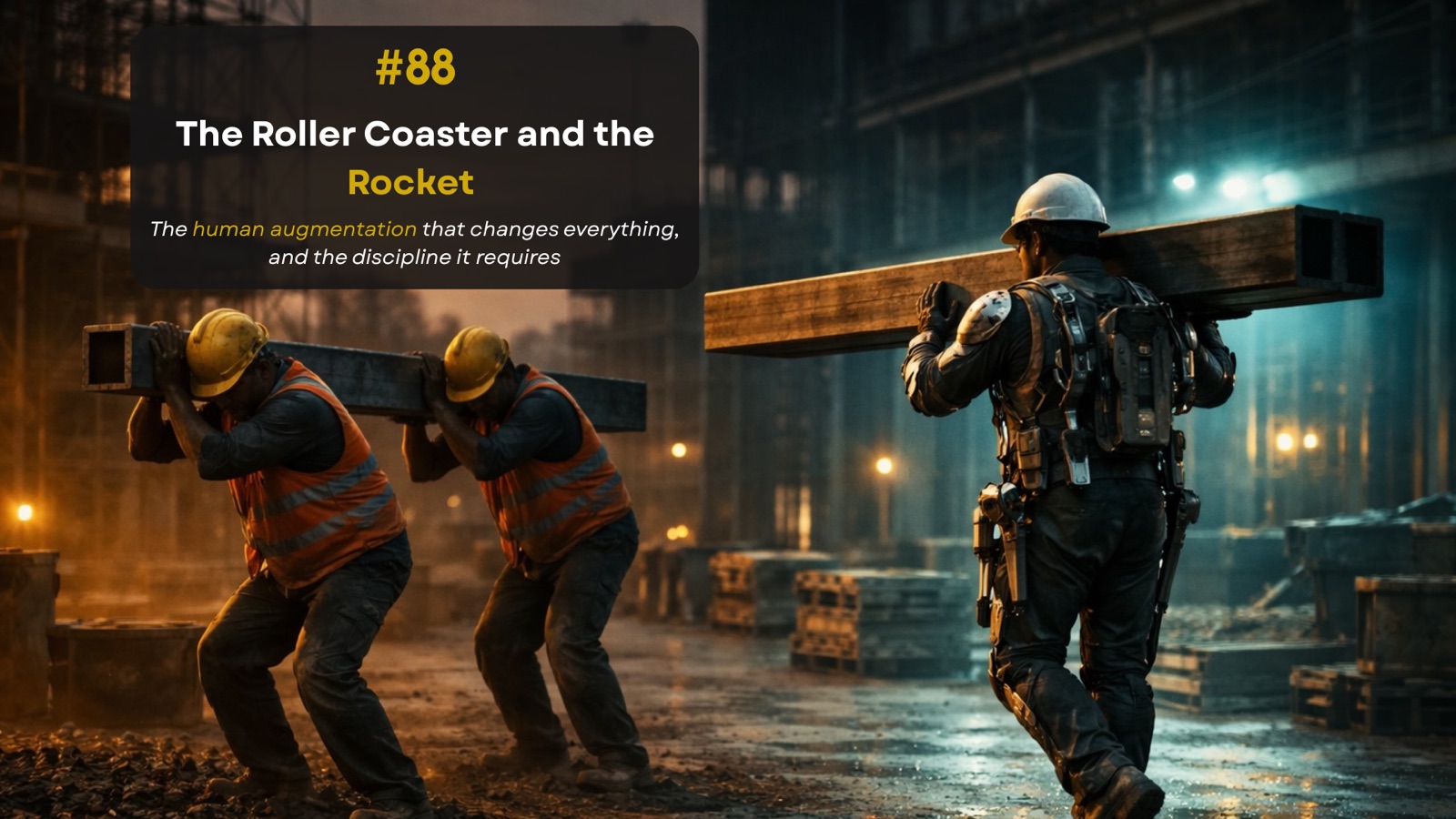
A client described watching workers on a construction site. Some were lifting and moving the way workers have always done; skill, effort, the body doing what bodies do. Others were equipped with exoskeletons; mechanical support that amplified what the human brought to the work. Those workers were moving more material, with less physical strain, more accurately, more safely, at a pace that was sustainable across the full day.
The exoskeleton didn’t replace the worker’s skill. It required it. A worker without the training, without the understanding of how the tool extended their own body, would fight the exoskeleton rather than move with it. The augmentation only worked in the presence of the discipline that already existed. And when it worked, it didn’t just benefit the worker; it benefited everyone in the loop. The site moved faster. The project finished earlier. The team went home less exhausted. Wealth created for everybody involved.
That image settled something I had been trying to articulate since the Ferrari visit.
The organizations getting the most from AI are not the ones who adopted fastest. They are not the ones who were most skeptical either. They are the ones who treated adoption as an engineering problem; who built the foundation before adding the amplifier, who understood that AI does not create discipline. It reveals whether discipline was already there.
The rocket team didn’t become a rocket because of nWave. They became a rocket because their craft was already strong enough to be amplified. nWave gave their discipline a mirror and an engine. The result was, in retrospect, inevitable.
The sky outside had gone from red to deep blue by the time I finished the last of my tea. The roses were still there in the darkening garden, patient in the soil. The golden rain tree had softened into shadow. Spring doesn’t arrive because you rush it. It arrives because the conditions have been prepared, and the time has come.
Your teams are somewhere on this spectrum right now. Some of them are slowing down without fully understanding why. Some of them are shipping fast and building a problem they haven’t discovered yet. Some of them are ready for the exoskeleton, and the question is whether your organization is ready to offer it in the right form.
The four dimensions of AI readiness; FOCUS, TECHNICAL, PRODUCT, FEEDBACK; are the diagnostic that tells you where each team actually stands. Not where they believe they stand. Where they stand.
The assessment takes thirty minutes. The clarity it creates lasts considerably longer.
→ Take the AI Readiness Assessment - 5 minutes to start your rocket
Next week: when the metrics you trust are measuring the wrong thing, the gap between perception and reality doesn’t just persist; it compounds. And the cost of that compounding is rarely visible until it isn’t.