

The Driver
The three layers under every governed AI stack, and why the best equipment on the track posted the slowest laps
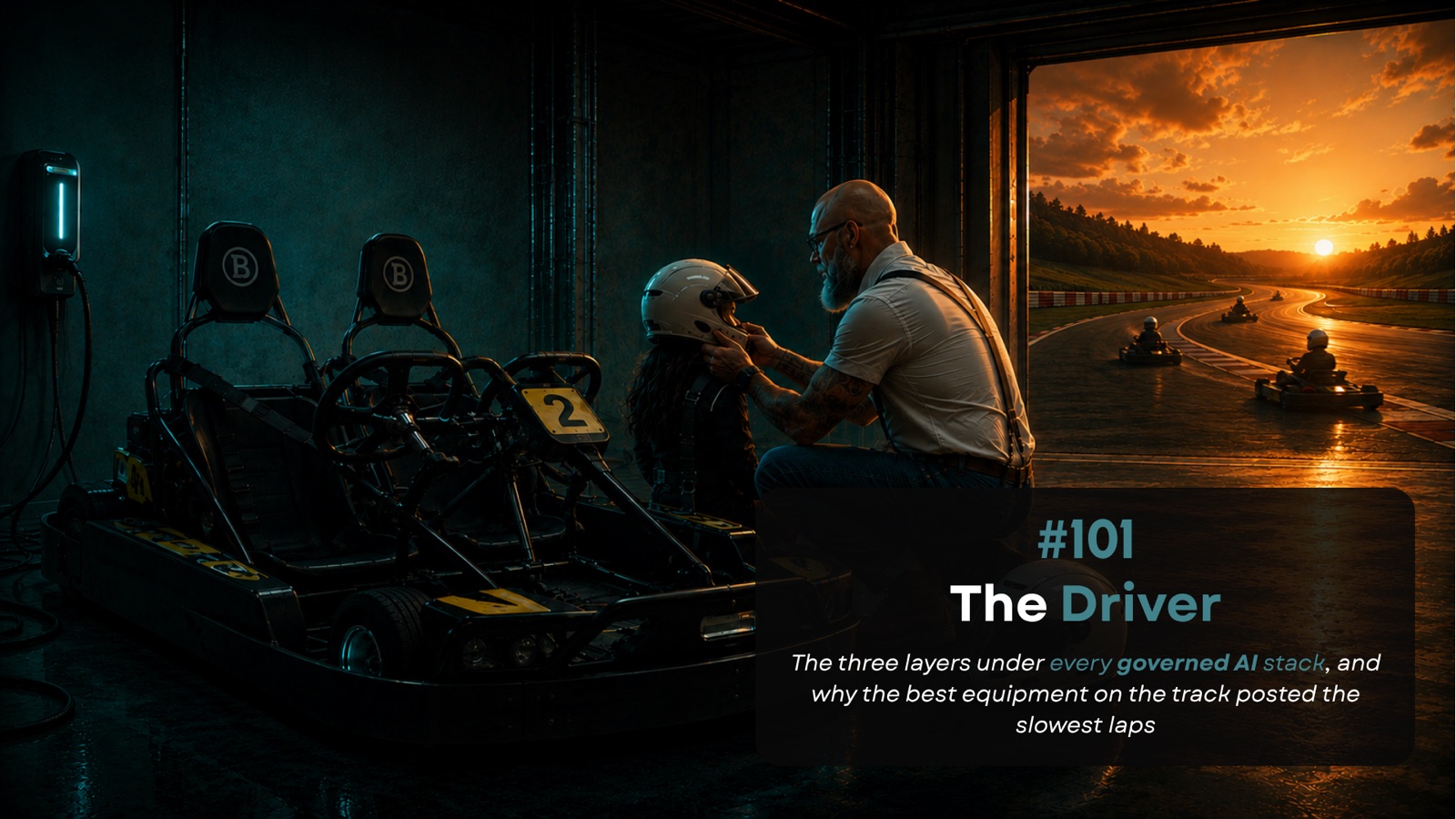
Speed, sweat, and tyres.
That was the whole smell of the place, a few months ago, at a go-kart circuit neither of us had been to before. Nothing in that air had ever been on fire. Hold onto that. It is the only thing I am going to ask you to carry, and it comes back at the end.
I was dressed wrong. No suit, no gloves, no driving shoes. Normal boots, and a helmet off the rack by the door that had been on a hundred other heads that week. My daughter climbed into the right seat. I took the left.
Two seats, two steering wheels, both fixed to the same steering rod. Hers moved when mine moved. Mine moved when hers did. The throttle and the brake were on my side only.
We were there so she could learn drifting, power control, what a machine feels like near its limit. Around us a group was running a competition between themselves. Timed, serious, their own gear, their own regulars. One of them said, loud enough to be heard, that he hoped the two-seater would stay out of the way.
That was fair. From where he was standing, that is exactly what we looked like.
Three laps
The first lap we did not race at all. We got in behind them and read the track. Where it opened, where it lied to you, where the fast line was not the obvious one.
The second lap we went slower on purpose, to open a gap and take the traffic out of the picture.
From the third lap we started asking the kart for everything it had.
By the end of the session we had passed all of them. The board showed the fastest time of the session, then of the week, then of the month, and we were less than a second off the overall circuit record. In a two-seat kart, with a child in the other seat, and boots meant for walking.
They came over while we were still climbing out. Helmets in hand, gloves not off yet, suits still zipped to the neck. Nobody had stopped to cool down first.
Crazy. Reckless. Overtaking like that with a small child in the kart. They had been frightened out there, which I understand, because from behind, competence you are not expecting looks exactly like recklessness.
My wife Sońa answered them in Slovak, in the warm and unhurried voice she uses for absolutely everything, including this. She explained that I was not the dad they had in mind. That I drove rally. Professionally.
Then everybody laughed, and the whole thing turned into the good half of the afternoon.
Rally, hillclimbs, circuit sessions. Years of it, back when the sport was wilder and the paperwork was thinner. These days I rent laps and race the clock, because the only driver worth beating is the one I was last time.
The tools were there. The skills were not.
Here is the part I have not been able to stop thinking about since.
Those drivers were not short of anything you could buy.
They had better karts than ours. Single seaters, lighter, no passenger, no second steering-wheel on the rod. They had their own helmets and their own gloves, which fit. They knew that circuit far better than I did; they were there every week. They had a competition running, with timing, with rules, with a marshal watching the track.
Everything you would put on a purchase order, they had. And they were slow, and none of them knew it, because everyone they measured themselves against was slow in the same way.
It seems like the hardest thing to see from inside a system is the ceiling of that system. Not the errors. The ceiling. Errors announce themselves. A ceiling just sits there, quietly, looking like the top.
That is the shape of most AI readiness gaps I meet. Not an organisation doing something wrong. An organisation doing everything it knows how to do, at the top of what it currently knows, with no reference point outside itself.
We have seen what happens when somebody finally supplies one.
In 2021 DORA measured elite performers against low performers and published the gap. Deployments 973 times more frequent. Lead time from commit to production 6,570 times faster. Change failure rate three times lower. Those numbers did what a decade of advocacy could not, because they put a mark on the wall above the ceiling, and every engineering organisation in the industry could suddenly see how far beneath it they had been sitting all along.
AI has no such mark. The multiples come from vendors, with no methodology underneath them. DORA’s own 2024 data associated each 25% rise in AI adoption with a 7.2% drop in delivery stability; by 2025 throughput had turned positive and stability still had not recovered. And in that same 2025 report, DORA stopped sorting teams into elite and low at all.
The people who gave this industry its reference point are not currently claiming to know where the ceiling is. Which leaves most organisations doing exactly what those drivers were doing, measuring themselves against the only people they can see.
So what sets the ceiling?
Not the machine. Everyone in that paddock had a good one, and DORA spent a decade showing that the elite gap was never about tooling either. Both times, the difference sat around the tool rather than inside it.
Around the tool there are only three things. Someone who knows what good looks like. A process that makes that knowledge repeatable by people who are not that someone. And a set of rules that decides whether any of it is allowed to run at all.
Judgment, enforcement, compliance. Layers rather than a list, because a list can be prioritised and these cannot. Pull one out and the other two come down with it, and I will show you each of those three collapses before the end.
Layer 1: human judgment
I could hand you the fastest machine ever built and it would still be expensive metal in the hands of someone who was never taught to drive it.
Every harness, every gate, every deterministic check rests on a person who knows what good looks like and can tell when the machine is lying to them.
That sentence is the whole first layer, and it is the one nobody puts in the budget.
In three years and 130+ interviews for this show, the pattern has been consistent enough to bore me: the tooling is rarely the constraint. The constraint sits in four places, and it is why the readiness assessment measures those four and not velocity.
- FOCUS: Nobody can hold attention on AI output long enough to supervise it >> Unsupervised generation, accepted by default
- TECHNICAL: Nobody can challenge the output on its own terms >> Plausible code, unexamined
- PErrors compound before anyone sees themRODUCT: The intent behind the request was never clear >> Correct implementation of the wrong thing
- FEEDBACK: Correction loops take days >> Errors compound before anyone sees them
The SW Craftsmanship Dojo® exists to build that layer. Not the tool. The person in the seat.
Layer 2: process enforcement
Now notice something about the drivers we passed.
They had process. Real process. Timing, rules, a marshal, a competition with an order to it. It ran cleanly all afternoon and it produced slow laps that nobody questioned, because process is very good at telling you whether the rules were followed and completely silent on whether the result was any good.
Process without judgment is a well-run session with a disappointing board.
This is the layer nWave implements: specification, then expectations, then test, then code, then documentation, with fourteen agents and fourteen counter-agents, so that every creator has a checker and every spec leaves an audit trail behind it. Governance by design rather than governance by memo.
And it only means something when someone in the building can read the trail and say, this passed every gate and it is still not good enough.
Layer 3: regulatory compliance
Motorsport writes rules because lives are on the line. Drivers, marshals, and people standing on the outside of a corner who never signed anything.
Group B is the case the sport has never put down. Between 1982 and 1986 the cars got faster every season and the regulations did not keep pace. In March 1986 a Ford RS200 left the road on the opening stage in Portugal and went into the crowd; a woman and two children died there, and a third child died later in hospital. Two months on, Henri Toivonen and his co-driver Sergio Cresto were killed on the Tour de Corse. The category was banned within hours.
The investigation that followed reached a conclusion worth reading twice. The cars had become faster than the human nervous system could reliably manage.
The regulator’s answer was not better drivers. It was slower cars, held there until the humans could catch up. That was the only lever available in 1986.
You have the other one.
Scrutineering, licences, technical regulations. None of it makes a car faster. All of it decides whether the car is allowed on the track at all.
The EU AI Act is your scrutineering. The compliance deadline moved to December 2027 under the Digital Omnibus on AI, and I want to be careful about how that gets read, because more runway is not less requirement. It is more time to build the layer that takes longest to build, which is the human one, and the organisations treating it as a reprieve will arrive in 2027 with exactly what they have today.
Remove one and you lose three
The three layers are not three initiatives on a roadmap. They are coupled, and the coupling runs through the person in the seat.
Take one away and you do not end up with two that still work. You end up with two that keep moving and have quietly stopped meaning anything.
Without judgment. Process still runs every gate and compliance still signs every form, and neither of them can tell you whether what came out was any good. The ceremony stays intact and the meaning drains out of it. That is ritual compliance, and from my own field work it runs to roughly five thousand dollars per developer per month in token spend that buys motion instead of progress.
Without process. Judgment exists in three people’s heads and travels nowhere. It cannot be repeated, taught, or shown to a regulator, so compliance has nothing to audit and the judgment itself cannot reach past the three people holding it. When they are busy, the organisation reverts to the ceiling it had before them.
Without compliance. Judgment and process keep producing genuinely good work, right up to the day it is not permitted to run, and then the quality of your engineering becomes irrelevant to the outcome.
Each removal leaves a system that still moves. That is what makes this difficult. None of the three announces itself when it goes; you find out from a board, an incident, or a letter.
The part where I am not the fastest person in the story
I should be honest about my own ceiling, because the afternoon has a second half.
Put me on a proper kart circuit against actual kart racers, on their equipment, and they will pass me like a grandpa leaving the grocery store. Not because they are braver. Because the synergy they have built with that specific machine is far beyond anything I have with it.
I am a driver. I am not a kart racer. Those are not the same skill, and thirty years of one does not buy you the other.
Which is the argument, precisely. Nobody in this story is talented enough to skip the training, including the person telling it. The layer is not a personality. It is a practice, and it has to be built for the specific machine you have actually put in front of your people.
Back to the pit lane
So: the smell.
Battery, sweat, and tyres. No petrol, no fuel, nothing in that air that had ever been on fire.
The kart was electric, and that was not the venue being modern. Electric was the right machine for what we were doing there, because the throttle answers immediately. No lag between the ask and the arrival of power. For a child learning where the limit of grip is, that immediacy is the entire lesson; she can feel the cause and the effect in the same instant, and adjust, and feel it again.
The machine had been chosen for the human sitting in it.
That is the sentence I want to leave with you, and it is the one most AI programmes have backwards. The tooling decision came first, the training was going to happen later, and the seat was configured for the machine.
Last week the fire had no colour. This week the pit lane had no smell, and both absences meant the same thing: what you cannot perceive, you cannot govern, and the answer is never to look harder. It is to build the person who knows what to look for.
Where to start
You do not need the whole stack this quarter. You need to know which layer is thinnest.
That is what the AI Readiness Assessment does, across the four dimensions above, and it is free because I would rather you had the map than the invoice. It takes less time than one status meeting about why the pilot underdelivered.
👉 FREE AI-Readiness ASSESSMENT for dev team
⏭️ Next week 🗓️: the ‘machine’ itself.
I have spent this piece telling you that the tool is not the point, which earns me exactly one week to show you the tool. I will tell you what nWave is, why it is open source, and what we were actually trying to protect when we built it.