

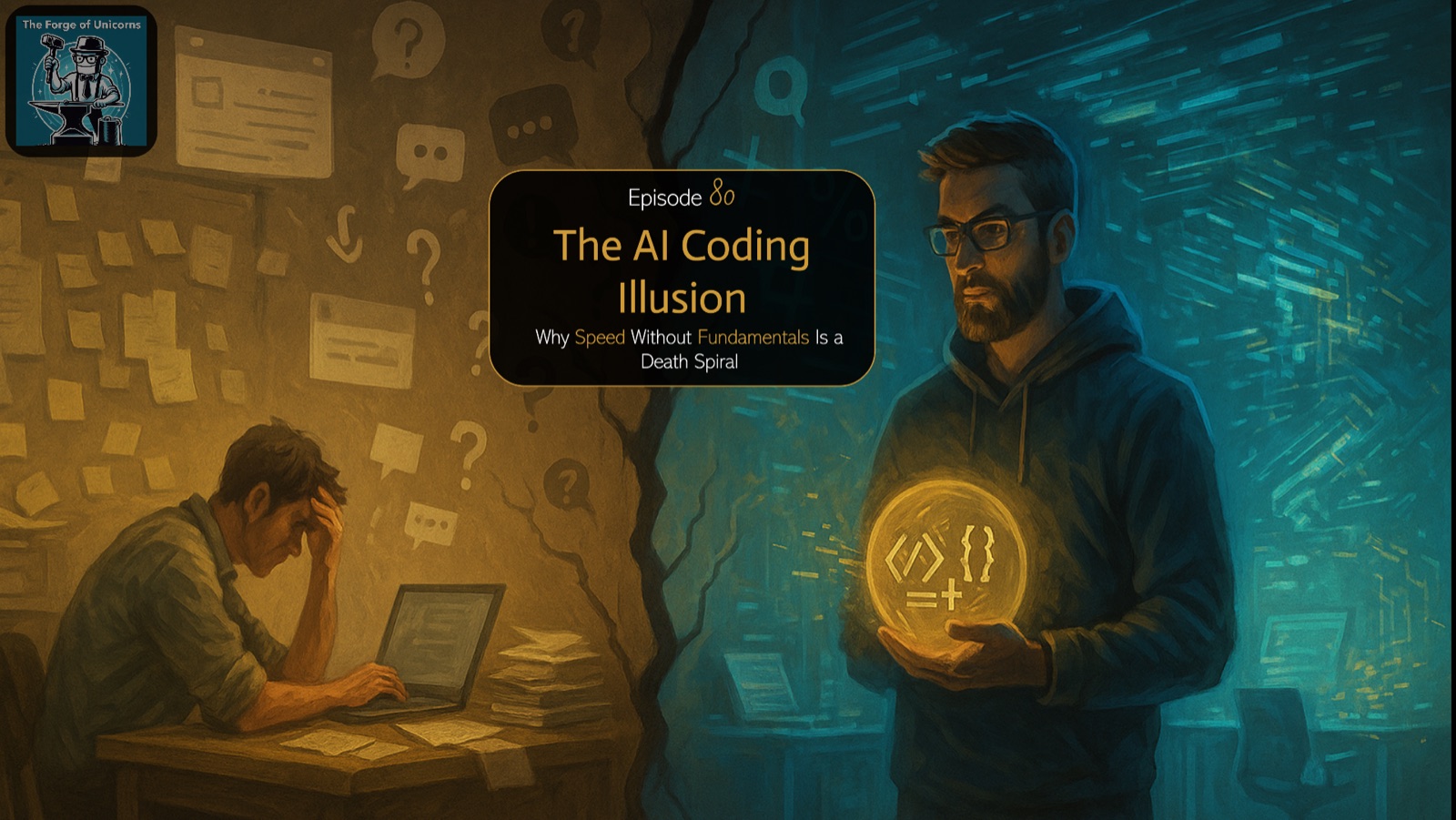
The AI Coding Illusion: Why Speed Without Fundamentals Is a Death Spiral
How Agile Destroyed 66% of Coding Time Before AI Arrived, And Why AI Makes It Worse.
Hey there, digital warriors! ⚔️
Last week, we uncovered the uncomfortable truth most leaders avoid: elite teams aren’t “trained.” They’re forged through dojo discipline, repetition, mentorship, and behavioral engineering.
But today, we move from mastery… to mayhem. Because what follows isn’t an article. It’s your AI‑era wake‑up call. Here’s the executive summary you were absolutely not ready for: Developers code 9% of their day (~30% including DevOps/SRE tasks). AI only speeds up that tiny slice while the remaining 70% is a warzone of meetings, context‑switching, Slack noise, cognitive fatigue, and broken fundamentals. The result?
AI doesn’t accelerate delivery. It amplifies the 70% dysfunction!
This deep dive is the autopsy of a system already collapsing, where the first touch of AI doesn’t boost productivity… it shoves your entire organization off the cliff, unleashing code with 48% vulnerabilities, 41% more bugs, and 4× technical debt.
And there’s only one conclusion any responsible leader can draw from this: AI is not your bottleneck. Your fundamentals are. And the MUST‑DO AI‑readiness scan starts right here, right now.
Today, we expose through hard data, neuroscience, and real‑world failures, why AI poured onto weak foundations triggers a death spiral.
Strap in💺… this is where the real story begins.
⚔️ The Involution: 30 Years of Declining Coding Time
Everyone obsesses over “AI coding speed,” but here’s the data punch the industry keeps ignoring: coding hasn’t been the bottleneck for over three decades 🥊!
The decline is brutal, linear, and fully documented. In the Waterfall era, developers spent 40–50% of total effort coding (Boehm, 1981), and up to 75% on coding + testing in later benchmarking studies (Reifer, 2004). In other words: the overwhelming majority of engineering time was real software development, not meetings.
Then Agile arrived. The 2011 study by González & Mark, “Collaboration, Information Seeking and Communication”, didn’t just challenge assumptions, it obliterated them: coding time had collapsed to 9%, with 45% of the day consumed by collaboration rituals and 32% lost to information‑seeking, largely because requirements were unclear, shifting, or incomplete.
And DevOps? It didn’t fix it. Large‑scale, instrumented industry research consistently shows the same pattern:
- Meyer et al. (2019) found developers spend 10–39% coding across multi‑study IDE tracking.
- The Tidelift/New Stack (2021) survey showed only 39% of time goes to new code; the rest is swallowed by maintenance, meetings, and overhead.
- Microsoft’s own multi‑year telemetry studies, “Today Was a Good Day” (2019) and the 2024 Time Warp follow‑up, revealed enterprise developers typically code just 10–12% of the workweek, sometimes even less in high‑noise environments, while wishing they could spend 20% or more.
All modern empirical research tells the same story: hands‑on coding is now the minority of a developer’s day! Not because developers outsourced it to AI. They’re coding less because the system forces them not to.
Standups, back‑to‑back plannings, sprint rituals, broken product management, Slack/Teams overload, and context‑switching create a productivity tax so heavy it wipes out most of the coding day. Agile (by the book) didn’t increase performance. It created interaction debt, and every year, the interest rate goes up.
“Coding is NOT the bottleneck.”
So if developers already touch code for only ~30% of their day, what exactly is AI accelerating? 🤨
🧠 The Cognitive Collapse: A System Designed for Fatigue
Let’s bring in neuroscience, because the numbers don’t just look bad, they reveal a catastrophic cognitive tax created by modern Agile, DevOps, and dysfunctional product management.
Developers begin the day with ~30% cognitive power available. Not from lack of sleep, but because the human brain is biologically wired for distraction.
🧩 Mind‑Wandering: The 50% Silent Productivity Killer
- The largest meta‑analysis on attention regulation (Randall et al., 2014; 68 studies, 500,000+ responses) showed humans mind‑wander 30–50% of the time during cognitive tasks. Half the “focus time” is gone before Slack even opens.
- Remote work makes it worse: Smeekens et al. (2023) found significantly higher mind‑wandering in remote setups, directly degrading working‑memory performance.
🔀 Multitasking: The 40% Performance Black Hole
- Meyer, Evans & Rubinstein (2001) — switching tasks incurs 40% productivity loss.
- APA (2023) — switching costs slow people 40%, with up to 25 minutes needed to re‑enter flow.
- Medina (2008) — multitaskers take 50% longer and make 50% more errors.
🔔 The Interruption Tax: The Real Bottleneck of Dysfunctional Interactions
The landmark CHI study by Mark, Gonzalez & Harris (2005) showed:
- 23 minutes 15 seconds to regain focus
- Interruptions every 11 minutes on average
Now put this together:
Developers code ~9% of the day… with only 30% cognitive power, double task duration, 50% more errors, and 23 minutes of recovery every time they’re interrupted (on average every 11 minutes).
In these conditions, flow becomes statistically impossible! Yet we blame developers for delays and bugs. For not being able to step up in the craftsmanship game, but:
“The system has destroyed them even before starting coding.”
This is not just a time tax. It’s a cognitive tax. The collapse of every mental condition required for high‑quality engineering. What was designed to “save” us became the silent killer: the environment suffocates focus, the noise erases flow, the system destroys craftsmanship. And commercial Agile (bent to waterfall leadership) transformed from a promised savior into a burnout‑driven poison.
So what happens when you drop AI into this ecosystem?
Nothing good. Trust me…
🚨 AI as an Accelerator of Chaos
Don’t get me wrong on the Agile mess, but I lived the real XP era, the real software agility. Customers at our side, feedback loops in pairs, and MOB measured in minutes, one‑week sprints aligned with OKRs, retros as beers with the whole team and the customer. That was engineering excellence born from collaboration, clarity, and craftsmanship.
Then the market tried to industrialize it. Agile was bent into command‑and‑control. Certifications replaced mentorship. Frameworks replaced judgment. Rituals replaced critical thinking. And the result is the dysfunctional system AI is being poured into today.
The industry keeps pushing one message: “AI makes developers faster.” But in organizations drowning in bloated ceremonies, chaotic backlogs, unclear product ownership, handovers, and cognitive overload, this is what the research actually shows:
- 48% of AI‑generated code contains security vulnerabilities (CSET Georgetown 2024; TechTarget 2025; Veracode 2025)
- 41% more bugs with AI assistants (HackerPulse 2024; Uplevel 2024)
- 2× increase in code churn (Kodus 2025; LeadDev 2025)
- 4× faster technical‑debt accumulation (Cerfacs 2025; Qodo.ai 2025)
- 7.2% drop in delivery stability (DORA 2024; Okoone 2025)
- and I can go ahead for hours…
These aren’t isolated findings. They’re the mathematical outcome of a cognitively bankrupt system. Developers code faster… but with less time, focus, and understanding. Juniors accept AI suggestions without the necessary technical or domain context. Seniors fall into noise autopilot. Reviews balloon. Maintenance becomes a minefield. Burnout accelerates.
Here’s the punch no vendor will say out loud:
Most companies using AI‑coding today are stuck with codebases no consultant wants to touch.
Why? Because without proper XP socio-techincal fundamentals, AI produces 💩code that is:
- untested,
- unclear in domain intent,
- architecturally incoherent,
- ownerless,
- and impossible to reason about.
Now imagine debugging this at 3 AM during an outage. Production on fire. Customers screaming. Leadership watching the logs in real time. You’re completely alone, and your AI assistant? It confidently tells you you’re right… without explaining a damn thing 💥.
Today’s AI is trained to please, not to challenge. It mirrors your assumptions. It amplifies your blind spots. It delivers answers with absolute certainty, even when they’re catastrophically wrong. This isn’t “AI pair programming.” It’s AI gaslighting with good intentions.
Now you understand why the pioneers of AI-coding are shouting counterintuitive messages like:
“We need AI‑free days to prevent skill atrophy.”
AI doesn’t fix dysfunction. It amplifies it, at agentic speed.
So let’s look at the first industry that already lived through this nightmare.
🚗 Automotive: The First AI-Era Autopsy
If you want to understand the future of software, look at cars.
100 million lines of code. 150+ interconnected modules. Processes. Standards. Certifications.
And yet:
- Volkswagen burned €14B on software failures (Cariad).
- BMW recalled 71,000 EVs due to software glitches.
- Tesla is swimming in autopilot incidents.
- Xiaomi SU7 deadly crashes.
The problem? Missing fundamentals. When an industry prioritizes process and speed over mastery, the collapse isn’t speculative. It’s guaranteed!
“What we believe is safe… is a fatality caused by software failure.”
If the most process-heavy, ASPICE & ISO-driven industry couldn’t protect itself from software chaos… what makes you think your organization will?
🧱 Fundamentals: The Only True Multiplier
MIT and McKinsey analyzed over 100 companies and landed on one conclusion that should stop every CXO in their tracks:
Companies with strong fundamentals achieve 4× performance when adopting AI.
Not 5%. Not 30%. Four. Times! Every single time.
Because fundamentals aren’t buzzwords, they’re force multipliers:
- T*D → up to 90% fewer defects
- Pair/Mob programming → kills bugs, environmental noise, and builds shared understanding
- Small teams (5–8) → cut interaction debt before it spirals
- DORA/DASA metrics → give socio-technical behavioral clarity, not vanity dashboards
- AI‑free days → stop skill atrophy before it becomes irreversible
- CoP and Dojo → to keep the mastery sharp on the individual and social level.
This is the line between evolution and implosion. You don’t strap a rocket engine onto a rusty chassis and expect a unicorn. But that’s exactly what the industry is doing.
And here’s the mathematical punchline:
Strong fundamentals + AI → 4× performanceBroken fundamentals + AI → 8× faster disaster
If coders develop only ~30% of their day and AI speeds up just that slice, the remaining 70% of dysfunction dominates the equation. The system doesn’t scale excellence: it scales chaos.
So, after all these investments, you don’t speed up delivery: you speed up failure. You don’t enhance craftsmanship: you erase it.
⏱️ Measure Before You Deploy
You’ve invested millions into software teams. You’ve burned years on Agile, DevOps, frameworks, and certifications. But now before the AI tsunami accelerates everything, good or catastrophic, you need one thing:
Measurement. Real measurement.
Not vanity dashboards. Not consultant theater. Not Jira velocity. But the hard fundamentals that decide whether AI becomes a multiplier or a time bomb.
Measure how your teams actually work. Measure behavioral readiness. Measure cognitive load. Measure socio‑technical alignment. Measure delivery stability.
And if you don’t know how to do it, let’s trust who spent years working on AI-enhancede code, since Kyte and TabNine were released before your shocking ChatGPT.
👉 Run our AI‑Readiness Quick Check, and get immediate feedback!
⏭️ And next week?
Episode 81 goes all in. We’ll reveal exactly why this AI‑Readiness framework is years ahead of the market, and how the companies adopting it are building unfair advantages their competitors won’t catch for a decade.