Two Platforms, One Truth: Why Human in the Loop Is the Architecture
Episode 91 - The Forge of Unicorns
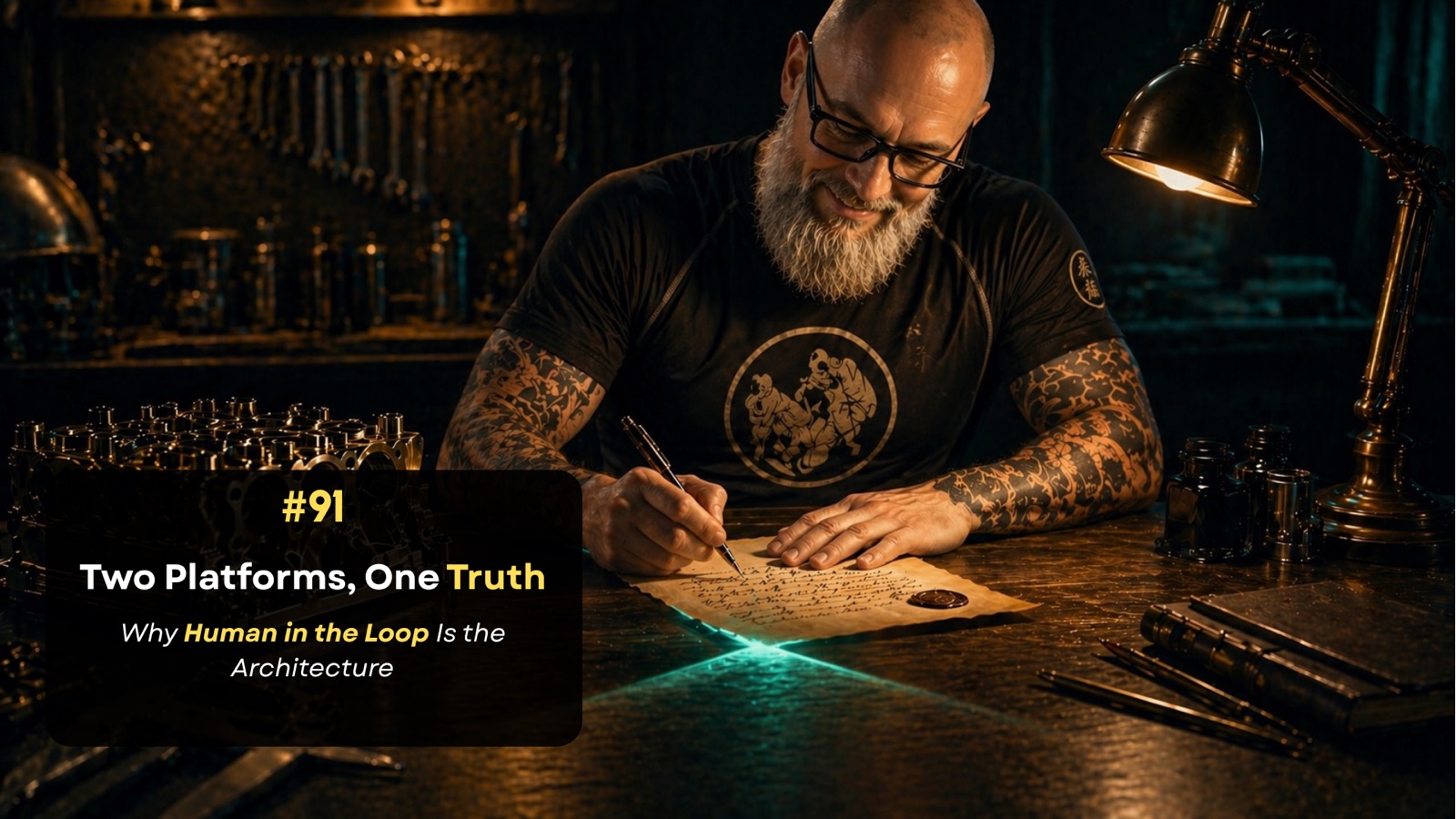
We were working on traceability. Alessandro and I, late afternoon, deep inside the telemetry layer of nWave Enterprise, solving a problem nobody had asked us to solve yet: how to make every decision an AI agent takes auditable under the EU AI Act before August 2026. It was the kind of work that feels invisible. No audience. No applause. Just two engineers and a compliance deadline five months away.
Then Andrea Laforgia sent a message.
Andrea is one of our earliest alpha users, a Head of Engineering who had been stress-testing nWave since before it had a name anyone outside our circle would recognize. He had built something with it. Using nWave’s workflow, Andrea had developed an algorithm that scores test quality against Dave Farley‘s eight properties of good tests: Understandable, Maintainable, Repeatable, Atomic, Necessary, Granular, Fast, and First. Then Bernard McCarty, a core practitioner in the MSE community, had taken Andrea’s algorithm and packaged it as an open source plugin for Claude Code. Using nWave to build it.
What impressed them both was not the output. It was the process. The pauses to think. The back and forth between human and machine. The way nWave kept the human in the loop not as a speed bump but as the person who decides what matters before a single line of code gets written. Andrea put us in touch with Dave and Bernard directly. Dave, the author of Continuous Delivery and Modern Software Engineering. The person whose eight properties Andrea had turned into an algorithm. The person whose 2010 book drew a line in the sand for software industry maturity that still holds today.
On the exploratory call, Dave told us he was using nWave to code.
He stopped mid-session and said something that I will carry for a long time. “This thing is addictive. You get what you ask, and it is in sync with my thoughts. I think something and then nWave shows it on the screen. Like it’s reading my mind.”
That evening, the invitation arrived. Dave was launching a new series on his MSE channel called AI Briefings, conversations with SW engineers doing interesting work with AI-assisted development. He wanted Alessandro Di Gioia and me as the first episode.
We said yes before the sentence was finished.
A few days later, a second invitation. Hina Siddiqui, the host of The Corporate Life Podcast, heard in 94 countries and ranked in the top 3% globally. She had come across my survival story, the coma, the cancers, the decades of martial arts and software craftsmanship, and the Valentine’s Day decision to release nWave as open source with no business model attached. Just a gift. She wanted to feature us.
Two hosts. Two audiences. One in the world of software engineering excellence, the other in the world of founders and corporate CEOs. And both of them, without coordinating, pulled the same answer out of Alessandro and me.
The human stays in the loop. Not as a constraint. As the architecture.
With Hina, the answer came out as a metaphor. She asked about the red pill: what is the uncomfortable truth most organizations are not ready to see about AI? Alessandro named it first. Large organizations still look at people and IT through a spreadsheet. Costs, not assets. Then I picked up the thread.
Imagine you put a Ferrari engine into an old rusty car. The engine will be more powerful. But the rest of the system is not ready for it. The brakes will not hold at the first curve.
AI is an amplifier. If your software production pipeline is not automated, if your outcomes are not predictable, if your data does not support informed decisions, then AI will amplify exactly the patterns you would rather it did not. The path forward is not more AI. It is the foundation underneath. That is a leadership conversation, not a technical one. And Hina pulled it out of us in front of an audience of CEOs and founders who live that tension every day.
With Dave, the same truth arrived in engineering language. We explained how nWave guides developers toward good practice without forcing a rigid process. Our biggest responsibility as software engineers is to understand the problem space and define it well before we start thinking about the solution space. AI hallucinates. AI is a mirror trained on whatever code exists in the public record, the excellent and the careless alike. The work of the human in the loop is not to type code. It is to give the machine the context it cannot generate for itself: the intent, the architecture, the taste, the judgment about what matters, the rigor of excellence.
Dave’s response on camera was generous and precise. He said the philosophy lined up with his own thinking, and he noted that some of his work had inspired ours. From the author who defined continuous delivery for an industry, that is not a compliment. It is a citation. He observed that nWave is opinionated: it does not force a particular way of working, but it has agents and skills that support practices we believe are good. Hexagonal architecture. Deployment pipelines. Double-loop test-driven development. Small steps with human checkpoints between them. The opinions are visible. The choices are explainable. And every decision the machine makes passes through guardrails and a human before the next step begins.
Two different rooms. Two different questions. The same architecture underneath.
When the same answer survives two completely different audience tests in the same window, it stops being an opinion and starts resembling something structural. The CEO needs to know whether the investment will deliver the return they were promised. The CTO needs to know whether the architecture will hold under production load. Both questions point at the same problem. Both get resolved by the same design choice: keep the human in the loop, not as compliance theater, but as the actual decision layer that makes everything else trustworthy.
This is what nWave does. It is the open source framework Alessandro and I released on Valentine’s Day 2026. We gave it away because we believe the engineering discipline underneath software development should be available to everyone who wants to build with care. The enterprise version pays for what large organizations need: governance, audit logging, deeper integration. The core is free. A love letter from Italy to developers everywhere.
There is a deeper convergence happening across the industry right now, and these two conversations were a small signal of it. Google, Microsoft, Anthropic, the teams behind LangGraph, CrewAI, AutoGen, and more. Different architectures from different organizations, all arriving at the same set of decisions. Why? Because ungoverned agentic AI does not scale. The human has to stay in the loop, or the system collapses under the weight of its own hallucinations. Next week, we look at exactly that convergence and what it reveals about where governed AI development is heading.
For now, if you want the conversations that started this: Dave’s episode is the engineering version. Hina’s is the human-scale one. Both are worth your time.
→ Watch the episodes and claim your gift nwave.ai/go/discipline/yt
The evening, after both recordings were published and both invitations had turned into real conversations on real platforms, Alessandro and I sat with the kind of quiet that comes after something you built finally reaches the people it was meant for. We had spent a year building nWave. We had released it on Valentine’s Day with no launch circus, no VC support, no artificial scarcity. Just a gift, sent out into the world, hoping it would find the right hands.
And now Dave Farley, whose principles lived inside the tool and outside through Andrea’s algorithm, was saying it felt like it was reading his mind. And Hina, who interviews Fortune 500 founders, was asking us why we gave it away for free, and the answer was the simplest one we had: because we believed the children at the orphanage in the periphery of the city deserved the same gift as everyone else.
We went to rest that night with a smile. The kind of smile you earn when the package finally arrives where it was always supposed to go.