

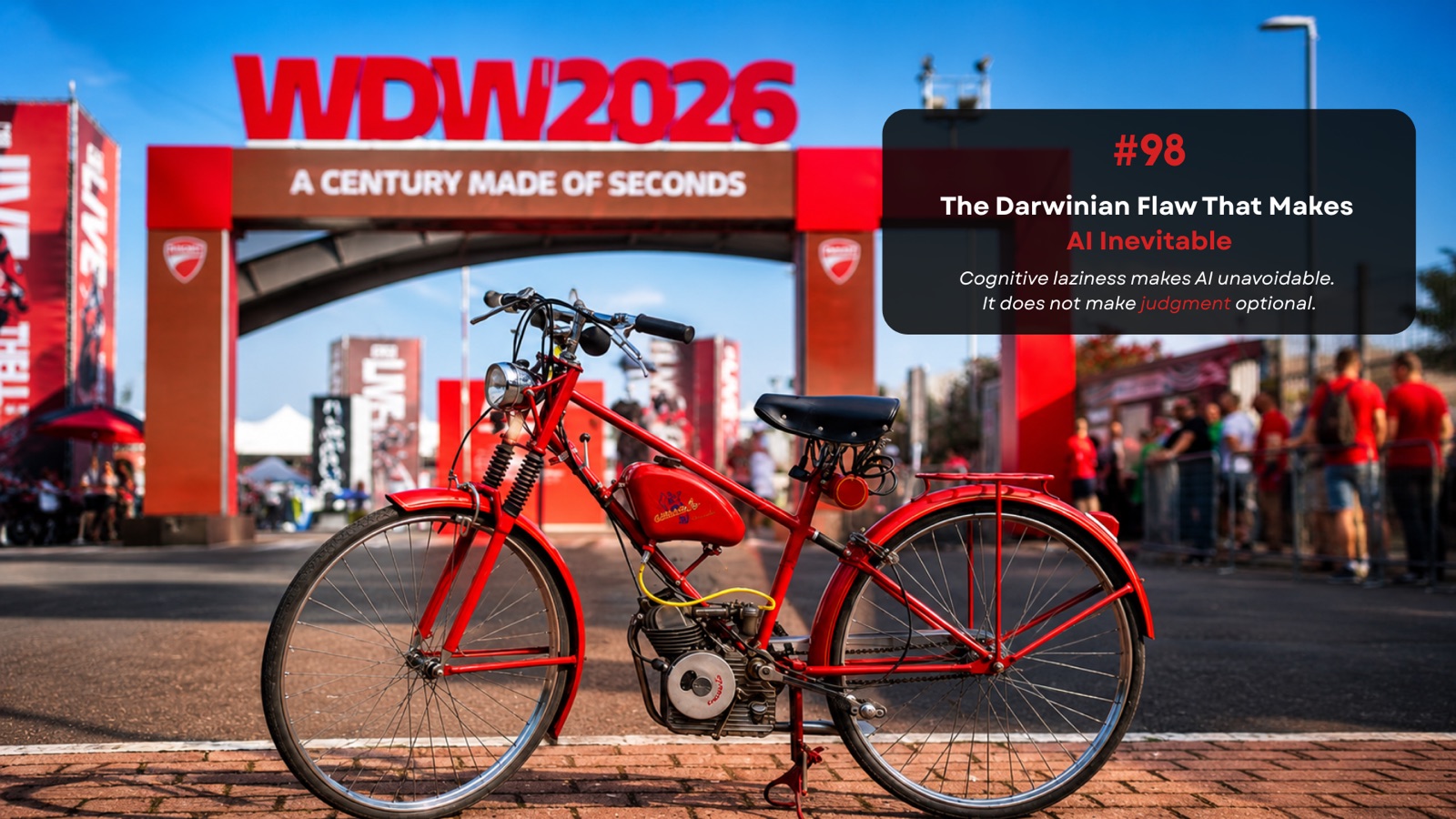
The Darwinian Flaw That Makes AI Inevitable
Cognitive laziness makes AI unavoidable. It does not make judgment optional.
(TL;DR). AI is the inescapable next step in how humans conserve energy. Industry 5.0 points the way: human judgment augmented, never delegated. The people and the companies that thrive will be the ones who train judgment on purpose, every single day.
WDW26 - The celebration of Ducati’s Centenary
Ten days. More than four thousand kilometers. Over thirty passes. The one I will carry forever is the Monte Bondone, the mountain above the town where I was born. Forty-six hairpins, one after another, the same forty-six that a few weeks earlier had hosted the Trento Bondone hillclimb. Perfect tarmac, perfect sky. I took the fast corners with my knee on the ground, my Hypermotard sliding under me as I downshifted and braked hard into each turn, reading the road a heartbeat before it arrived. Inside the helmet, the smell of hot tarmac, sweat, and petrol. From there we dropped to the Molveno lake, climbed again toward the Paganella, and pushed on to the three peaks of the Brenta by way of Madonna di Campiglio.
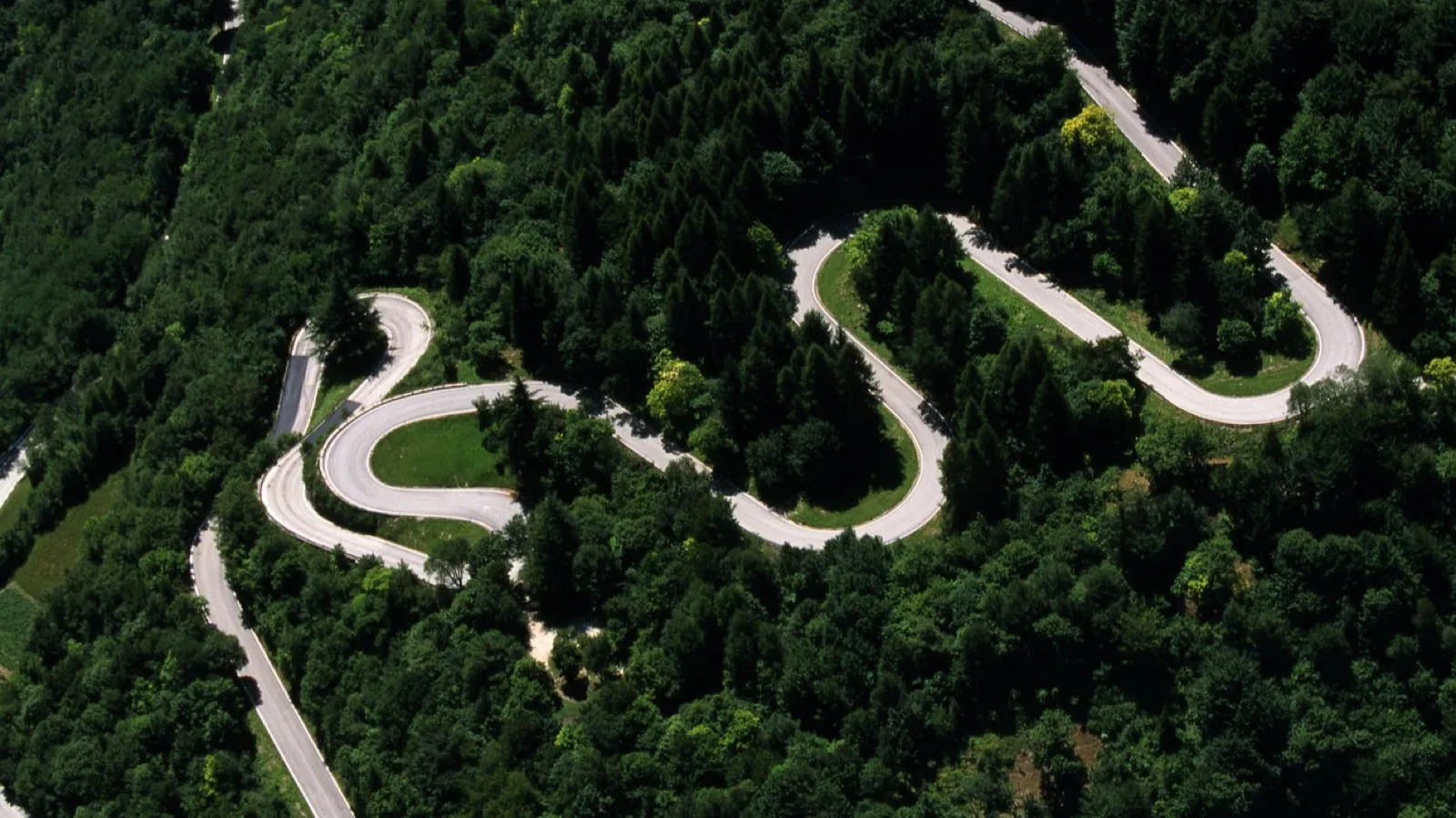
7 tornanti - the famous 7 hairpins

Tre Cime
My friend and I made one rule for the whole ride. No lunch. Not because of some diet, but because a full stomach pulls blood away from the head, and a mountain pass does not forgive a soft head. On a motorbike you carry what I call ten eyes. Two on the apex, two on the gravel at the edge, two on the car that has not indicated yet, two on the farthest point you can see ahead, two on the friend in your mirror. The moment any pair of those eyes closes, the mountain collects what you owe it.
Every evening, after the long ride, we did our calisthenics. In Rimini, at the end of the Ducati week, we still walked down to the sea to swim. Legs heavy from the saddle, the Adriatic cool against the heat of the day, the water pulling the ride out of the body one muscle at a time. Twelve hours with ten eyes open, and still we chose the water over the deck chair. Not because we had to. Because that is the whole point. That is the discipline that keeps body and mind at peak shape, and it is the proper preparation to enjoy a typical Italian dinner.
I did not think of any of this as discipline. On the bike it felt like joy, the effortless kind that comes from paying full attention to the one thing in front of you. It was only in the days off the machine, training where I could to keep the legs honest, that the routine started to turn into something else.
The empty parks
After days on the road, training where I could, I was finally in an equipped park. It was empty. They were all empty. Ten days across three countries, and the green held only children and a handful of runners. On the beaches of Croatia and Italy, families sat under their umbrellas, faces lit by the blue glow of a screen. In the supermarket queues, the carts were full of packaged highly processed food. I saw the same picture everywhere I crossed, in the locals and in the visitors who had flown in from the far side of the world.
Here is where I want to be careful, because the easy version of this story is the wrong one. The easy version says people have grown lazy. That is not it, and saying it would make me sound like a man shouting in the wind. The accurate version is kinder and far more useful. We are running Paleolithic hardware in a world of abundance. For most of human history, moving cost calories you could not spare, so evolution wired us to rest whenever rest was safe. The anthropologist Daniel Lieberman calls the result a mismatch:
bodies tuned for scarcity, dropped into a world of endless supply.
The empty park is not a moral failure. It is a design feature meeting an environment it was never designed for. Remove the survival trigger, and the default setting is stillness. I recognized that stillness, because I catch it in myself the moment I reach for my phone out of pure habit, no reason at all. And that is when it hit me: what I had just spent ten days watching happen to the body was already happening, faster and with less resistance, to the mind.
The bionic brain
The same instinct that empties the park has been reaching for our tools all along. The lever and the wheel extended the arm. The engine extended the leg; the Ducati Cucciolo, an engine bolted to a bicycle, was literally that. The exoskeleton and the bionic limb carried the logic further. Every one of these took a physical burden off the human and handed it to a machine.
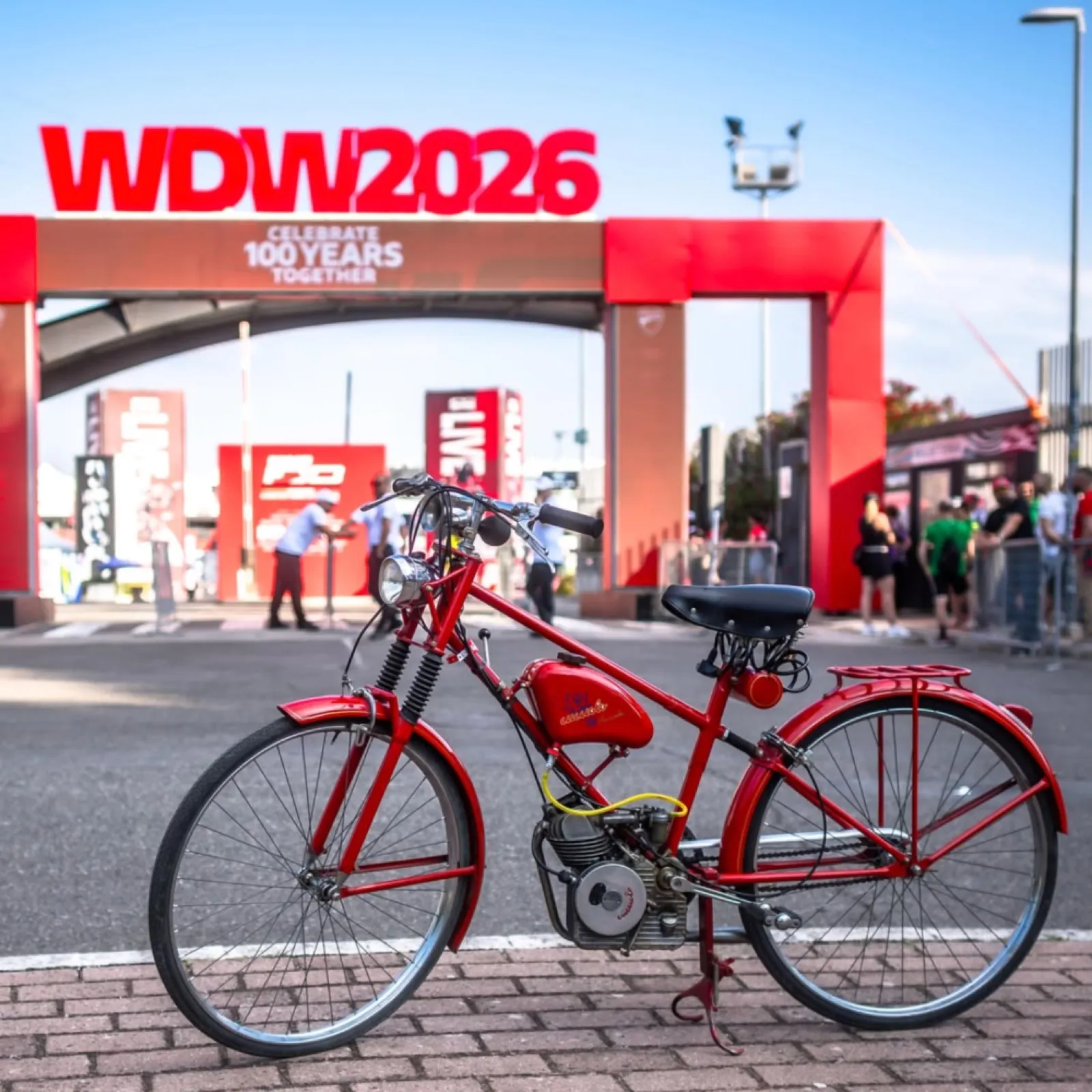
Ducati Cucciolo in front of the WDW2026 gate
There was only one organ left to augment. The brain.
That is what AI is. Not a gadget, not a trend, but the bionic brain: the first tool that offloads thinking itself. And here is the part most commentary misses. The brain is the most energy-hungry organ we own. It is roughly two percent of your body weight and burns close to twenty percent of your energy. Evolution has spent a million years trying to make that organ cost less. So the temptation to hand your thinking to something outside your skull is not a weakness of character. It is the oldest instinct we have, wearing a new interface.
This is why AI adoption is not a maybe. I heard the words “AI” and “ChatGPT” on almost every radio in the countries we crossed this summer. The bionic brain is already inevitable, for the same reason the empty park is inevitable. It is the path of least energy, and water always finds it. The question was never whether we would use it. The question is what happens to the muscle we stop using.
What we already know about the muscle
I did not have to guess. The evidence has been arriving for years; I simply had not gone looking for it until that week on the road forced the question. In 2011, a study in Science showed that when people expect a computer to store information for them, they remember the information itself less well, and instead remember where to find it. Psychologists call it cognitive offloading. Nicholas Carr spent a whole book, The Shallows, tracing how each convenience quietly reshapes the mind that leans on it.
Then, in early 2025, Microsoft Research and Carnegie Mellon put numbers on the exact thing we are living through. They surveyed knowledge workers on their use of generative AI, and found that:
the more a person trusted the AI, the less critical thinking they reported doing.
Confidence in the tool went up; the cognitive effort of the human went down. The researchers were describing test theater for the mind: work that looks like thinking, with the thinking quietly removed. The muscle does not announce its own atrophy. That is precisely what makes it dangerous.
None of this means the tool is the problem. A motorbike is not the problem; an unwatched road is. The tool is inevitable and the tool is extraordinary. What is optional, what is entirely a choice, is whether the human keeps ten eyes open. I kept turning that choice over for the rest of the ride, until I found the clearest answer to it not in a research paper, but in a man who stopped walking on the busiest day of his company’s hundred-year life.
A hundred years of keeping the eyes open
Which brings me back to the week that started all of this. Midway through the trip we rode to Maranello to meet my brother Christian, and walked the Museo Ferrari: the Formula 1 cars of the Schumacher years, an F40 built to race. I put my hands on an F40 and sat in it. Twenty-five years of my own work trace back to a Ferrari pit lane, so this was not tourism. Then we chased the Futa and the Colla over the Mugello and dropped into Rimini for the red family week.
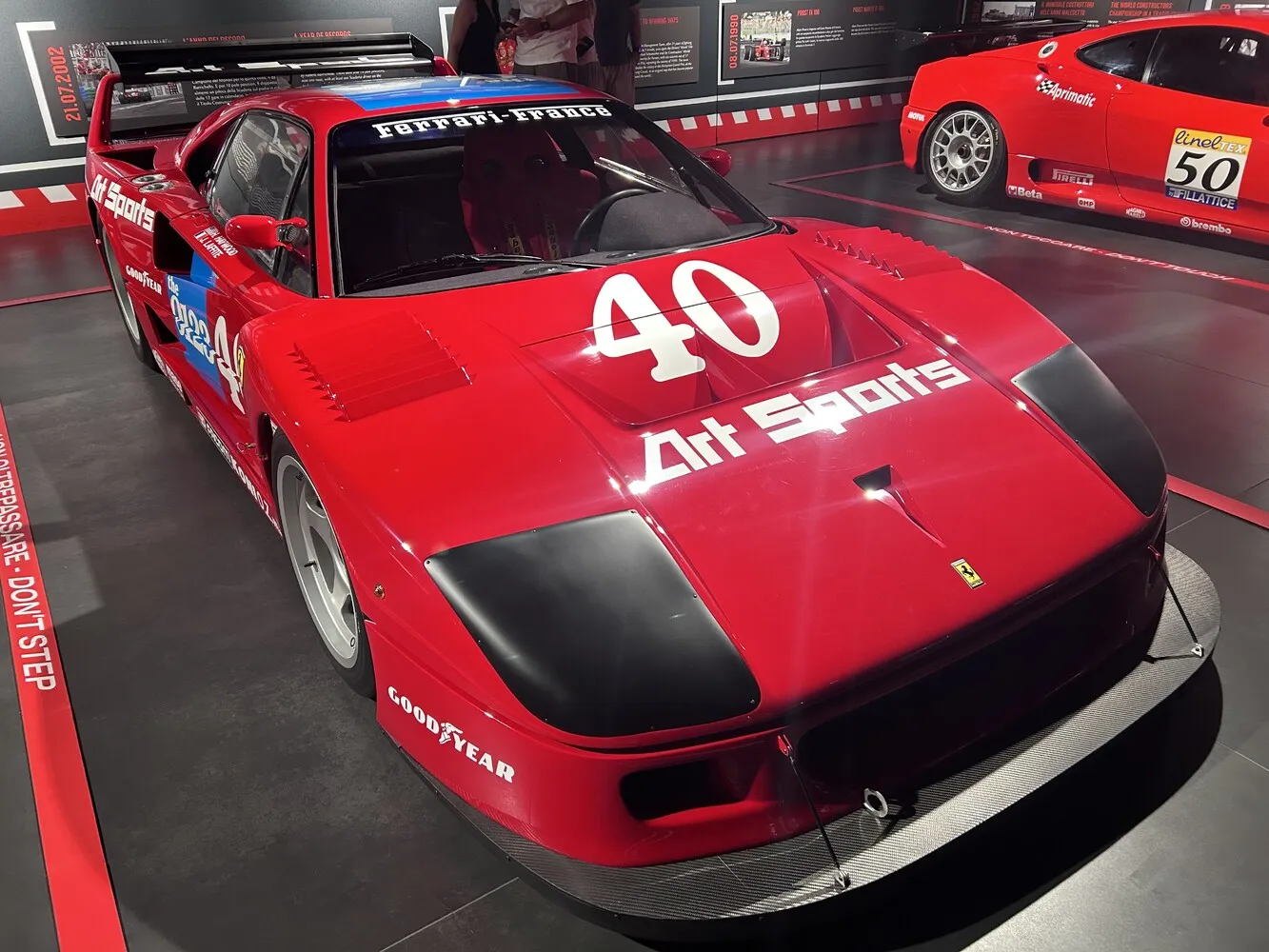
Museo Ferrari - F40
Two red houses, Ferrari and Ducati, born in the same corner of Italy, both insisting they are engineering and technology first, machines second. Ducati has been insisting on it the longest.
In 1926, in Bologna, Antonio Cavalieri Ducati and his three sons, Adriano, Marcello, and Bruno, founded the Società Scientifica Radiobrevetti Ducati. They did not make motorbikes. They made vacuum tubes and condensers, riding the wave of Marconi’s radio revolution. Ducati began life as a technology company, in the most literal sense. Then the front rolled over Bologna. On the twelfth of October 1944, around forty Allied B-24 Liberators reduced the Borgo Panigale factory to rubble. Everything had to be built again, in a country where almost everything had to be built again. And what did they reach for? Not a grand machine. In 1946 they began to manufacture a micro-engine, small enough to bolt onto a bicycle, perfect for moving around a country that had to be built again. The Cucciolo. From that humble engine grew a century of engineering.
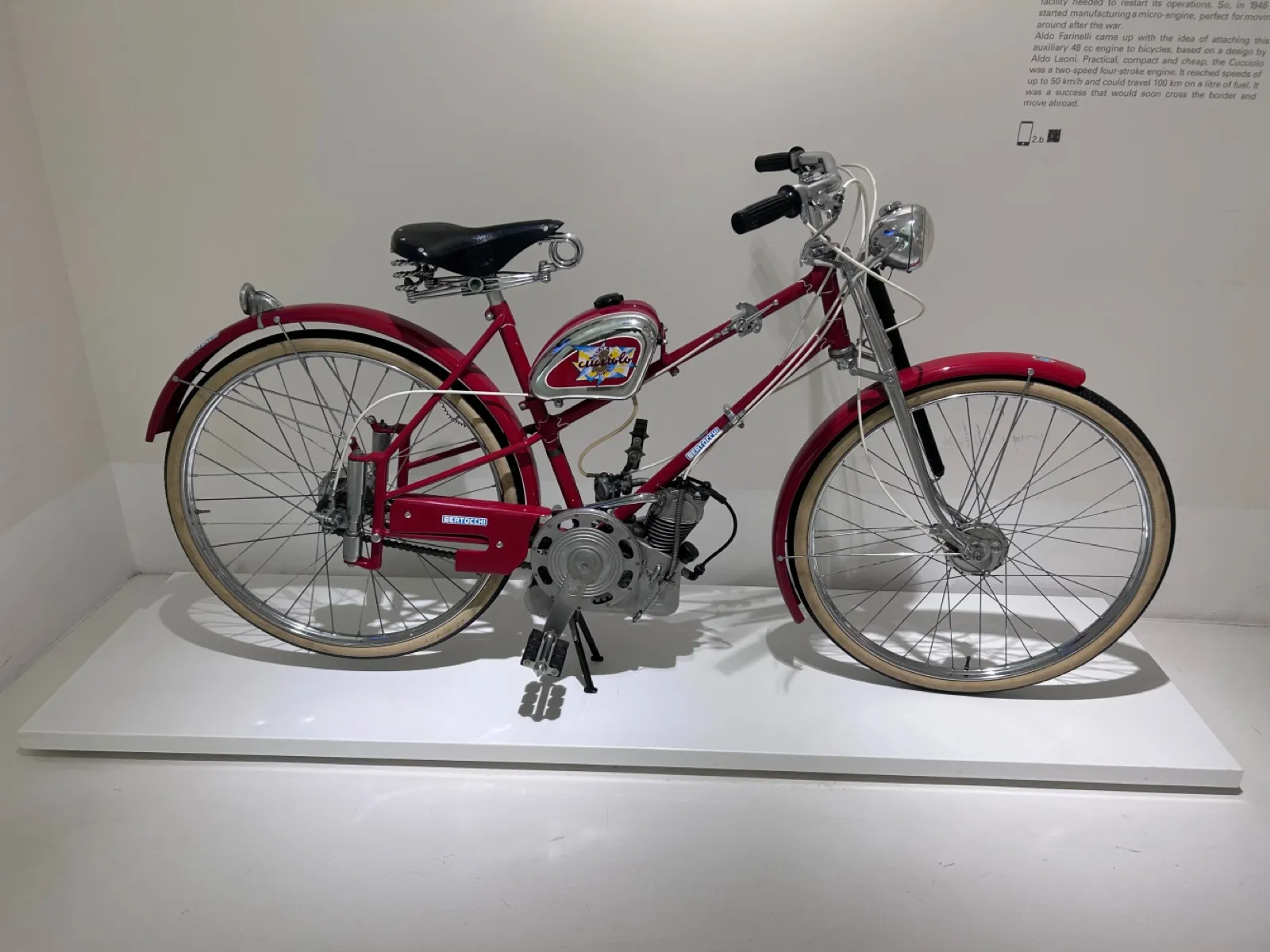
Museo Ducati - Cucciolo 1946
At Misano this July for the hundredth anniversary, there were 118,000 riders from 94 countries. I watched Nicolò Bulega take the Race of Champions.
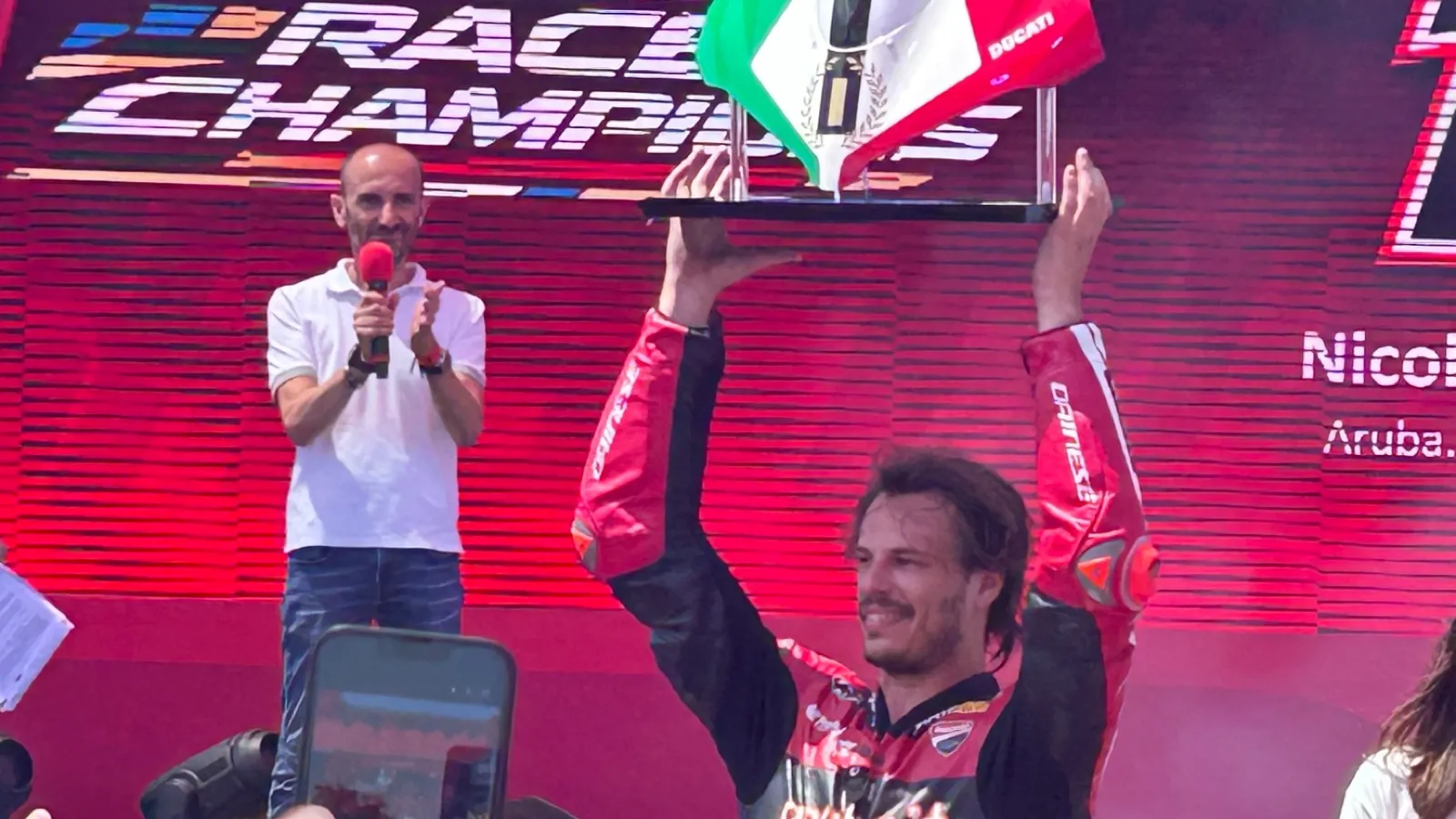
Race of Champions Podium
And walking back from the podium, on the most crowded day of his company’s hundred-year history, I asked Claudio Domenicali a single question:
when will Ducati use AI the way its DNA has always used technology, to disrupt? He stopped walking.
A man with a hundred thousand guests to host, and he stopped, because the question was worth stopping for. Before we parted, he handed me his personal phone number.
A century on, Ducati still behaves like what it was born as in 1926: a technology company that happens to build motorbikes. That is not nostalgia. It is a firm choosing, decade after decade, to keep its eyes open. Companies, like riders, do not stay sharp by accident. They stay sharp on purpose, or they drift toward the empty park. That is the same choice sitting in front of every leader reading this, on a scale no mountain pass ever demanded.
The skill nobody is teaching
So here is the last mile, and it is a human one.
Every serious framework of the last two years arrives at the same doorstep. The academic work on agentic engineering calls for an Agent Coach who can review what the machine proposes. Kaminski’s AI-native model needs an orchestrator who can write intent clearly enough to be verified. A tool can enforce a process; it cannot supply the judgment that makes the process mean anything. The one governance layer no framework can automate is the human who looks at a confident answer and says, calmly, that is wrong.
This is what Industry 5.0 is trying to name. The last industrial wave chased automation, the human lifted out of the loop. Industry 5.0 turns back toward the human at the center, the machine as amplifier, not replacement. You augment the judgment; you do not delegate it.
That judgment is a trainable skill, and almost nobody is training it. I have spent forty-five years on the tatami and twenty-five on software engineering learning one lesson in two languages: capability without discipline is just faster failure. In the dojo we call the daily practice bonsai. Small, deliberate cuts, every day, against the pull of entropy. It is the calisthenics after the ride. It is the thing that keeps the tenth eye open when the tool is doing nine-tenths of the work.
This is what the AI Readiness assessment measures under the name FOCUS: not whether your team has the tools, but whether they still have the cognitive capacity to supervise what the tools produce.
Vibe coding is cognitive laziness in its purest form: describe the vibe, let the machine write it, ship it unread. It is fast, it is everywhere, and it is not going away. nWave keeps the speed and restores the missing eyes. Superhuman code, at vibe-coding speed. The quality is built in, so what you ship earns five stars before a single user sees it.
The tool is inevitable. The eyes are a choice.
You made the right call bringing AI into your organization. The finish line simply moved after you started, the way it always does. The last mile is not more tooling. It is the disciplined human in the saddle.
You do not need to become an athlete to keep your judgment sharp. You need a daily practice, and someone who has walked the road beside you.
If you want to see where your team’s ten eyes are today, the AI Readiness assessment is a short, honest place to start; it costs you nothing and it tells you the truth. And when you want to talk about turning that picture into a daily practice, I am beside you, not above you. I’m only a message away from you.
Next week, we go from the individual to the organization: what happens to the sharpness of a whole company when the junior pipeline that used to train the eyes starts to thin.
Keep the eyes open. One pass at a time.
Bibliography
- Daniel Lieberman, The Story of the Human Body (2013): evolutionary mismatch.
- Sparrow, Liu & Wegner, “Google Effects on Memory,” Science (2011): cognitive offloading.
- Nicholas Carr, The Shallows (2010).
- Lee et al., “The Impact of Generative AI on Critical Thinking,” Microsoft Research + Carnegie Mellon, CHI 2025.
- Brain ~2% body mass / ~20% energy (Raichle).