
The Hammer Comes Last. Foundations Come First.
Why the best AI tools reward only those who know the work.
The full video conversation with Jeff Bailey is at the end of this article.
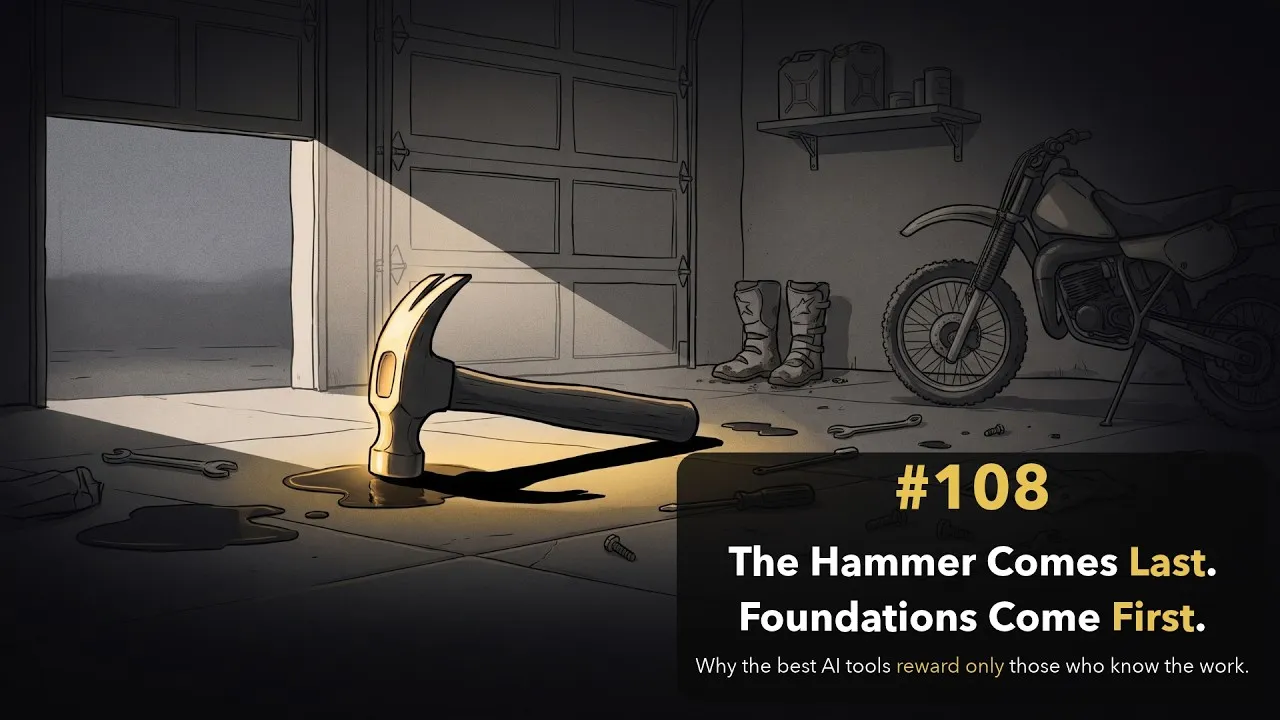
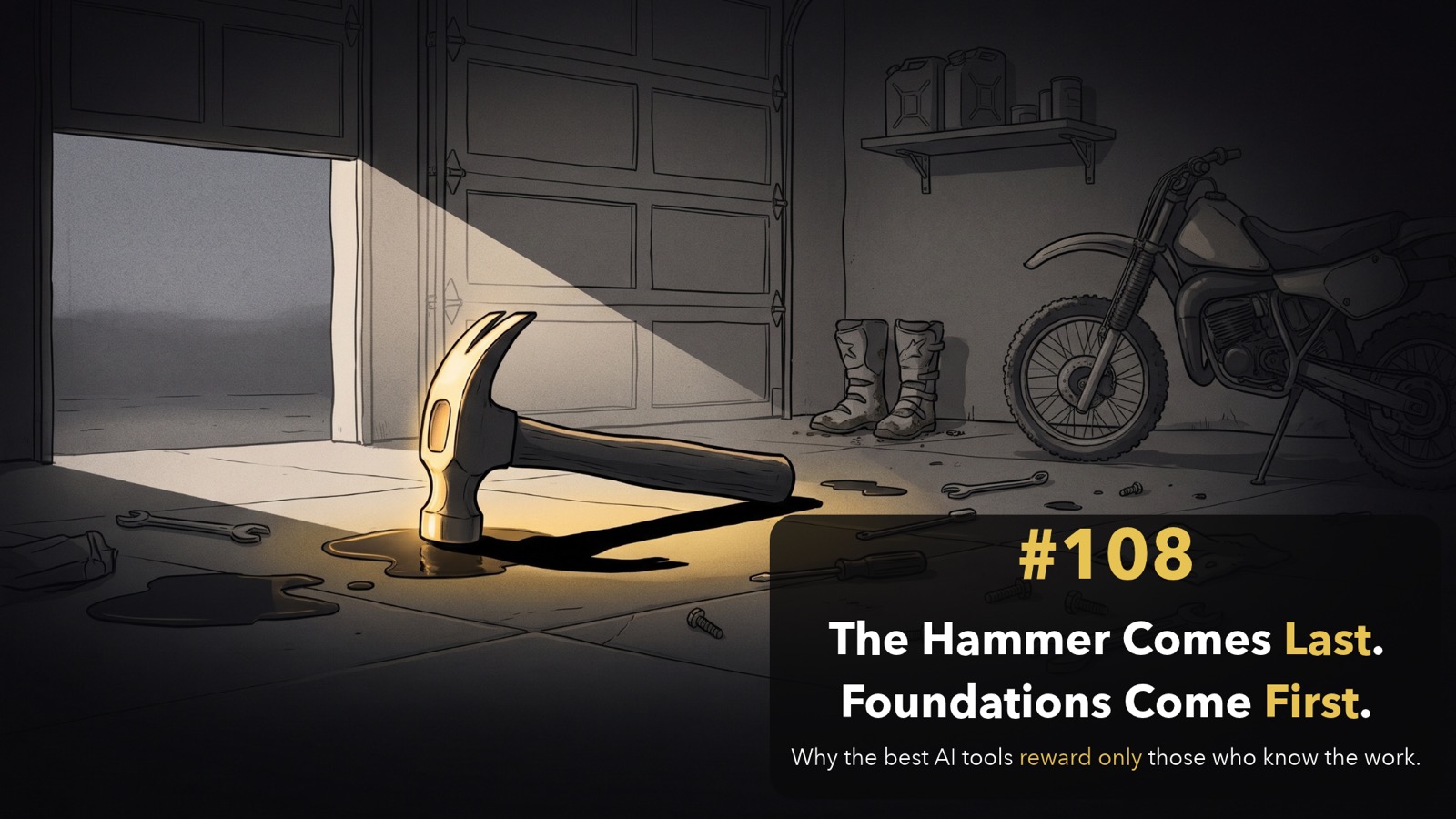
[Late 1980s] I was all in with motocross. The bike was an SWM 175, a glorious widowmaker. My brother and I were still kids, but that piece of iron gave us more fear and head scratching than any machine since. In its tough way, it taught us how work is done, mostly by showing us how it should not be. We weren’t engineers at that time, so the tools were whatever we could improvise. The hammer was the order of the day, and there was oil spilled on the floor almost everywhere. Tools falling on the ground, curses over crushed fingers and torn nails: that was always the moment our parents arrived, to check what mischief we had made this time. That is how somebody without a master tries to learn. By trying, and in the process all they achieve is a lot of mistakes.
[Early 2000s] More than a decade later, my brother joined the Ferrari Formula 1 team, in the years Michael Schumacher drove for Ferrari. There he learned a rule that nobody had ever told us. The hammer is the last resort, because it is the most destructive tool in the room. Every other tool has to be used before it, and you need to master all of them to understand which one fits your goal. Since then, I have walked through many racing workshops in MotoGP and Formula 1, and I have watched rally mechanics on duty take a car apart and put it back together in record time.
The people there work in coordination and in white coats. No shouts, no stain of oil on the ground. They study the datasheets and the blueprints before they touch an engine. They must know it by memory and do it blindfolded, because that is how, under pressure, they can tear apart an engine and put it back together in less time than it takes to swap seasonal tires. Behind that speed is always a master who guides your steps, and when you’re lucky to find the way, it’s forever. Through repetition, it becomes your identity. That is what my brother found in Ferrari. The rule came home with him, and it changed how we work, from amateurs to professionals. Today, when a custom machine needs a tool that does not exist, we draw it in CAD, fast-prototype with a 3D printer, and then build it with CNC machines.
Now this way of working obsesses me. When I visit a friend’s workshop, the first thing I look at is the floor and the layout of the tools. They certify the kind of work done there: where nobody has ever had a master, the hammer is still within reach and the oil is still on the floor, as it was under our SWM.
Get every new episode in your inbox the day it ships. Free to join, yours to leave anytime.
We send one email per new episode, and nothing else. Your address goes to Brevo, our email provider, which sends you a confirmation link: you join the list only when you click it. We can see whether you open each email and which links you click. See our Privacy Policy.
[May 2026] Before the podcast recording, nobody had said the word hammer to Jeff Bailey. Ale and I had only asked him what he makes of the AI industry as he was one of our nWave early adopters. Alessandro Di Gioia is the engineer I build nWave with, and between the three of us, I had said as we began the recording, we carried almost a century of craft. Jeff is a principal software engineer at Nike, and he answered the way a man answers when he has already been through this once. In the nineties he had lived for a while in Silicon Valley, where a new internet startup announced itself every day, pets.com among them, and where people with no resume wrote one and found a job the next morning by saying they had used a computer. Then the databases arrived, each one swearing it was the one that scaled, and he still has a favorite video from those years, about a hammer and a world in which every problem is a nail.
Today, he said, there are “hundreds of hammers,” and every one of them comes with a voice insisting that it is the one you should be using. Some of the people building them have never learned how to make one, so they ask their preferred AI to build it and then release it to the world. He said so without any shade, because he believes we should push the limits of this technology to see how far it can go. In his view, the industry will shake out in the end and settle on the right tools, and until then, he said, the fundamentals matter more than ever, because they are what we lean on to use any of these tools well.
Jeff loves code, and over the years he has automated everything he possibly could, from linters to automatic formatting; he works almost entirely on the command line. His advice for the hours that the machines give back is to spend them on the foundations: the tools you hold in your hands, the patterns of software, databases and data science. With them you can recognize what the AI is doing, understand why it is doing it, and then question it.
Jeff told us how he began to practice what he preaches. Early on he cloned the source code of Python, a language that countless developers rely on every day, and asked the AI to list every pattern and every anti-pattern hidden inside it. He found the experience fascinating: a code base that had lived and evolved for years, opened up with the AI beside him, and he calls it a great way to learn.
A friend of his used to go to community events, and into companies, to teach other people test-driven development. On one project, a heavy piece of graphics work that needed some very complicated texture-mapping tools, Jeff watched this friend do what had seemed impossible. What the friend brought was a discipline, applied in small iterative steps, one after another, until the hard problem gave way. Jeff saw it work with his own eyes, which is why he thinks the people who dismiss the practice without ever having tried it are misinformed.
Jeff drew us a map of the field, from one end to the other. At one end is the old auto-complete, where Copilot began. At the far end is Gas Town, a village of agents ruled by a mayor: you speak only to the mayor, and the mayor sends everyone else to work. It borrows its world from Mad Max Beyond Thunderdome, and above its towns a tool called Wasteland governs them. Jeff would not pick an end. Each one, he told us, has its use in some context, even auto-complete.
Somewhere in the middle of that map he placed nWave. He likes it because it lets him understand what is going on along the way while he still delivers fast and with best practices: it takes the point of view of the software craftsman on the journey to delivery. He followed that with a warning:
“Don’t pick the wrong tool for the wrong job in the wrong context. Otherwise, you’re just going to break everything.”
You can fill a toolbox with the finest instruments money can buy and still stand over an open engine with a hammer in your hand, because nobody ever taught you how that engine comes apart and goes back together. If you do not know how the work is done, the odds that you will pick the right tool, and use it the right way, are close to zero.
We recorded this conversation on May 8, after Jeff was one of the first people to try nWave, and I kept it on a shelf for almost six months. The reason is the story you read last time: we do not hand over our SW Factory, because a tool serves only the people who know how the work is done. Without that half of the story this would have been a pleasant chat between three engineers; with it, Jeff’s words become a second voice saying the same thing from another side of the table.
He described a nightmare: a bug in production, millions of dollars draining away, nobody in the room who truly understands the code, and an agent that takes hours to find the cause. In a company, he said, you cannot blame the agent and fire it, and the reason lies underneath. The old machines were deterministic: the assembly you wrote did what you expected it to do. AI, he said, is non-deterministic by design, and it infers what the right answer is.
We had walked into the same wall from another direction. We had thousands of tests in a code base, and bugs still slipped through, and when we went looking for the reason we found that the machine checks what you ask it to check and nothing else. A test would keep passing after the machine had wiped the hard drive, so long as nobody had written down that the drive must stay. The machine does not know that what is not mentioned is not supposed to happen. We explored a way to tell it, a context Ale calls a universe, the one you want to preserve, and he is the first to say that it is still an experiment, the experiment that later became the foundation of nWave SW Factory.
Jeff named a second blind spot, and this one has nothing to do with code. Whether a thing is worth doing is a judgment the machine cannot make. It can give you advice, but it does not hold your full context, and work happens in complex contexts that it cannot possibly understand. The people at the table carry decades of that context, and nobody else has it. That is where the human spirit earns its place, Jeff said. The AI is a tool that frees us to focus on what matters more, and the destination is always value for a human being: the one across the table, a colleague in another department, someone outside the company, a friend. That, he told us, is what he is here for.
Later he came at the same idea from the other side, almost in passing: since AI needs context to work well, we should probably understand humans better. Jeff has a name for what the machine cannot supply: power skills. He refuses the usual label, soft skills, because he thinks it underrates them. Collaboration, problem solving, critical thinking and creativity are what make you a quality engineer and someone a company wants to keep, a linchpin, he said, and nobody can take them away from you, AI included.
Here the two stories meet. Last time I wrote about Anthropic putting $100 million behind a program to train 10,000 engineers who can take its tools from an idea to production inside real companies, and about how it describes those people as the hardest talent to find. Jeff reached the same place from the other direction, after a long career spent building software. Put side by side, they show what is emerging in the industry: the world is handing us power tools we have never held before, and they pay off only in the hands of elite engineers who know the fundamentals, know which tool fits the job, and can question what the machine produces. Those engineers also have to collaborate, with each other and with colleagues augmented by AI. Without them, and without that collaboration, you go nowhere. It is the conclusion of those of us who have done this for a living for decades, and it is my reading, mine and not Anthropic’s, of why Anthropic is investing so much in its Academy. It is also where the rest of our story begins: how you grow such engineers, and how you make the agents working beside them perform at the same level, in engineering and in product.
Three things have to stand together. The first is the people, engineers whose foundations are strong enough to read what the machine writes and to challenge it. The second is a harness built around the way your company and its people actually work, so that the tool fits them and not the other way round. The third is an ethic and a discipline for the agents themselves, built on determinism and on behavioral science: determinism for a machine that is non-deterministic by design, behavioral science so that the agents behave within a variance that resembles a human’s, and when a person works with the machine there is no unexpected behavior to erode trust in the tool. We aim at agents that work in symbiosis with the people and the company, and that know what they are doing at an elite level, in engineering and in product.
If this doesn’t happen, we’ll keep seeing engineers withdraw into their shells, as Jeff said, each one shipping alone with their own agents, while we want the opposite: working meetings, not talking meetings, where people learn together how to work with these tools.
I still look at the floor first. It tells me what kind of work happens above it, and whether the people there know which tool comes next.
Jeff found a use for every tool on his map, auto-complete, nWave, and Gas Town included, in the right context. The same goes for the hammer: it was made to drive nails, and it does that better than anything else in the box.
The trouble starts on the day the tool you wanted does not work, and the hammer is right there, very tempting. What separates the SWM garage from the Formula 1 workshop with the clean floor is foundations, earned one engine at a time, and my brother and I earned ours slowly, with engines we ruined and oil on the floor, like everyone else out there.
Before I go, one last question:
Who in your company has the mastery and practice to know which tool comes before the hammer?
A clean floor is not something a company can buy; it is what remains when the people working above it have learned, beside a master, which tool comes before the hammer. That is the work of our Dojo, on your own engines: your people grow into crafters, then into engineers who can read and question what the AI writes. Then, with us beside them, they build a SW Factory of their own, shaped on how your company works and tied to no single AI provider.
→ Start the Dojo on your own floor
→ No name yet: take the free self-check