The Mountain, the Research, and the Last Mile
The FREE AI-Readiness assessment is live!

The hill was steep enough to make my lungs burn.
Halfway up a mountain bike trail outside Bratislava, legs heavy, breathing ragged, I had the kind of idea that only arrives when your body is too exhausted to let your mind overthink it.
For three years, I had been sitting across from CTOs, CEOs, and investors. The same pattern, every time: leadership pouring billions into AI transformation while their engineering teams quietly drowned. Not because the tools failed. Because nobody could see the gap between the investment and the finish line.
I knew the research. I had spent months building a behavioral model; the KBI framework, mapping how software organizations actually function beneath the surface. Key Behavioral Indicators. Social metrics that predict organizational health the way a blood panel predicts yours. I had synthesized over 30 peer-reviewed studies, from Stanford’s analysis of 120,000+ developers to METR’s randomized controlled trial, into a comprehensive picture of what AI actually does to engineering teams.
And nobody could use any of it.
“Mike, I can’t read all this stuff!”
That feedback hit harder than the hill. A CTO I respected, someone who genuinely wanted to understand, pushing back not because the research was wrong but because it was impenetrable. Too much theory. Too many papers. Too many dimensions. Everything I had built was landing in the trashbin before it could be processed.
I had seen this movie before.
When software becomes invisible
Years ago, before the AI conversation consumed everything, I wrote about Boeing and Volkswagen in the Forge 🔥 of Unicorns. Not the headlines; the structural failure underneath them. Boeing‘s 737 MAX wasn’t a sensor problem. It was the consequence of treating software as a cost center in an engineering company unable to evolve. Volkswagen Group‘s CARIAD platform didn’t collapse because of bad developers. It collapsed because leadership treated software like a bolt-on to manufacturing processes. €14 billion in losses, not from writing bad code, but from misunderstanding what software actually is in modern industry.
The pattern was identical to what I was seeing now with AI. Industry 4.0 promised digital transformation. Industry 5.0 promised human-centric integration. In both cases, the companies that flew were the ones who understood software as the backbone. The ones who got smashed were the ones who treated it as plumbing.
AI is the same lever. It amplifies whatever you already are.
Stanford’s Software Engineering Productivity Research proved this across 600+ companies. Teams with strong fundamentals saw 30-40% productivity gains from AI in new codebases. Teams without them? Zero to negative. The gap between top and bottom performing teams was widening, not closing. Their “cleanliness index,“ measuring test coverage, documentation, modularity, explained roughly 40% of the variance in AI outcomes.
The rich were getting richer. The rest were accelerating in the wrong direction.
The perception trap
Then METR published the study that changed the conversation.
Sixteen experienced open-source developers. 246 real tasks in codebases they had worked on for years. Each with five or more years of experience on their specific projects. Randomized: half the tasks with AI, half without.
Before each task, the developers predicted AI would save them 24% of the time. After finishing, they estimated it had saved 20%.
The measured result: AI made them 19% slower.
Read that again. Developers who knew their codebases intimately, who predicted AI would help, who felt faster after using it, were actually slower. A 39-point gap between perception and reality.
And 69% of them kept using AI anyway.
This isn’t a failure of developers. This is a cognitive trap. DORA’s 2024 report confirmed it at scale: 7.2% decrease in delivery stability with AI adoption. GitClear documented the downstream evidence across 211 million lines of code: refactoring activity dropped 39.9% since 2021, duplicate code blocks increased eightfold, and copy-pasted lines exceeded refactored lines for the first time in recorded history.
AI wasn’t breaking anything. It was revealing what was already fragile, faster than anyone could adapt.
The invisible weight
Here is what the research doesn’t capture but every CTO feels.
Gloria Mark’s landmark studies showed that knowledge workers are interrupted every 11 minutes and need 23 minutes to recover focus. Meyer’s telemetry research at Microsoft found developers spend only 10-12% of their time actually coding in enterprise environments. Randall’s meta-analysis of 88 studies confirmed that 30-50% of cognitive time is lost to mind-wandering during complex tasks.
Now add AI review overhead to that already fragmented attention. Every AI suggestion requires evaluation. Every generated function needs verification. Every autocomplete creates a micro-decision. The cognitive load doesn’t decrease; it shifts from production to supervision.
Meanwhile, Gallup reports 77% of global employees are disengaged. Developer burnout hovers around 40%. And the CTO is asked to deliver at strategic level for the board and tactical level for the teams, simultaneously, while somehow providing human support for people burning out.
A mission impossible for a single human.
Four questions on a hillside
So there I was on that mountain, legs burning, and the idea crystallized with the clarity that physical exhaustion sometimes grants.
All of this research, the 30+ studies, the KBI behavioral model, the patterns from 130 conversations with unicorn builders, needed to collapse into something a CEO could understand in five minutes. Not dumbed down. Distilled. The way an F1 dashboard reduces thousands of telemetry points into the signals that actually matter.
It took two months. Two months of synthesis, testing, discarding. The hardest intellectual work wasn’t building the model; it was ruthlessly simplifying it. Compressing six years of AI-pairing experimentation, 82 podcast episodes, and field work across enterprises, scale-ups, and regulated industries into four macro clusters.
Four questions. Five minutes. A readiness score that tells you where you actually stand.
1️⃣ Focus and Cognitive Capacity. Can your teams sustain the deep work AI supervision demands? Or is their attention already shattered across meetings, context switches, and Slack notifications?
2️⃣ Technical Validation. Do your engineering practices create the clean foundation AI needs to amplify? Or will AI accelerate your technical debt at the rate GitClear documented?
3️⃣ Product and Backlog Clarity. Do your teams build the right things, with specifications clear enough for AI to help? Or does ambiguity compound into the brownfield trap METR exposed?
4️⃣ Customer Feedback Loops. Does reality reach your teams fast enough to course-correct? Or does AI accelerate you confidently in the wrong direction?
Each dimension maps directly to the research. Stanford’s cleanliness index validates Technical. METR’s brownfield trap validates Product clarity. DORA’s stability metrics validate Feedback loops. The cognitive science validates Focus.
And MIT/McKinsey’s data ties it together: teams with strong fundamentals across all four dimensions see 4x the performance multiplier from AI. Teams without them see compounding dysfunction.
Why it had to be free
The assessment launched today at ai-readiness.dev.
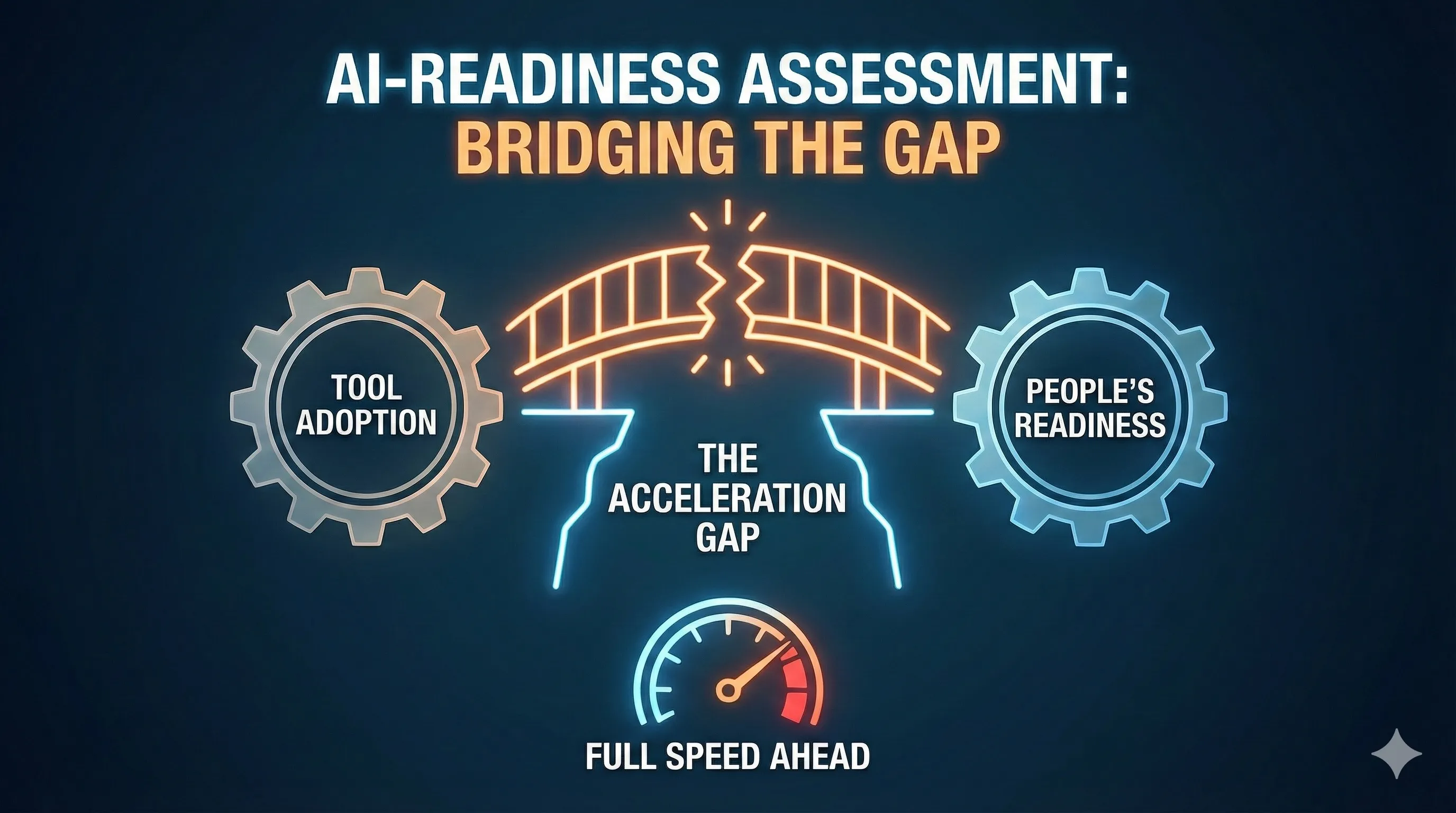
Four questions. Five minutes. Open source under AGPL-3.0, with every research citation linked and verifiable. Because the developers who need a way to talk to their leadership shouldn’t have to pay for the vocabulary. And the CTOs carrying the weight of AI transformation shouldn’t have to hire another consultant just to understand where they stand.
You made the right investment. The AI tools work. The strategy is sound. The system moved the finish line before you could cross it.
This assessment won’t tell you what’s wrong. It will show you where you are, and how far the last mile actually stretches.
When you’re ready to walk it, I’ll be beside you.
Your timeline. Your choice.
P.S. On Saturday, Valentine’s Day 💝*, we release nwave.ai; an agentic AI code assistant built on the same research foundation. Open source. For the teams who are ready. More on that soon…*
Next on The Forge of Unicorns: nWave.ai in action…