

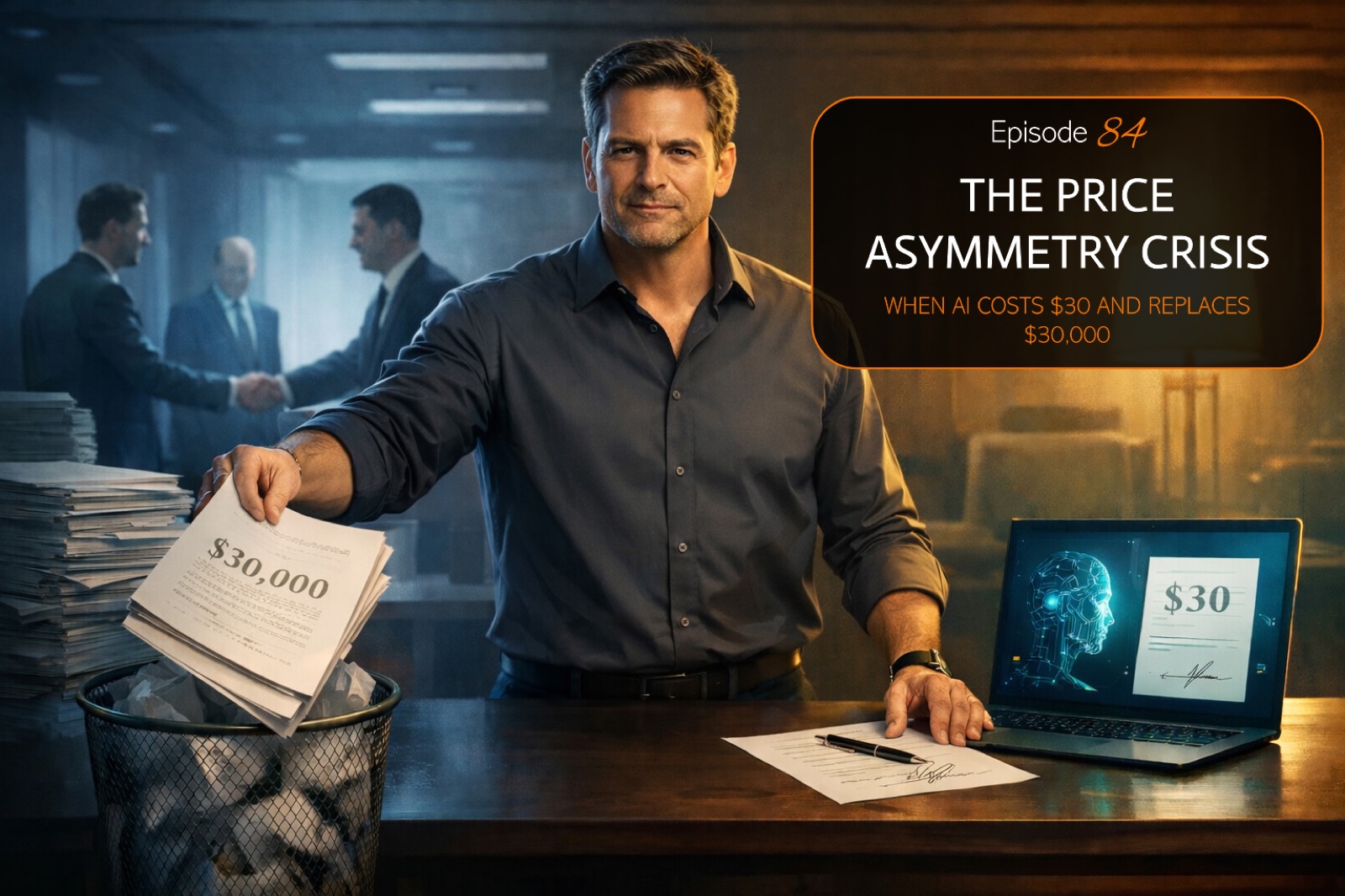
The Price Asymmetry Crisis
WHEN AI COSTS $30 AND REPLACES $30,000
Every morning, before the world wakes up, my agents have already been working.
I built them to do what I cannot; scan the noise, filter the signal, surface what matters. By the time I sit down with my black tea, there is already a digest waiting. Most mornings it is routine. That morning, one article stopped me cold.
I was watching my daughter. She was sitting across the table, the particular stillness of a teenager who has not yet decided whether to be present or somewhere else entirely. I had the tea in one hand and a financial expert’s breakdown of the SaaS crisis open on the screen. Oracle in freefall. Salesforce retreating. The numbers were not a correction. They were a reckoning. And somewhere between the first paragraph and the second, I was no longer in that room.
Last summer. A swimming pool in Slovakia. My beloved daughter, a different version; younger, louder, completely unaware. I was supposed to be watching her cut through the water. I was watching her. But my mind was buried in something I could not yet name: The circular economy of AI.
Nvidia producing chips, investing in CoreWeave, which buys Nvidia chips, which sells compute back to Nvidia, which sells capacity to OpenAI, which pays for more compute. Money moving in loops, not lines. Valuations rising not because businesses were profitable but because the players at the top needed the ecosystem to look healthy enough to justify their own multiples. I searched for serious analysis of where this ended. Nothing credible existed. Just my notes, her laughter, and a slow dread I could not quite locate.
Then, post-Christmas. The holiday quiet when most people are still digesting panettone and the industry briefly forgets to perform urgency. My agents kept working. One morning they surfaced something that pulled me back to that swimming pool feeling; a long, careful analysis of exactly the pattern I had been tracking: the energy crisis citizens were absorbing invisibly to feed data centers, the techno-feudalism forming beneath the luccicante surface of AI progress, the geopolitical chess game playing out between Silicon Valley and Beijing. Someone else had found the same rabbit hole. And they had gone further down it than I had.
I spent that week reading slowly. Something was crystallising.
“Dad.”
I looked up. My daughter was smiling at me with the particular patience children reserve for parents who disappear inside their own thoughts.
“It’s been a minute. You were staring right at me and you were completely gone.“
She was right. I had been gone. Back at the swimming pool, back in the reports, back in the dread that had been quietly assembling itself for eighteen months into something I could finally name.
The price asymmetry crisis. And it was no longer coming. It had arrived.
A $30 monthly subscription to an AI coding assistant does what a $30,000 annual contract with a professional services firm used to do. Not partially; substantially. The gap is real, it is widening, and it is moving faster than most organizations have time to process. The SaaS companies that built their entire business model on the assumption that software complexity would always require expensive human intermediaries are now watching that assumption dissolve in real time. Salesforce, ServiceNow, Oracle, Adobe; these are not failing companies. They are structurally challenged companies, which is a different problem entirely and a harder one to solve.
The Wall Street reaction confirmed what the market had been whispering for months. SaaS multiples that once seemed permanently elevated are repricing. Not because the products are bad. Because the value proposition that justified the price has been partially replaced by something that costs $30 a month and works well enough for most use cases most of the time.
For a CTO reading this, the instinct is to frame it as an opportunity. The tools are cheaper. The capabilities are stronger. The promise of doing more with less is finally, genuinely real. That instinct is correct. BUT, it is incomplete.
Here is what the circular economy story taught me, sitting by that pool while my daughter swam.
The $30 subscription did not appear from nowhere. It was funded by capital that needed the ecosystem to scale fast enough to justify the infrastructure spend, which was itself funded by the same players who owned the infrastructure. The price asymmetry is real; but it was manufactured at a speed that outpaced the governance structures any organization would need to use it responsibly. When professional services cost $30,000, the price itself created friction. You thought carefully about what you were buying. You had contracts, deliverables, accountability. You had a human being whose job it was to be right.
When the same capability costs $30 a month, the friction disappears. And with it, often, so does the accountability.
Someone still has to be right. Someone still has to review the output, challenge the errors, own the decisions that the AI made quickly and cheaply and sometimes incorrectly. That someone is your team. And 94% of tech organizations are now routing their operational spend toward AI infrastructure without asking whether the humans on the other side of that infrastructure are ready to govern what it produces.
The price dropped. The responsibility did not.
This is not a story about AI being dangerous. It is a story about speed.
The organizations navigating this well are not the ones who moved slowest. They are the ones who moved fast on the tools and deliberately on the governance; who understood that deploying AI capability without building the human layer to supervise it is not transformation, it is debt accumulation. Technical debt with a compliance expiration date.
The question your board will ask eventually is not “did we adopt AI?” They adopted it. The question is “who approved the output that went to production, and what was the process?” When a $30,000 professional services contract went wrong, there was a contract, a scope, an accountable party. When a $30 subscription produces an error that reaches a client, the accountability lands on whoever deployed it. That is your organization. That is your name.
I spent the last year trying to understand where the circular economy ended. I am still not certain. But I know what the organizations that survive it look like. They are the ones who treated the price asymmetry as an invitation to go faster and a requirement to go deeper:
faster on adoption, deeper on the human readiness to govern what they adopted.
Watching my daughter swim last summer, I felt something I did not have words for yet. It was not fear exactly. It was the particular weight of seeing a pattern form before it has a name, knowing it will have consequences, and not yet knowing how to help people prepare for it.
This week, I have a name for it. And tools that did not exist last summer.
The AI Readiness Assessment I built takes thirty minutes and maps exactly where your organization sits on the gap between AI adoption and AI governance readiness. Not to expose what is broken; to show you where the last mile is, so you can walk it with intention rather than stumble into it under board pressure.
The terrain shifted while most organizations were busy deploying tools. The $30 subscription is not the story. The question of who governs its output is the story. And the organizations that answer that question deliberately, before a regulator or an incident forces the answer, are the ones who will still be standing when the circular economy finishes its current loop.
Your daughter’s generation is inheriting whatever we build now. I would rather hand them something governed than something fast.
When you are ready to map your last mile, I am beside you.
→ Free AI Readiness Assessment - 5 minutes, 4 questions, a score.
Next week: we go deeper into the journey paradox of being AI-native.
A controlled study gave experienced developers the best AI tools available. Measured their speed. Then asked how they felt about it. The gap between what the data showed and what they believed was 43 points. A gianormous reality gap. They weren’t lying. They genuinely couldn’t tell.
And that’s the part that, from what we see on the market, keeps every CTO up at night… and we can’t leave it in this way.