
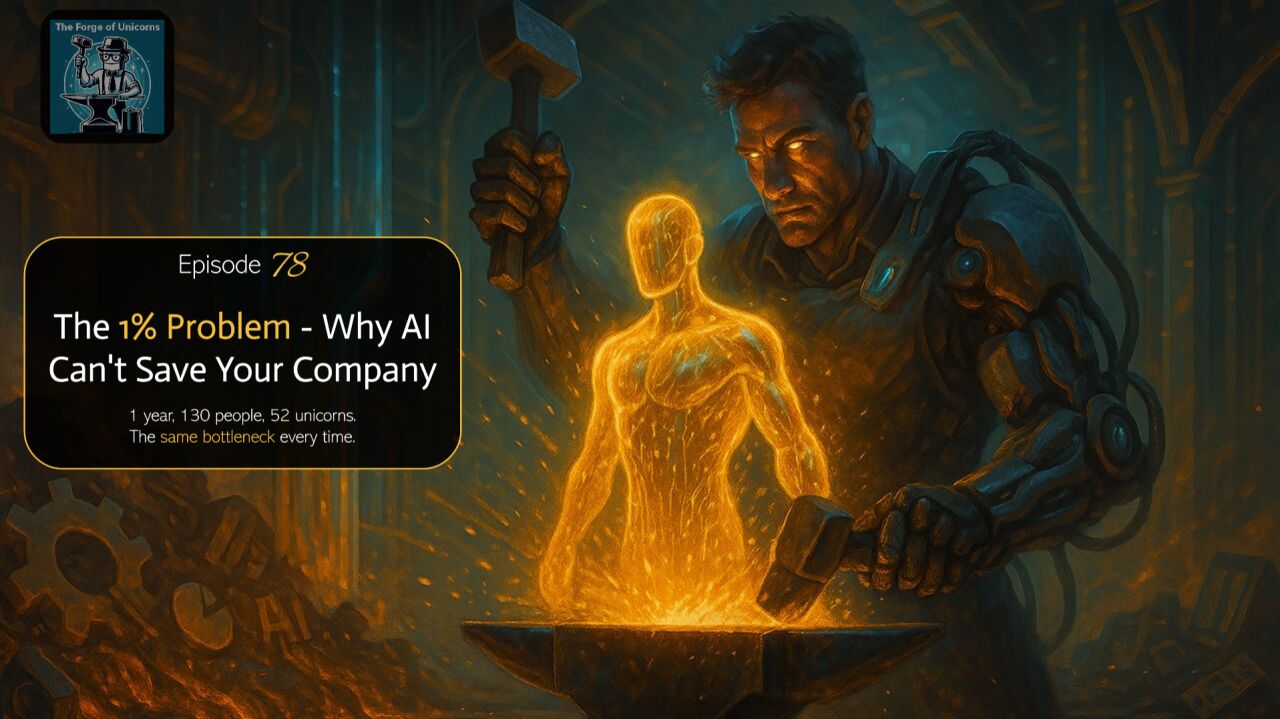
📰 EP 78: The 1% Problem - Why AI Can't Save Your Company
Hey there, digital warriors! ⚔️
Three years ago, ChatGPT burst onto the scene… and the world lost its mind! 🤪 Billions, then trillions, poured into AI. Everyone scrambled to “transform.” Yet here we are, three years later, still staring at the same bottleneck we started with. 🤨
On November 30, we’ll mark the third anniversary of that ChatGPT moment. Over these years, I’ve been obsessed with one question: how will AI and coding evolve into what Andrej Karpathy calls the Software 3.0 era? To find out, I spent the last year analyzing 130 people who founded or built 52 unicorns: different industries, different frameworks, different playbooks. And still, every conversation, every dataset, every insight circled back to the same uncomfortable truth.
It wasn’t AI. It wasn’t Agile or DevOps. It wasn’t capital. It was the 1% problem: the rare few capable of turning potential into performance. The ones every company desperately needs but almost no one knows how to build.
That’s where our story begins.
The Uncomfortable Truth Nobody Admits
I began my research on elite software organizations nearly 25 years ago, standing trackside with my brother Christian Brissoni and his friend Simone Zucco, mesmerized by the flawless choreography of Ferrari’s F1 crew. That was the moment I made it my mission to replicate that level of precision and mastery in the software industry. Years later, at IBM, I saw the same principles move the company’s stock from $80 to nearly $300; a tangible proof that behavioral engineering works when applied with discipline. It was then I knew this story had to be told on stages and through this very newsletter.
After 77 podcast episodes, 26 of them with VCs who funded unicorns, CTOs who scaled engineering teams, and CEOs who built billion-dollar companies, I noticed something striking. They all used different words, but they all described the same problem: the extreme scarcity of people who can actually execute at an elite, Formula 1-like level.
The industry keeps throwing money at tools and frameworks instead of people. Billions go into AI code assistants, Agile coaches, and cloud migrations, while human and social-behavioral readiness gets left behind. We hope technology will fill the gap we refuse to face. We convince ourselves that a profitable quarter means progress. But it doesn’t.
Because when the market turns, and it always does, profit margins won’t save you from cultural collapse, layoffs, and the social ripple effects of disengaged, burnt-out teams. It’s the illusion of success that kills slowly.
And here’s the bitter truth: every time we ignore this reality, the system bites back. Hard. Tech chaos, economic instability, geopolitical pressure. All magnify the cost of mediocrity. So let’s be honest: it’s not the world that’s broken. It’s our way of leading it.
The question is: will you keep steering from your ivory tower, or finally step into the forge where real leadership is made?
The Pattern Across 52 Unicorns
When you study 52 unicorns up close and compare them with all the others that never made it to that status, something remarkable surfaces. It’s not hidden in their tech stacks, market timing, or funding rounds. It’s in their people, their culture, and their collective mindset.
Every winning organization I analyzed shared one common denominator: small, elite teams that execute with relentless precision. Not bloated corporations wrapped in process. Not armies of average talent managed by meetings. Just a few exceptional humans moving with clarity and conviction.
Across all 52 cases, the data stayed consistent: small elite teams always outperform larger, mediocre ones. Not occasionally. Always. When speed, quality, and creativity matter (and they always do), few exceptional engineers will outthink and outdeliver fifty average ones.
Why? Because the 1% don’t need playbooks to tell them how to perform. They don’t rely on process to cover missing fundamentals. They simply execute.
But here’s the harsh truth: you can’t buy the 1%. You have to build them.
It’s the same principle that drives professional sports and special operations. As a tactical combat and Jiu-Jitsu trainer with multiple black belts, I’ve seen it firsthand: you don’t find SWAT operatives or Olympic-level fighters ready-made on the market. You scout raw potential (the ones with grit) and forge 🔥 them into elite performers through endless, focused repetition. Over time, habits hardwire into instinct, freeing the mind to react with flawless precision.
That’s what separates ordinary teams from the ones that make history.
And if you think that level of discipline only exists in the dojo or the battlefield… wait until you see what happens when it’s applied to a software organization and development.
Why IT/Software Is Different (And Not In a Good Way)
Let’s get brutally honest for a second. What’s broken in software isn’t the tools, it’s the foundation. Compare IT and software to medicine and engineering. Both demand precision. Both impact lives. Both require years of discipline. Yet only medicine and engineering have professional standards that actually protect people from systemic failure.
Medicine and engineering:
- Consistent quality outcomes
- Adherence to strict protocols
- Universal standards everyone follows
- Consistent trust and reliability
- Predictable safety
IT and software:
- Inconsistent quality outcomes
- Lack of universal standards
- Hope that frameworks compensate
- High-performance scarcity
In medicine, you trust the process. Even a mediocre graduate can safely operate because the system enforces a baseline of mastery. You never ask your surgeon where they ranked in class; you trust the discipline that trained them.
In software, there’s no such safety net. You don’t trust the system. You hope the developer belongs to the 1% who know how to build something that won’t collapse under real-world pressure. You accept faulty terms of service, buggy updates, and outages as “normal.” We’ve normalized dysfunction. Need proof?
Let’s look at the Porsche Taycan. A brand synonymous with engineering perfection entered the EV age and drove straight into the wall of software mediocrity. The Taycan, Porsche’s first full EV, was supposed to redefine performance. Instead, it turned into a digital nightmare: cars stuck in limp mode, batteries misreporting charge, doors locking themselves, and owners waiting months for software patches. The legendary growl of a Porsche engine was replaced by the quiet hiss of disappointment. How did that happen? Porsche’s software development met ASPICE Level 2 standards. Compliant on paper, yet disconnected from reality. The process was followed, the audit passed, the documentation pristine… and the product still failed. Because checklists and certifications don’t create mastery. Real reliability is born from real behavioral and technical readiness, not bureaucracy.

The punchline? VW Group’s wider software fiasco, through its CARIAD division, proved the same point at scale. A sea of processes, suppliers, and PowerPoint slides cannot replace craftsmanship. The automotive world discovered what software leaders have known for years: standards without deep skill produce predictable mediocrity.
And here’s the irony that should make every boardroom sweat: even with all these rigorous standards, audits, and compliance frameworks, we’re still in a software shit show. 🤯 So, what does that say about an industry like ours that has no universal standards at all?
The Market Reality: A Funnel of Scarcity
Here’s the harsh truth the market refuses to face: we don’t have a shortage of people, but a shortage of competence. The hiring funnel is broken because it’s filled with process, not talent.
Market offering (top of funnel): Everyone claims they can do the job. The market is flooded with polished résumés and buzzwords but light on substance.
Technical mastery (first filter): Narrow it to those who actually possess real technical depth. Maybe 10% make it here.
Social skills (second filter): Further reduce to those who can collaborate, communicate, and lead without friction. Another 60% disappear.
Elite mindset (bottom of funnel): What’s left? The 1%. The people who combine mastery, social intelligence, and relentless execution. The ones who don’t wait for permission. The ones who fix what’s broken before it explodes.
That’s your unicorn team. The ones who built those 52 companies I analyzed. And it’s exactly who you don’t have enough of. Because the market can’t supply them, and your hiring process is designed to filter for compliance, not capability.
Most organizations respond to this talent crisis by reaching for the same crutch: process. More frameworks, more governance, more layers of control. But every time leadership chooses process over people, it sets the compass toward the same crash site Porsche hit with the Taycan: compliance without competence.
When you rely on process to make up for missing mastery, you guarantee mediocrity at scale. You don’t build teams; you build bureaucracy. And that’s exactly how world-class brands end up in the ditch, wondering how they got there despite “doing everything right.”
So, before you add another playbook or hire another consultant to “fix” your process, ask yourself: what if the real fix isn’t in the process at all, but in the people?
The Five Discoveries That Expose the Clusters of Mediocrity
Across one year of conversations with 130 founders, CTOs, and investors behind 52 unicorns, and a comparative analysis with those who failed to scale, a pattern emerged. Each success and each collapse fit into one of five behavioral and technical hypotheses. Together, they explain why some organizations thrive in the AI era while most stagnate.
#1: Small Elite Teams vs. Large Bloated Organizations The claim: Quality beats quantity. Small elite teams outperform large mediocre ones. The data: In every case, smaller high‑skill teams outpaced larger groups by 5-10× in speed and delivery consistency. Fewer layers, faster feedback loops, stronger ownership. Behavioral friction in large teams was the hidden tax no one measured until it was too late.
#2: Generative Culture vs. Process‑Heavy Approaches The claim: Culture creates capability. Process creates compliance. The data: Generative cultures, where experimentation is rewarded and failure is treated as learning, consistently produced sustainable innovation. Bureaucratic cultures, even those wrapped in glossy “Agile” labels, plateaued. Frameworks delivered paperwork; culture delivered the proper outcomes.
#3: Modern Software Craftsmanship vs. Framework Dependency The claim: Technical discipline matters more than frameworks. The data: Teams practicing clean code, TDD/ATDD, and continuous integration achieved 60–90% fewer production incidents and released 10× faster. AI multiplied their precision. In contrast, teams chasing Agile frameworks (SCRUM, SAFe) without mastering fundamentals only multiplied chaos. AI doesn’t fix bad code. It exposes it, brutally.
#4: AI Amplification Principles vs. AI Replacement Fantasy The claim: AI amplifies your foundation; it doesn’t replace missing skills. The data: Code assistants boosted senior engineers’ productivity up to 50%, while decreasing junior developers’ code quality when left unguided. The difference wasn’t in the tool, it was in the maturity of the human using it. AI fails not because of hallucinations, but because we hand it to unprepared teams or players.
#5: Behavioral Engineering vs. Hope‑Based Hiring The claim: You can systematically develop the 1%. You don’t have to hope you hire them. The data: The top‑performing organizations invested deliberately in behavioral engineering, aka our SW Craftsmanship Dojo®, mentorship/coaching, and continuous practice. Within six months, with zero productivity lost, measurable behavioral KPIs (KBI) improved by 25–40%. Instead of waiting for the market to supply talent, they built it internally, aligning people with mission, elevating above‑average contributors into elite performers.
The conclusion is crystal clear: the only scalable strategy is to build your own 1%. Because in a world where AI amplifies everything, the real competitive edge isn’t the tool, it’s the people disciplined enough to wield it.
Why This Matters Now More Than Ever
Three years post‑ChatGPT, we’re standing at a crossroads.
One path - 💀: keep pouring trillions into AI tools while neglecting the human foundation. Keep hoping frameworks will fix what a lack of readiness keeps breaking. Keep scaling teams instead of scaling capability. That path leads to stagnation; mediocrity at scale. Maybe even the next economic bubble, one that could make 2008 look like a warm‑up. The patterns of capital flow suggest it’s already inflating, and this time, it’s not just finance at risk. It’s the credibility of innovation itself.

The other path - ☀️: invest in people. Systematically develop your 1%. Engineer culture instead of outsourcing it. Build generative teams where elite performers thrive, and use AI to amplify excellence rather than mask incompetence. That path leads to exponential, measurable results.
Here’s the best part: we make this accessible to anyone willing to take the first step. While most consultancies charge tens of thousands for a shallow AI‑readiness report that only tells you what’s wrong, we do it differently (and for free. YES for 🆓). Our AI readiness quick scan doesn’t just assess your readiness to use AI; it reveals how to fix the root cause: the behavioral and cultural gaps keeping your organization from performing at an elite level.
Because the truth is, you don’t need another glossy audit. You need a system that turns mediocrity into mastery. The data across 52 unicorns, 77 episodes, and 15 years of research all point the same direction:
small, disciplined, elite teams built from within consistently win.
Most organizations deploy AI with teams that don’t truly understand software engineering, craftsmanship, and end up shipping garbage faster. The Software Craftsmanship Dojo® rebuilds teams from within, using battlefield-tested behavioral engineering. The same system that forged those unicorn teams. Your organization is literally one quick-scan away!
👉 Get your FREE AI-readiness assessment: Clear data. Actionable insights. Zero cost.
Because in the age of AI, only those who master the right fundamentals will become the elite who survive.
📺 Enjoy the full retrospective 🍿🍺
⏭️ Next
Episodes 79 will dive deeper into the biggest misunderstood concept: behavioral engineering: How engineering elite teams in a dojo will predictably change your culture even in a hostile environment. Stay tuned.