

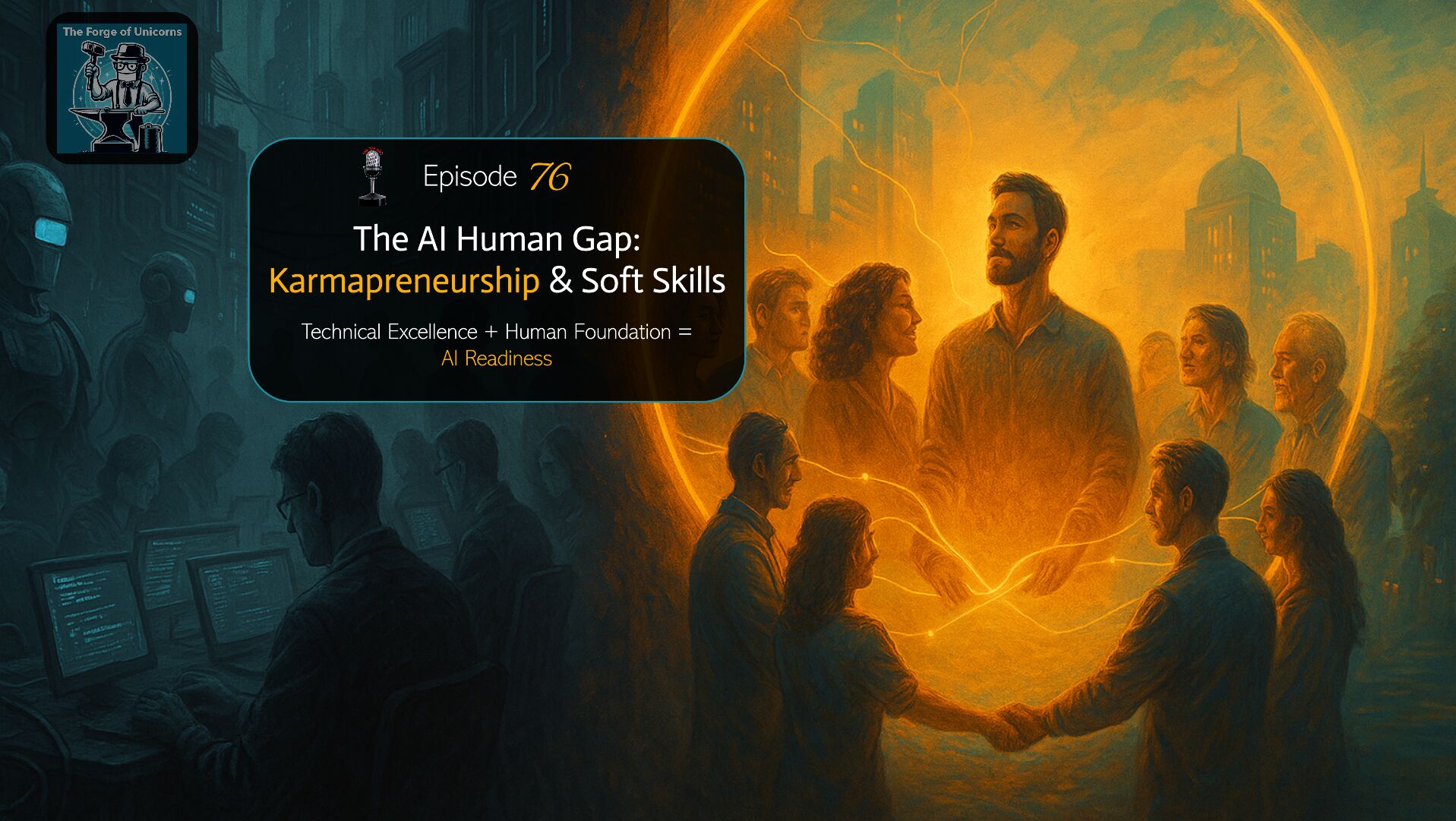
📰 EP76 - The AI Human Gap: Karmapreneurship & Soft Skills
Hey there, digital warriors! ⚔️
Last week, in Episode 75, we explored with Piergiorgio Vittori how a small company can compete against giants if they leverage and nurture the three pillars of elite organizations: customer obsession, technical excellence, and human-centric culture. Together, we revealed the concept of collaborative-AI, a hybrid coworking model where humans in the driver’s seat is enhanced by AI, and why every organization now needs an AI-readiness test to see if their AI is amplifying value or chaos. This week, we go deeper, into the heart of what AI still can’t replicate and why human AI-readiness is paramount!
We sat down with Craig Weiss, a man who’s lived three professional lives: from patent attorney to unicorn CEO to venture capitalist. But what makes his story truly unforgettable isn’t just his success. It’s his belief that business without soul is just automation. And that the future of AI depends entirely on our ability to stay human.
🧩 The Soft Skills Paradox and why that matters more now…
Let’s start with a hard truth: every time we teach machines to think faster, we risk forgetting what makes us human. The paradox of progress is that automation promises freedom, but often steals social human connection. Craig Weiss nails this contradiction in one perfect line:
“AI is never going to understand what it’s like to bury a parent or to fall in love or to pull an all-nighter or, in your case, to get punched in the face… those are human experiences.”
While the world races to automate everything, the smartest leaders are rediscovering the human code: empathy, curiosity, and execution. You can’t automate passion. You can’t outsource courage. You can only cultivate them.
“I’ll take great execution of a bad idea over poor execution of a great one,” Craig told me. “Without execution, you’ve got nothing.”
After a decade evaluating ideas as a patent attorney, he learned the brutal truth: ideas are abundant, discipline is rare. The same holds for AI adoption today. Without human drive, even the most advanced model becomes another expensive ghost in your tech stack.
So if AI isn’t delivering, maybe it’s not the algorithm. Maybe it’s us.
Because the real question isn’t ‘How smart is your AI?
It’s ‘How ready are your humans?’
And that question opens a door: what happens when we measure that readiness with data?
What 100+ portfolio analyses reveal about AI failures.
Let’s zoom out for a second. The data doesn’t lie, and neither do the patterns it reveals. Across hundreds of organizational audits and venture portfolios, one truth echoes louder every year: AI amplifies the culture you already have. Strong behavioral foundations? AI multiplies capability 🏆 Weak, chaotic cultures? AI multiplies dysfunction 💥
This is the brutal truth most organizations refuse to face. They invest in beautiful decks, not capable humans. They assess pitches, not cultures. They reward process, not ethics. And when the cracks start to show, they blame the algorithm instead of the atmosphere.
“I forgot how much I hated VCs,” Craig laughed. “Ten young dumb guys who’d never run a business, thinking the world runs like an Excel spreadsheet.”
The irony? Those same persons are now spending millions on “AI tools” that analyze numbers instead of people. But data without empathy is just noise. The pattern keeps repeating:
- Founders with dazzling slides but zero execution muscle.
- “AI experts” who were selling French fries last month.
- Teams collapsing under the weight of their own automation.
- People burning out trying to prove they’re still more useful than their AI assistant.
Here’s the raw truth: AI reflects our hidden behaviors, our blind spots, our unspoken culture. It doesn’t invent chaos; it simply amplifies the one we’ve been tolerating.
So, before chasing the next AI feature, we ask ourself:
If AI exposes our culture tomorrow, will it reveal mastery, or mayhem?
Because what we found next explains why empathy and curiosity are the only true firewalls against that chaos. 👇
Karmapreneurship: the cultural prerequisite AI needs.
Craig didn’t open this topic with theory. He opened it with fire 🔥 In a world where ethics are often a marketing campaign and empathy is outsourced to HR, he dropped a truth bomb:
“You could sell french fries and still be a karmapreneur,” Craig said. “If you treat your people, customers, and vendors well, you’re doing the right thing.”
That’s not charity; that’s strategy. Karmapreneurship is his blueprint for a new kind of leadership where the how defines the why. It’s the missing bridge between capitalism and conscience.
“The business world thinks spiritual people are hippie-dippy wackos. The spiritual people think the business world is full of bloodsucking vampires. There’s no dialogue. Karmapreneurship builds the bridge.”
He’s right. Modern society celebrates overwork, ego, and greed as signs of success. But as Craig reminds us:
“It is no measure of health to be well adjusted to a profoundly sick society.”
We call it progress, yet our workplaces are quietly collapsing under burnout and disengagement. AI, without empathy, doesn’t fix this, it magnifies it. In our research at the cornerstone of the Unicorns’ Ecosystem, and foundation of the Software Craftsmanship Dojo®, we treat behavioral engineering as one of the most successful antidote: building systems where curiosity, trust, and purpose are not motivational posters, but performance prerequisites for technical excellence.
Just like in Formula 1: elite teams don’t start with tools, they start with people. They obsess over precision, communication, flow, and passion! That’s why they win despite the highly costs to be in a paddock lane.
So before your next digital transformation, ask yourself:
What if the real competitive advantage isn’t your technology… but your humanity?
F1 pit crews beat bloated engineering teams every time.
Let’s shift gears. If Karmapreneurship defines the culture, this next piece defines the battlefield. Here’s what modern execution looks like when human + technical excellence replaces blueprints and passion replaces bureaucracy and process:
- Small teams (8 elite engineers)
- High technical standards
- High social cohesion
- Zero process overhead
- Tons of passion, shared purpose, and ethical camaraderie
This is the Formula 1 mindset of digital evolution. A world where speed and precision come not from bigger teams, but from better synchronization. AI isn’t the driver; it’s the co-pilot whispering data into the ears of masters. Execution here becomes symphonic: fast, coordinated, instinctive. A primordial habit of human and technical excellence. Craig’s own transformation didn’t happen in isolation. His mentor became a daily sparring partner during his first years as CEO.
“I probably called Eli every day for two years,” he said. “Those conversations built the muscle that saved the company.”
That’s coaching culture in its purest form: curiosity, discipline, and honesty forged through repetition. Later, a spiritual mentor added the missing ingredient:
“When someone speaks, don’t think of what to say next. Feel in your body where their words land.”
That’s empathy in motion, the invisible mechanism behind every high-performing elite team. You can’t fake that in bloated org charts or bureaucratic standups. But in small, tight squads, it becomes instinctive.
This is a better picture of it in action:
- Traditional org → 50 engineers, 20 meetings, AI chaos due to missing alignment & mastery.
- Elite org → 8 engineers, continuous alignment, AI amplify mastery.
That’s the blueprint of the new LeanOrganization model: precision through connection, clarity through purpose, excellence through empathy.
And the question that follows: What if your team’s next upgrade isn’t another AI integration, but a behavioral one?
The test that reveals whether your AI adoption will succeed.
The final lap of this journey begins here. Everything Craig shared, every data point uncovered, every principle of Karmapreneurship and LeanOrganization we explored, they all converge into one truth: you can’t automate excellence without cultivating it first.
Craig exposed the gap. The data proved the pattern. Karmapreneurship built the bridge. And our research in behavioral engineering showed how to operationalize it. Now, it’s your turn to act.
Every organization dreams of scaling with AI, but most deploy it into fragile ecosystems that only amplify their dysfunction. The few who win are those who rebuild human (curiosity, compassion, and execution)and technical foundations first; then let AI multiply that human and tech mastery.
You’ve already invested in tools. Now invest 30 minutes to understand how ready are your people. Because until your human system is ready, your AI will always underperform.
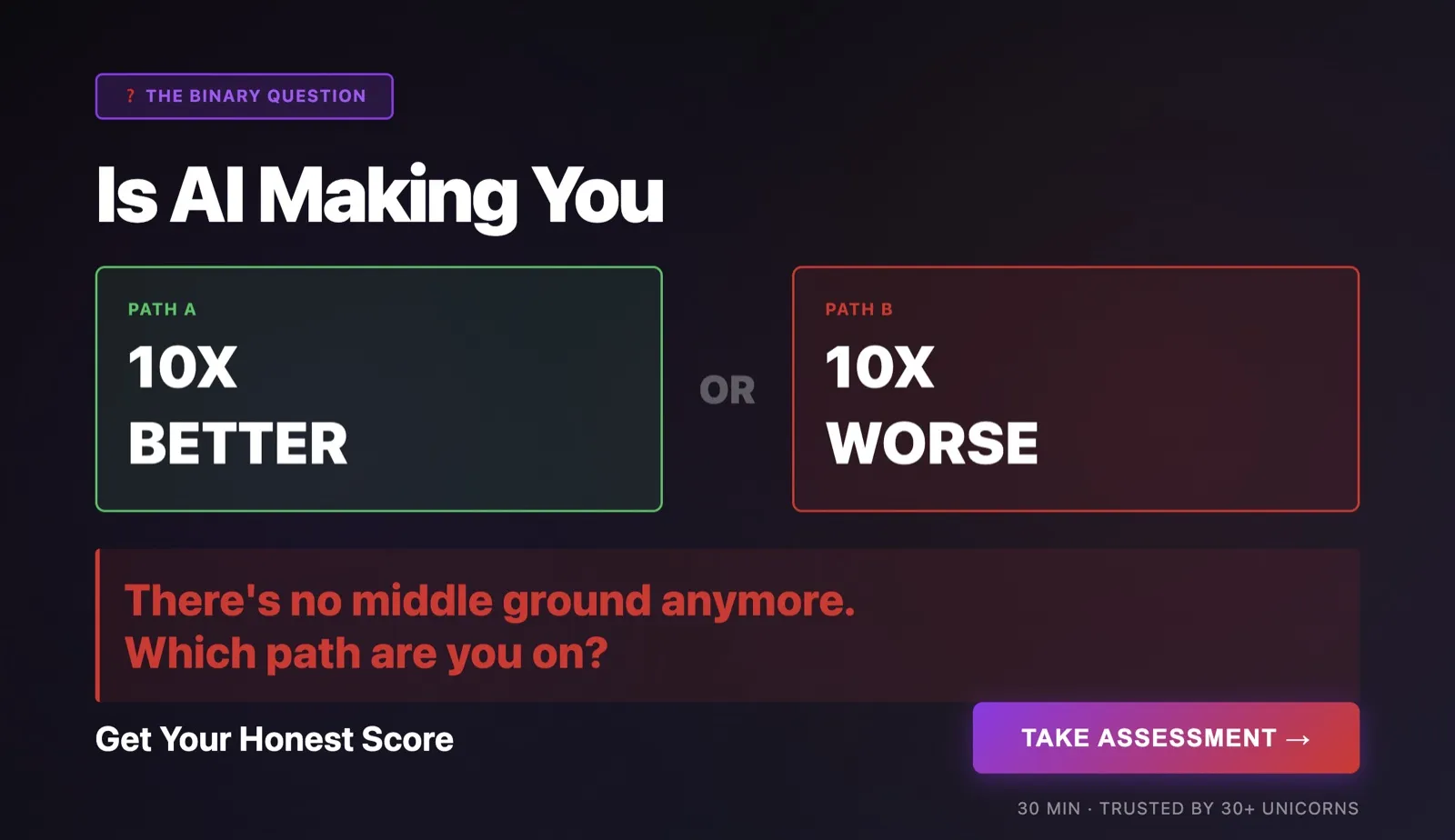
Contact me 📬 to be part of the FREE AI-Readiness assessment, we’re here to help you and your people to get this tech marriage working without blood and tears.
📺 Enjoy the interview 🍿🍺
🗓️ Upcoming: A 3-Year Reckoning
Here’s what’s coming, and why it matters.
We’re approaching a milestone: 3 years since ChatGPT publicly launched the AI revolution. And almost 1 year since we started the deep research across 100+ investors, SaaS CEOs, and engineering leaders, many of whom you’ve heard right here on this podcast.
It’s time to step back. Zoom out. Reflect.
What the hell actually happened? What did we learn? What patterns emerged across all these conversations? And most importantly: Why does behavioral engineering keep showing up as the missing piece everyone ignores, and misunderstands?
So we’re doing something different.
A deep reflection series that breaks format. No single guest. No standard interview structure. Instead:
- 📬 Your questions answered. The ones you digital warriors have been asking in comments, DMs, and emails
- 🧠 Behavioral engineering unpacked. Theory AND practice, no fluff
- 📊 3 years of AI adoption data synthesized. What worked, what failed, why
- 🔥 The patterns nobody’s talking about. From 100+ portfolio conversations
Think of it as a State of AI Readiness address. Raw. Data-driven. Unapologetically honest about what we’ve learned by watching organizations succeed and fail with AI.
Get ready for a completely new, crazy format.
Because after 76 episodes and hundreds of hours of research, it’s time to connect the dots.
Stay tuned. 🦄⚔️