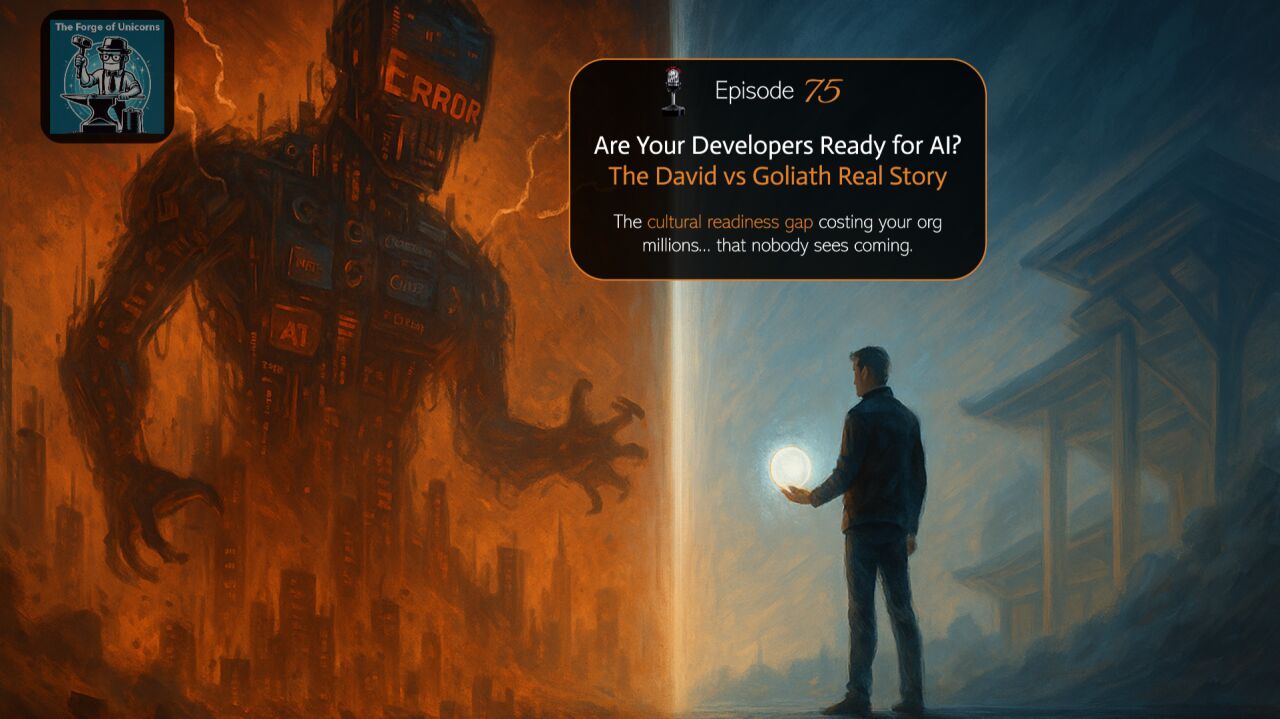
📰 EP75 - Are Your Developers Ready for AI? The David vs Goliath Story
Hey there, digital warriors! ⚔️
Over the past weeks with Stephan Donzé and Meir Rabkin — the man who built twelve unicorns in just five years — we’ve heard from both CEO and investor perspectives why technical excellence in software is non‑negotiable. Yet somewhere along the way, the industry traded mastery for mediocrity, ditching upskilling and craftsmanship in the name of “cost reduction.”
But at what cost? 💸
We’ve inherited organizations overflowing with disengaged engineers, exhausted managers, and teams that call themselves “developers”… yet 97% lack the fundamental skills to deliver in production a mission-critical application! And when you pour AI into that mix, the cracks don’t disappear: they explode.
Without craftsmanship and technical excellence, AI doesn’t make you faster. It makes you fail faster and with a bigger crash 💥
That’s where today’s guest steps in. Pier Giorgio Vittori, who is playing David against the Goliaths of the AI industry with Spitch.ai. They are rewriting the AI story around the essentials most corporations forgot:
Customer trust. Employee happiness. Ethical adoption. Continuous Technical excellence.
The truth? AI isn’t failing technically; it’s failing culturally. And Speech AI proves that when you build on ethics, mastery, and empathy, you don’t just compete with giants. You outclass them with humanity and creativity.
Because that’s the real battlefield, isn’t it? Not algorithms. Not GPUs. Not even data. In a world busy fighting in the noise, the war is cultural, between those chasing a magic‑button illusion and those who see AI as a mirror reflecting who they already are.
Every rushed decision, every corner cut in the name of “speed,” comes back amplified by the same tools meant to save them. That’s why the giants stumble under their own weight, and why human-centric companies, grounded in patience, nurturing, and purpose, are quietly winning.
The Mirage of AI Adoption
Executives dream of AI-driven revolutions. Investors demand it. Boards cheer it on. Yet behind the dashboards and keynote slides, reality whispers a darker truth: billions spent, zero tangible transformation.
“Technology should serve the customer… Technology serves to support the need, to address the need, and to make it possible.” — Pier Giorgio Vittori
Most companies treat technology like a quick painkiller, soothing symptoms instead of curing causes. They keep throwing AI at broken processes, rigid hierarchies, and disengaged teams, expecting miracles, and instead scale dysfunction and burnout
When those same untrained, anxious teams begin using AI tools, the illusion of progress collapses into pure chaos. AI doesn’t create excellence; it magnifies the dysfunction hidden beneath all those glossy Agile and DevOps posters.
Ask your CFO how much was poured into cloud contracts, Jira licenses, and dashboards, and then compare it to what you invested in actual technical mastery. Chances are, you spent fortunes on process and pennies on people, buying the dream of innovation while starving the very engineers meant to build it.
I know… none of us enjoy when someone points at the nail in our own head. But let’s face it together. You wanted acceleration and innovation, and you paid the price for it. Yet instead of speed, you got fragility; instead of progress, paralysis. You didn’t fail because you didn’t try.
You failed because you somehow forgot the people who had to make it work.
So tell me this. You invested millions to move faster, but how did you end up building an organization that isn’t capable of harvesting the 10x AI factor everybody is talking about?
The Human Factor
Every leader talks about customer satisfaction, but too many forget its first law of gravity: happy employees create happy customers.
“You cannot get the customer satisfaction if your employees are not satisfied.” — Pier Giorgio Vittori
Think about it. Would you ever give a five‑star review to a restaurant where the waiter looked unprofessional and disengaged? Of course not. So why does the IT industry expect satisfied users from teams crushed by burnout and incompetence?
The truth is uncomfortable: tech has normalized exhaustion and anxiety, all in the name of “fueling the AI revolution.” But when creativity lives in fear, it dies quietly, and with it, every chance of true innovation.
You can’t ask a developer in survival mode to imagine a healthy AI-coding future. You can’t expect collaboration from teams that compete for their daily jobs. And you definitely can’t expect AI excellence from people terrified it will replace them.
Spitch.AI turns that nightmare upside down. Every developer, every customer, every line of code lives in a culture of trust and mentorship, in an ecosystem where people are coached to grow into masters of their craft. Only from that space can true collaborative-AI emerge: human intelligence and expertise guiding artificial intelligence with purpose.
They build software the way great chefs create signature dishes: with patience, skill, and pride.
So let’s be honest, your AI strategy might look perfect on paper, but without skilled, empowered humans to drive it, isn’t it just another expensive illusion, like it was Agile and DevOps?
The Rise of Collaborative Intelligence
Most companies are cutting back on people to chase full automation, a shortcut that’s backfiring badly. It’s creating a social and cultural fracture that undermines the very foundations of their digital ambitions. Remember: AI is a mirror. When fear drives your strategy, AI doesn’t amplify excellence… it amplifies fear 🙀 !
Yes, many organizations were cornered by shrinking markets and impatient boards. But leadership is about courage, not compliance. Sometimes, saying no to unethical AI adoption is the only way to protect what truly makes a company great: its people.
That’s exactly what Spitch.AI did. Instead of surrendering to the automation frenzy, they embraced collaborative augmentation: their take on collaborative AI. It’s a model I once called the Hybrid Approach, but Pier Giorgio gave it a name that says it all ❤️
“We are looking for what we call a collaborative AI… where human and AI agents work together, using the best of each other.” — Pier Giorgio Vittori
In this model, AI doesn’t replace talent; it amplifies their mastery. It keeps humans at the core, turning the so‑called “AI loop” into something deeply human. Rather than just hoping for the best, Spitch.ai invests from day one in people through coaching, tutoring, and mentoring.
Because creativity only thrives where people feel safe. Safe to experiment, to challenge, to fail without fear. Innovation is born from psychological safety as much as from algorithms. When failure becomes punishment instead of learning, every chance for true progress dies, no matter how much money you pour into the AI toolchain.
So while big tech builds tools to replace people, a small team in Switzerland builds systems that make people better. And that difference isn’t cosmetic… It’s existential!
So before we move to the operational side of this deep dive, let me ask: Would your AI adoption program pass the real test (empathy, integrity, and resilience) when your people face uncertainty, change, or layoffs?
Turning the Ship Around: From AI Chaos to Human Healing ❤️🩹
As we’ve learned so far, the real AI challenge isn’t technological: it’s emotional 🥹 and cultural 🤔. Restoring trust is the gateway to true collaborative-AI, because fear is the silent killer. Layoffs, cost-cutting, and fear-driven automation might please investors for a quarter, but they quietly destroy long-term value. What looks like “efficiency” today becomes disengagement, burnout, and emotional trauma tomorrow.
Across 100+ investor portfolios researched in the last year, we found the imbalance between operational data and human data to be staggering. Operational metrics flow in real time; human data limp behind through biased self-assessments. The same surveys issued by the companies that sign the paychecks. How honest can you really be when the system itself feels unsafe?
Now imagine those employees: a mortgage, a family, a world in turmoil, and your company asks, “How do you feel?” They’re scared, underpaid, unsure if their jobs will survive the next round of automation. Some vent anonymously; others fake positivity out of fear of being identified. Either way, the truth is lost. Bye Bye 👋
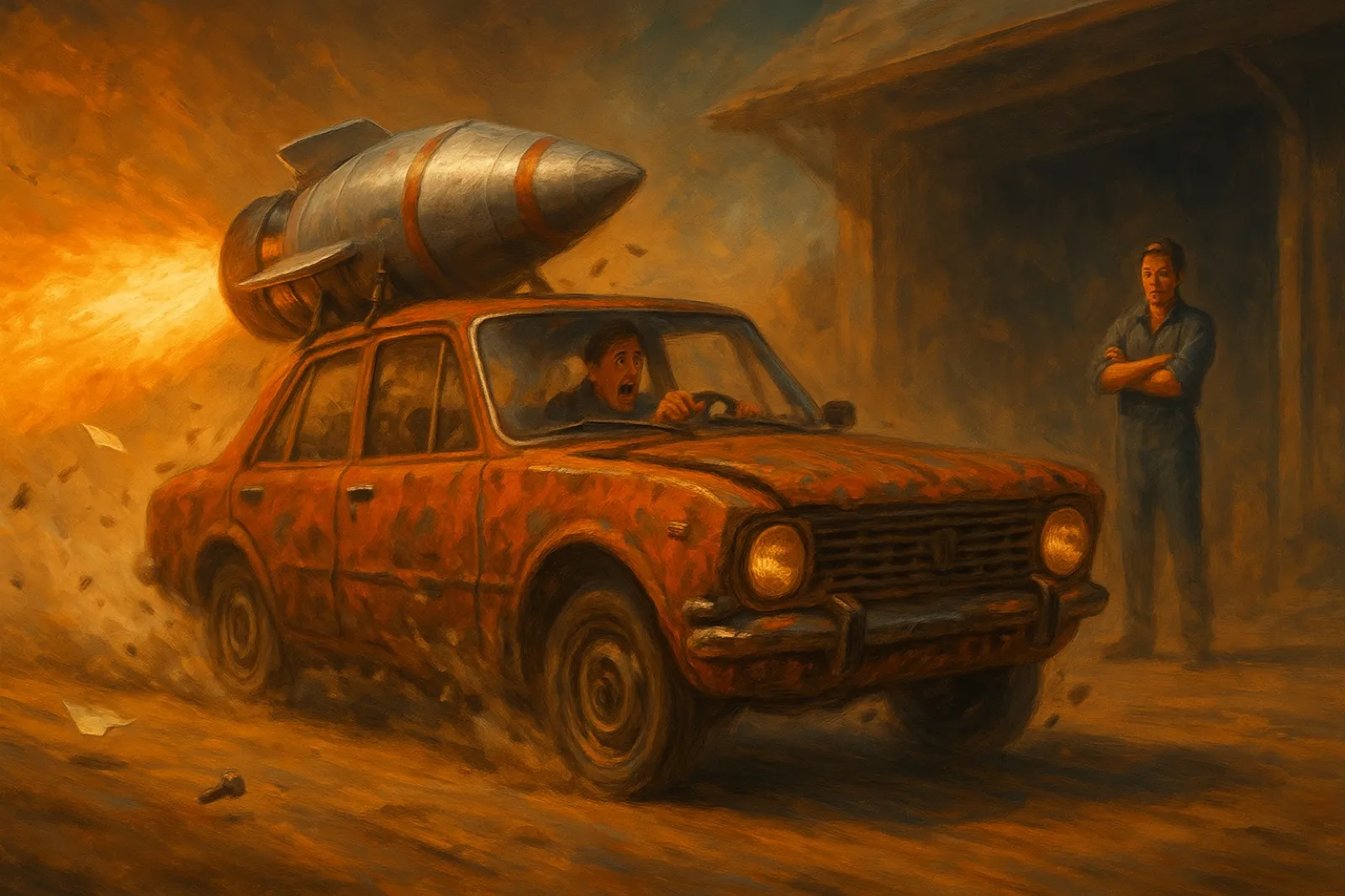
But research is also telling us that ~80% of the global workforce is disengaged, and when fear rules the room, innovation dies. You can’t ask for creativity from people stuck in survival mode. AI adoption without psychological safety and cultural readiness is like installing a rocket engine on a cracked chassis. It might ignite, but it must likely explode. 💥
But here’s the silver lining: most companies have already invested in AI tools. They’re halfway there. The missing half is human. Now they must invest in the people expected to use AI.
What they need is a systematic healing process ❤️🩹 One that rebuilds trust, mastery, and belonging.
That process exists. It’s called the SW Craftsmanship Dojo® v2.0, and it was born from my personal journey from the Formula 1 world. Back in 2010, facing cancer, I didn’t know if I’d survive. So I made the original Dojo open source, a gift of craftsmanship and purpose. Fifteen years later, the AI revolution prompted me, along with many skilled crafters, to collaborate on its evolution. The new AI-era version combines behavioral psychology, neuroscience, and decades of field experience to give employees a safe environment to rediscover curiosity, experiment freely, and rebuild confidence, all while mastering the fundamentals of true craftsmanship.
The Dojo v2 isn’t a training program; it’s a behaviorally engineeredcultural reset system. It re-establishes both technical and emotional foundations before layering AI collaboration on top. Once people feel safe and technically proficient again, they naturally adopt AI-collaborative patterns: pairing with peers, engaging in social programming, and co-creating customer-centric products through the new emerging Spec-Driven Development, where humans and AI collaborate where they excel in sharing intent, feedback, and craftsmanship.
That’s the future: enhanced coders evolving into crafters, assisted (not replaced) by intelligent, AI-empowered tools.
You’ve fought hard to reach this point. You’ve gone all-in on AI. But if AI has exposed the cracks in your culture, the question now is simple: will you keep patching the code, or finally start healing the humans who write it?
This last question is your epiphany moment. The signal that the path forward is finally clear. From hype to harmony. From chaos to culture. From fear to mastery.
AI didn’t break your organization; it simply revealed what was already fractured.
David vs Goliath isn’t about size; it’s about mastery.
“Don’t be afraid of technology. Use it gradually, depending on the maturity of the people, of the company, and of the customer.” — Pier Giorgio Vittori
If your developers aren’t ready for AI, your investment is already leaking value.
After analyzing 100+ investor portfolios and watching billions burned on culturally unready AI adoption, I built a 30-minute assessment that reveals what six-figure consulting firms can’t measure: behavioral readiness indicators.
Most organizations pay consultants who only see the technical surface. You get direct access to the methodology that exposes the human factor; the actual bottleneck killing your AI ROI.
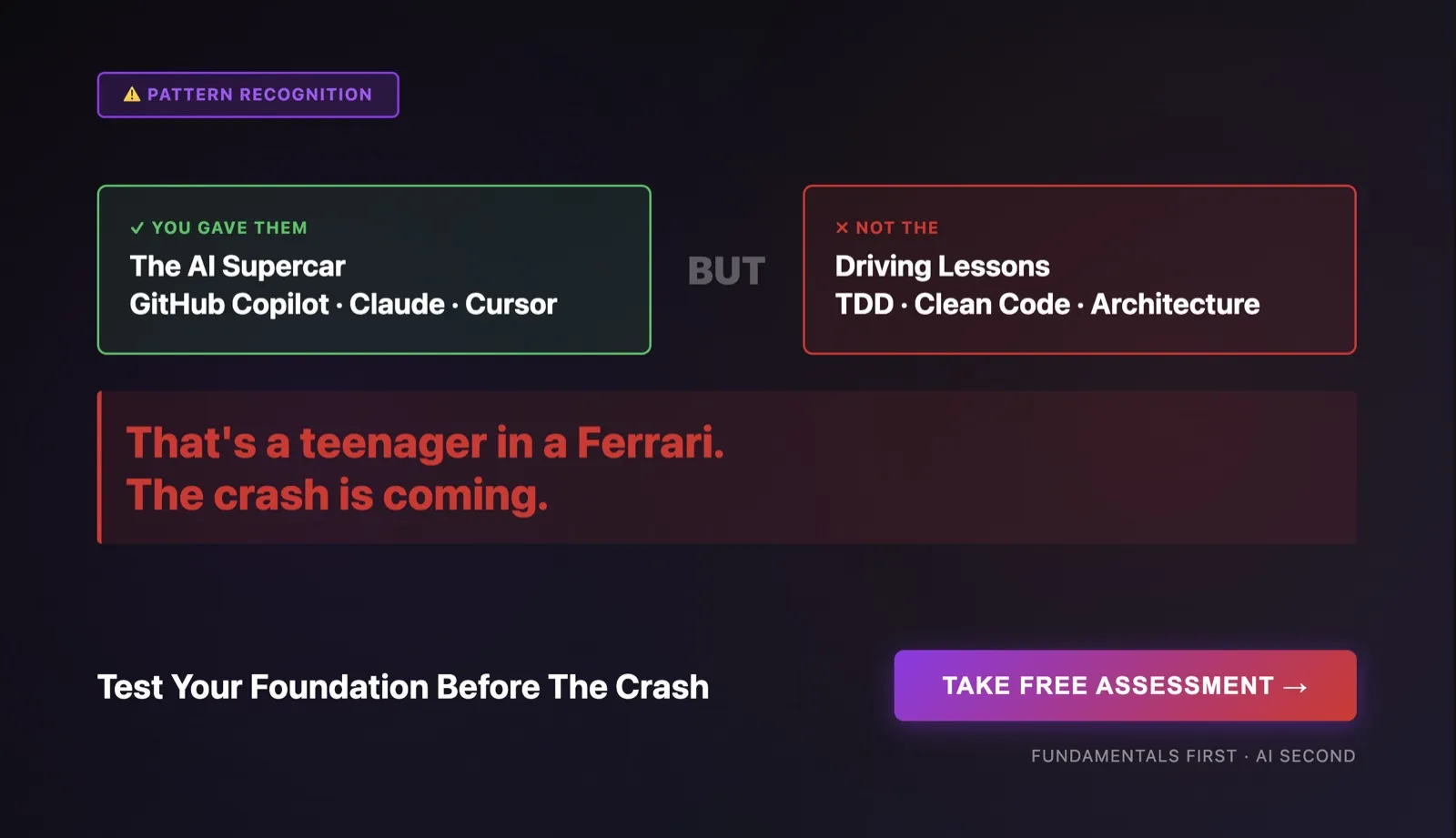
📬 Message me to book your Organizational AI-Readiness Assessment. Clear data. Actionable insight. No fluff. The kind of clarity companies pay thousands for, now available at zero cost. We have only 5 spots available for this 2025 Q4.