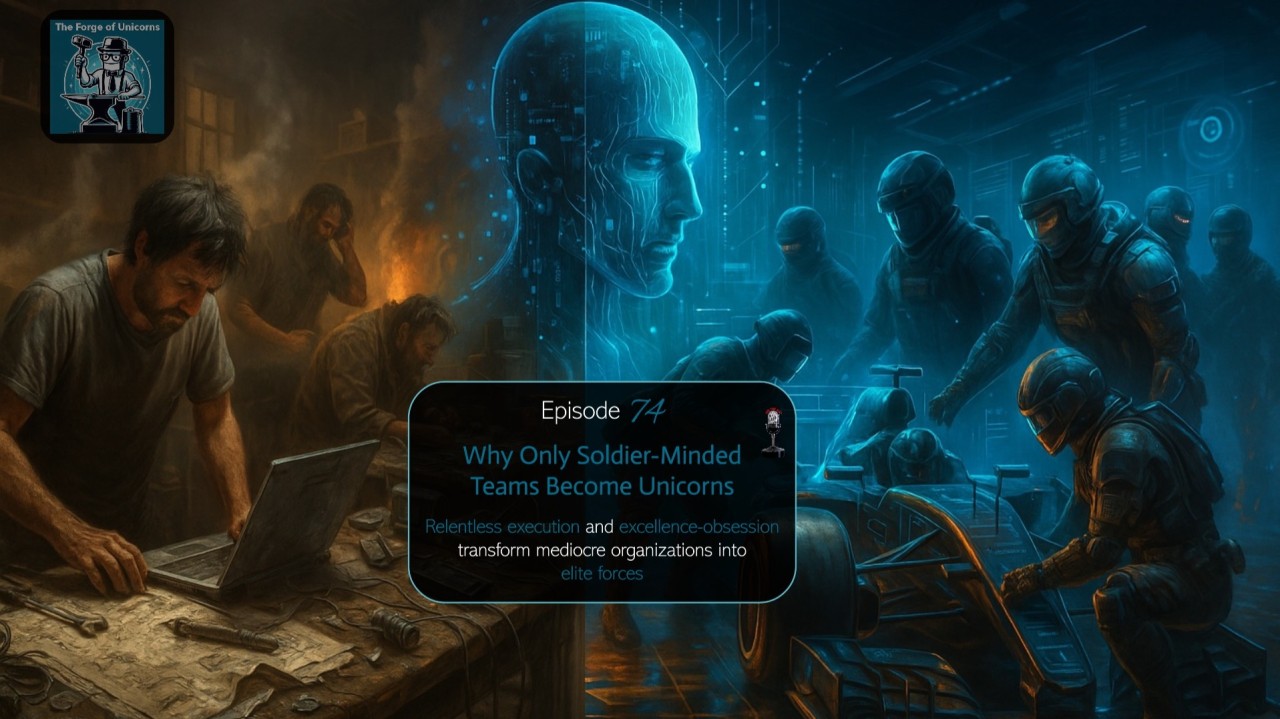
📰 EP74 - Why Only Soldier-Minded Teams Become Unicorns
Hey there, digital warriors! ⚔️
Last week, with Stéphan Donze (CEO AODocs), we exposed a brutal truth: the software industry isn’t just lagging, it’s broken. A culture addicted to frameworks and shortcuts has killed discipline, mastery, and excellence. Most companies are now racing into AI with that same weak foundation, and it’s about to blow up 💥
AI isn’t your savior; it’s your mirror, amplifying whatever lives inside your organization: excellence 🥇 or chaos 📉. And since mediocrity dominates the landscape, the result will be predictable: massive investments, mass layoffs to cover the costs, and a widening gap between those who evolve and those who collapse.
After we showed with Paul O’Brien how venture studios can fill this industry gap for new ventures, this week we bring the missing piece:
how to rebuild excellence inside existing organizations before AI exposes their cracks.
In this episode of Forge 🔥 of Unicorns, Meir Rabkin, Founder & Managing Partner at Blue Vision Capital , reveals how he and his team forged 12 unicorns in just 5 years, and how that mindset can become the lifeline for every company stuck in its own digital & AI transformation.
⚠️ The Framework Mirage: Why Companies Confuse Process with Progress
Let’s pause for a reality check. For decades, organizations convinced themselves that frameworks, scaling models, and playbooks could impose order on complexity. But now AI has shattered that illusion. It doesn’t patch the cracks: it magnifies 🔍 them. It reflects every dysfunction you’ve ignored, every shortcut you’ve taken, every meeting where checklists replaced craftsmanship and excellence. Yet most companies still think salvation comes in the form of an army of developers with the new shiny framework (Agile, Lean, SAFe, OKRs, now GenAI) as if templates could replace the talent gap.
“Companies hire large engineering teams because they want speed and scale, but it’s a double-edged sword. Growth at all costs makes you crater if you don’t hit milestones.” – Meir Rabkin
The truth? Every framework still misses the one ingredient that truly drives success: people trained to master their craft. Without technical discipline, frameworks are like fitness plans built on junk food. AI drives human augmentation, but without a solid foundation, what do you expect it to amplify?
Zero times anything is still zero, and mathematically speaking, when mastery falls below dysfunction, AI accelerates your downfall 📉 instead of your evolution.
I get why you bought those frameworks. They’re safe, measurable, and look great in board slides. Training people feels risky. They can walk away 🚶♂️once they’re trained 👋. But that fear of loss is exactly what’s killing your growth and proper AI adoption. The frameworks and tools you buy can’t compensate for untrained minds or disconnected teams. Investing in technical practices and continuously training your people to think, build, and evolve with AI is the only path to excellence, to leap over the chaos.
And if you don’t believe my math demonstration of your struggles, across every state-of-the-art AI study, organizational performance and ROI only improved in organizations already demonstrating engineering excellence.
So, the real question is this: 👉 Is your team operating on technical excellence, or just hiding behind frameworks and tools?
🪖 The Soldier Mindset: Mission First & Excellence Always 🎖️
Now we see it clearly: those hiding behind processes are mediocre by design. But here’s the good news: this is the turning point. 🎖️ Elite organizations choose a different path. They breathe purpose, move with intent, and train daily like survival depends on it: because it does. Excellence isn’t a one‑off workshop or a playbook on a shelf; it’s muscle memory forged through repetition, feedback, and relentless pursuit of better. This is where the shift begins: from frameworks to flow, from compliance to mastery, from fear to evolution.
“They search for the right people with the right mindset. Then they train them to become the best of the best… this is exactly how a special team in the Army works.” – Mike
They operate like special forces: compact squads, fully aligned, capable of acting under pressure without hesitation, executing with ruthless precision. They don’t just work harder; they move as one, guided by shared habits and intent, clarity, and trust. Psychological safety isn’t a slogan; it’s built through sweat, feedback, and iteration under fire.
These teams don’t manage talent: they forge 🔥 it. They turn individual brilliance into synchronized power. Semi‑gods of execution, trained as superhumans within systems that elevate them instead of breaking them (note: unlike the average organization, where 77% of employees are disengaged and nearly half are burned out).
And that’s the truth most leaders avoid: AI won’t rescue your team from your mediocrity by design; it will expose how myopic your judgment was.
I know it sounds hard, and I genuinely feel your pain after all the sacrifice and sweat you’ve poured in. But here’s the uncomfortable truth we must face together.
Your HR policy on training budgets might be your biggest hidden limiter. If you fear investing in people because they might leave, you’re already bleeding value faster than you can replace it.
So let me help you reframe it with a constructive question, simple yet revealing: 👉 Is your company investing in mastery like special forces, or trusting YouTube tutorials to save you while AI amplifies the chaos of undertrained teams faster than excellence?
Technical Excellence: The F1 🏎️ Mindset
I see your rollercoster to understand today what frameworks have brought in your company, and that your trusted HR department instead of protecting your interests is your silent daily poison. So let me help you to escape this silent killer. Welcome to the Technical Ecellence paradigma!
Like an elite F1 pit crew, unicorns win by reducing behavioral friction and time waste to zero. Every move is practiced, measured, and refined. They don’t chase efficiency: they engineer efficiency obsession.
“Relentless execution beats perfect strategy… winners are those who adapt, iterate, and prioritize speed over perfection.” – Meir Rabkin
In Formula 1, tolerances are measured in microns. Time is counted in milliseconds. Perfection isn’t luck. It’s the science of repetition and feedback. Each pit stop is rehearsed hundreds of times until it becomes pure instinct: 25 people,2.1 seconds, no hesitation, no friction, no failure.
This isn’t passion. It’s discipline forged through obsession. SWAT units, elite organizations, and F1 crews share the same DNA: a commitment to daily mastery, precision under pressure, and systems that enable them to transcend human limits. They train relentlessly, equipped with cutting‑edge technology that transforms feedback loops into fuel for performance. These are not casual workers; they’re professionals who refuse mediocrity.
Now, look at the average software team. Errors tolerated. Bugs fixed “sometime this sprint.” Meetings labeled as alignment while teams remain emotionally disconnected. Rows of coders, heads down, keystroking without purpose. A silent army of untapped potential that AI won’t ever raise. They are humans trapped in a cocoon of dysfunctions greater than their talent.
AI instead rewards the F1 mindset: technical excellence, human precision, relentless iteration, and continuous pursuit of better knowledge. Execution without an obsession for excellence is just busywork, killing all your AI illusions and investments.
I hear your inner question. Your dilemmas are rising to the surface. If my HR department failed, and if my leadership team couldn’t guide us there, how do we turn the ship around and chart a new course toward the star of technical excellence?
✍️ Engineering Your Tech Excellence Culture
Before we dive into how to build technical excellence, let’s pause for a reality check. A clear look at the battlefield we’re all standing on. The data doesn’t whisper; it screams: disengagement and burnout now drain organizations of nearly 10% of global GDP every year. And those traditional “culture initiatives”? Corporate painkillers. Workshops, consultants, and posters about teamwork may soothe symptoms, but the disease spreads quietly in coffee corners and Zoom calls alike. If we want to change course, we need to face this truth first. Only then can we start building the systems that turn people, not processes, into the real engine of AI-enhanced excellence.
Elite organizations don’t buy culture; they engineer it.
No “DevX” buzzwords. No foosball tables. No pizza Fridays. Instead, they build environments where curiosity, pride, and craftsmanship ignite every morning. Discipline and data provide the backbone, but passion is the spark, carefully designed, cultivated, and protected. They don’t just engage employees; they awaken professionals who love their craft and find purpose in continually improving it. In such places, behavioral engineering isn’t a trend: it’s a science.
This is the core principle Meir described as the secret sauce of his 12 unicorns:
Hire the right people, train them relentlessly, and align everyone around mission and mastery.
What his unicorns achieved by hiring top CTOs and leaders from tech giants, our method replicates through design, building that excellence internally when hiring them isn’t an option. A way rooted in two decades of field research, from the paddocks of Formula 1 to the boardrooms of Fortune 500s, starting where every failed transformation ends: at the board level, where technical excellence must be treated as a strategic asset, not a slogan.
“Building a culture of excellence is absolutely key. Like a soldier — you’re extremely driven to achieve that goal, with the right incentives in place.” – Meir Rabkin
A strategy where Key Behavioral Indicators (KBIs) surface dysfunction and ignite the true engine of transformation: OKR powered with a behavioral model. This is not theory, it’s behavioral science in action. Data becomes the nervous system connecting mission to tactics, revealing how individual behaviors compound into collective results. In a world where AI acts as a human amplifier, precision in measurement is no longer optional; it’s existential. This system aligns purpose, execution, and behavior into one continuous stream of daily, measurable excellence, turning insights into action and linking what people do with why it matters. The bridge between human passion and AI performance.
This is the foundation of any predictable behavioral architecture. An adaptive model for forging elite organizations ready to thrive in the AI era, where excellence becomes the norm, not the exception. Continuous active-learning systems like the Software Craftsmanship Dojo® have to evolve into the living heart of this AI transition, turning disengaged coders into high‑performing engineers fluent in both deep technical mastery and socio‑technical collaboration, ensuring humans (not algorithms) stay in command.
With the rise of Software 3.0, we recognized early on that craftsmanship itself had to evolve. After nearly three years of experimentation in the field, our two‑decade‑long research made its own leap forward, to a new generation of AI‑enhanced crafters. Through measurable, data‑driven results with our clients, we certified the discovery many now call Spec‑Driven Development as the cornerstone of Software Engineering 3.0. A way of working where human mastery and AI precision operate symbiotically: AI doesn’t replace the crafters, it becomes the ultimate assistant, amplifying excellence at scale.
This isn’t hype, it’s math, behavioral science, and repeatable performance. The AI-Enhanced Software Craftsmanship Dojo® with its new AI-Coding module is the missing bridge! It enables teams to code, learn, and evolve faster than ever before, transforming software delivery to stand the AI-investments expectations.
Here lies the new standard for Unicorns: a dozen trained engineers equipped with the proper behavioral excellence engine can outperform two hundred disengaged developers drowning in tools and frameworks.
So ask yourself: 👉 how many in your team are true engineers, and how many are just coding?
Because in a world where even unicorns like Instagram, Telegram Messenger, QRFY, or Figma scale on teams of 15 to 30 engineers, the answer should be obvious: it’s not about headcount, it’s about mastery. And if your headcount is far from that number, it means you’re not there yet, and we’re here to help you…
From Zombie 🧟 Armies to SWAT 🪖 Teams
If you’re leading (or trapped inside) an organization racing to deploy AI without true software craftsmanship, you already know the outcome: shipping garbage faster. The elite few do it differently. They master the fundamentals, then unleash AI to amplify excellence.
I see your frustration; years of transformation, endless tools, yet the same disconnection. You don’t need another framework. You need a behavioral evolution to fix your fundamentals. The AI‑Enhanced Software Craftsmanship Dojo® is your turning point, rebuilding your team from within using our battle‑tested behavioral model, the same scientific recipe at the core of Meir’s 12 unicorns.
This is where it begins: from code to craft, from tools to talent. The path to mastery is one message 📨 away. Contact me.
📺 Enjoy the Interview 🍿🍻
🗓️ Next week
Piergiorgio Vittori will tell us how the little David Spitch.ai is capable to beat the tech giants Goliath.