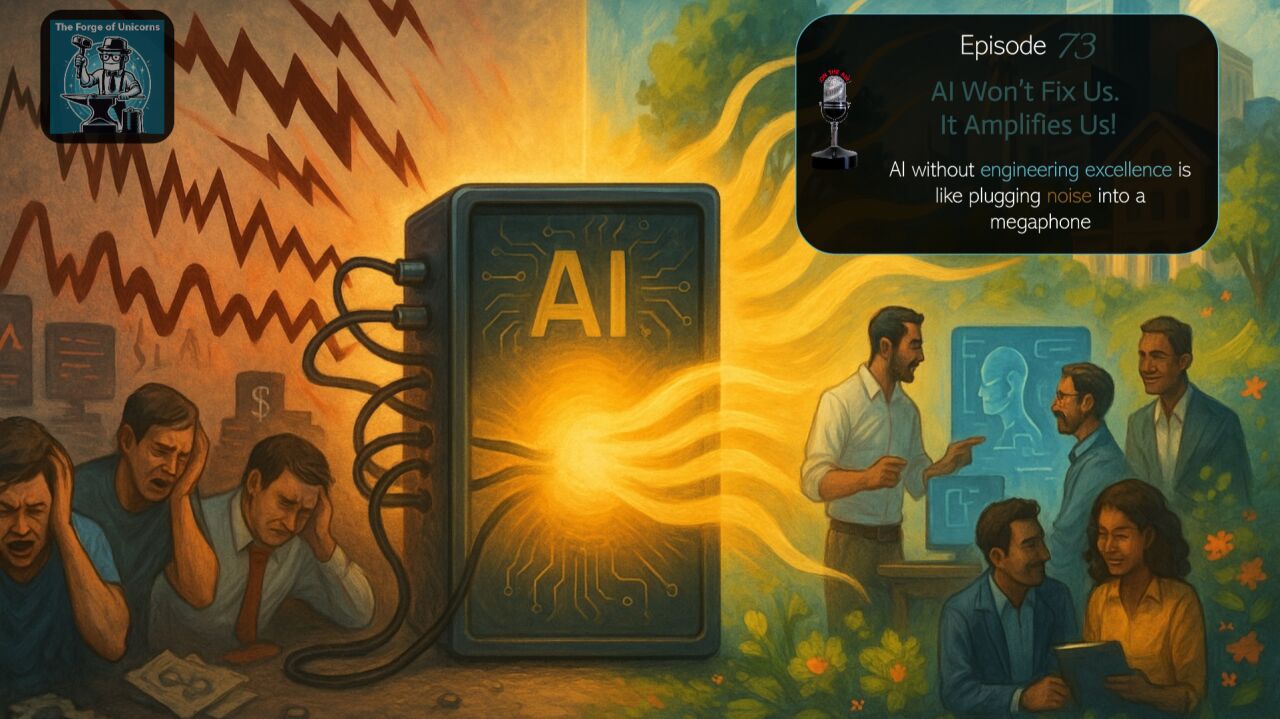
🎙️ EP73 - AI Won't Fix Us. It Amplifies Us!
Hey there, digital warriors! ⚔️
Last week, Paul O’Brien dropped a bombshell:
👉 “AI is a tech disruptor greater than the invention of the internet itself.”
A big statement. And one that captures the magnitude of the industrial shockwave we’re living through. Some even say AI isn’t just disruption: it’s a revolution. But here’s the catch: disruption alone doesn’t guarantee progress.
The 2025 DORA report just confirmed the brutal truth: AI is not a savior. It’s a mirror. An amplifier. 🎛️
If your teams practice excellence, AI is rocket fuel to Olympus. 🏎️💨
If your teams are trapped in mediocrity, AI is gasoline on the fire. 🔥
AI the Amplifier: Confronting the Bias Behind the Numbers
Let’s be blunt: AI won’t fix you. It will expose you.
The 2025 DORA report is crystal clear: AI multiplies what’s already there. Excellence becomes unstoppable. Mediocrity becomes unbearable.
But here’s a twist: even the famous DORA numbers don’t capture the whole picture. Why? Self-selection bias.
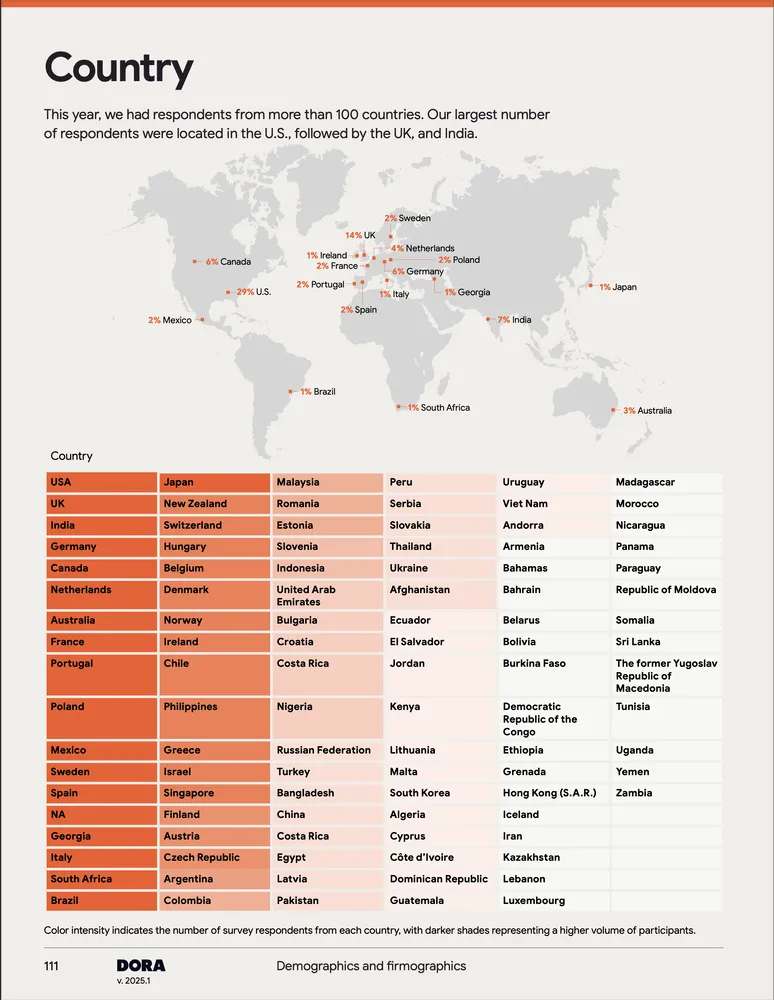
DORA relies on snowball sampling, surveys shared across mailing lists, social media, and professional networks. But who responds?
The Real Plateau of Excellence
Let’s trace the DevOps/DORA data with clear eyes:
- 2018: Elite cluster introduced → 7% of teams.
- 2019: Surge to 20%.
- 2021: Peak at 26%.
- 2023–2025: Flatlined at ~18–20%.
After an early leap, the industry slammed into a wall. For six years, the elite share has barely moved.
And let’s be honest: even those figures are suspect. Today’s claim of 40% sitting in the old “elite clusters”? (note: the new team archetypes 6 and 7, see next chapter) Most likely inflated. Not to diminish the power of the research, DORA is invaluable, but behind the greatness of the research sits a darker truth about the industry itself. And we’re gonna unveil it now 🔦… Every time I step into companies, speak at conferences, or coach teams, I don’t see so “many elite organizations.” I see firefighting. I see shortcuts. I see mediocrity written into contracts where bugs are treated as normal, acceptable, inevitable.
Thus I ask myself, could it be that DORA’s elite numbers are buoyed by the few who strive, while the silent majority of low-performers never reply? I mean look at the map up there. Also, my own experience in over 25 years of spreading software excellence supports it: the clients eager to contribute to the research were high/elite performers. The low and mid performers? Nowhere to be found; they never replied to the survey. 😳 This means the real share of excellence is much smaller than the charts suggest. Despite a decade of science and DevOps breakthroughs, the software industry is stuck in neutral. Mediocrity has become the default operating system.
Prove me wrong: which other industry bakes failure into contracts? Not automotive, not aerospace, not nuclear or civil engineering, not healthcare. You buy a washing machine with a 10-year warranty, but a mobile app almost guarantees daily bugs. Even industries once known for reliability are crashing against software mediocrity: BMW i-series cars stopping on the road after failed over-the-air updates; VW’s €20B Carid fiasco closing factories. Try getting liability insurance for a software house at a fair price: good luck. Can we have in an industry like this, so much greatness how the respondent in the DORA surveys are showing up? Difficult to say and to believe…
And this opens the pandora’s box, because software, the backbone of our lives and the kernel of AI itself, is broken at the DNA level because the industry abandoned the scientific cultural rigor and practical discipline of the 1970s for hype, ignorance, and tool-worship.
We should thank powerful research like DORA for holding up the mirror, IT Revolution for the Accelerate best sellers, and all the other research, showcasing how science can be applied to software. But leaders must open their eyes:
without returning to treat software as an engineering discipline, not a playground for subpar professionals, every dollar invested in AI is wasted.
This isn’t just another tech trend. It’s the most powerful human advancement since the invention of fire. And right now, we’re letting it burn us due to the industry’s overall behavioral ignorance.
If we’re lucky, maybe 10% of those 20% of organizations can work as disciplined engineering teams. The rest? Still trapped in firefighting and mediocrity. So here’s the question we must face: how long can an industry built on such fragile foundations continue to function, and what unwanted effects will working in these environments have, not only on humans but on humanity itself?
The Human Cost of Mediocrity: Burnout, Friction & Lost Talent
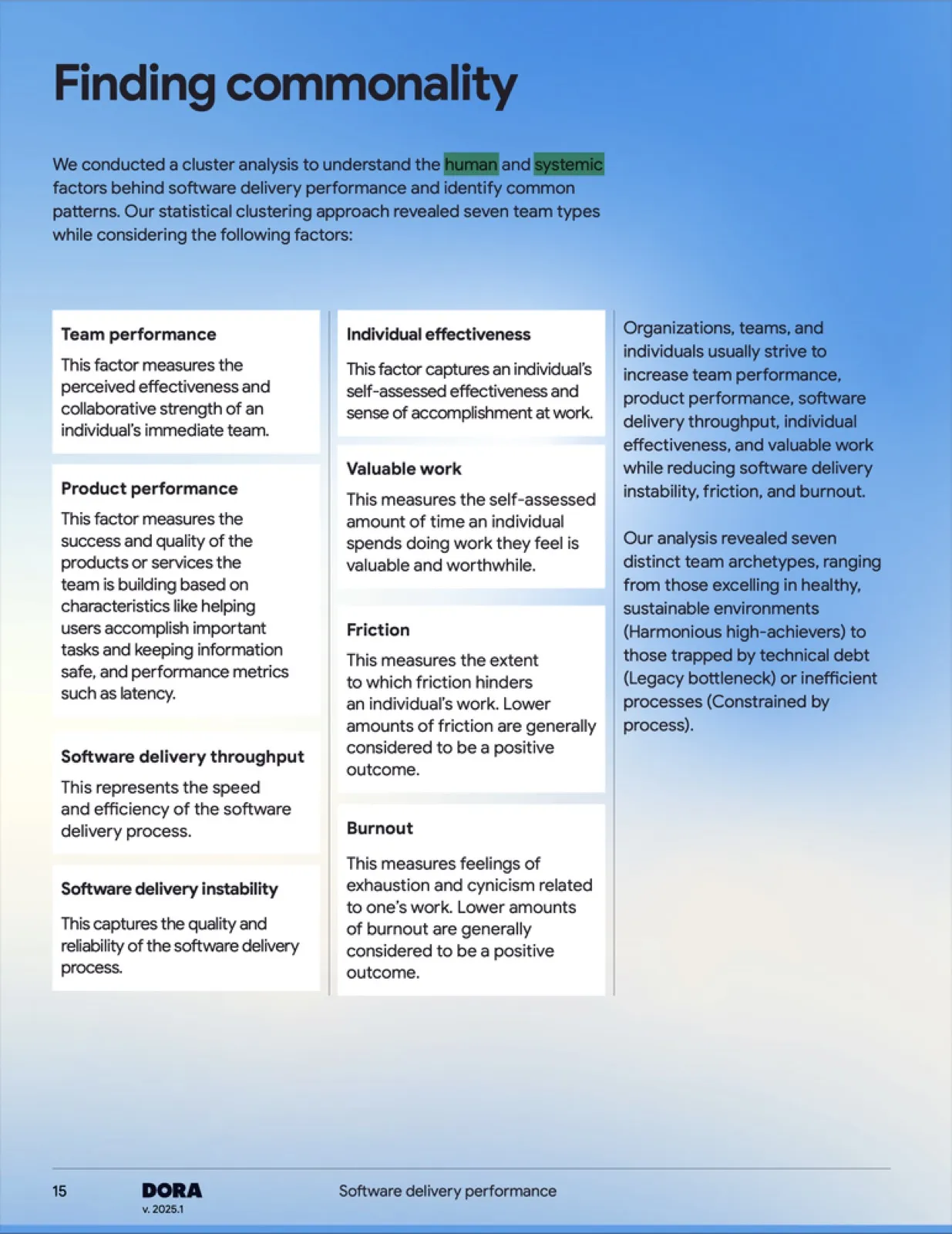
Here’s where it gets truly uncomfortable. The 2025 DORA report didn’t just measure deployments and lead time. It elevated team well-being as a core metric. Burnout, friction, and individual effectiveness now sit alongside throughput and reliability. Hard proof that low-performance environments are as much human as they are technical. Stephan and I called it out:
the blind obsession with speed is the root sickness of the software industry. Accelerate warned us in its very first chapter.
Seven years later, AI is everywhere, and the gorilla in the room is back, louder than ever: team well-being.
And it exposes a brutal imbalance in how we measure reality:
- Systems are tracked with real-time automated observability.
- Humans are reduced to self-reported surveys… 😱
Engineers are asked: Have you felt burned out? Cynical? Ineffective? Did work damage your personal life? These are validated constructs, but they’re fragile compared to how we measure CPU cycles or defect rates. Fortunately, Gallup and Infinite Potential are pairing DORA with staggering well-being confirmation:
- 77% of employees (even managers) are disengaged.
- 44% of employees suffer burnout.
This means we can no longer pretend human debt is invisible. Roughly 80% of the labor force is showing symptoms directly tied to low performance, validating my claim that selection bias inflates the DORA elite. If 20% are reported as elite, yet four out of five people are disengaged or burned out, can we really believe the Olympus is that crowded? I leave it up-to-you to decide…
But, DORA went further this year with its archetypes spider map, making the human impact visible and undeniable: seven clusters that expose the massive social and organizational cost of neglected well-being, even as AI nudges systemic metrics forward.
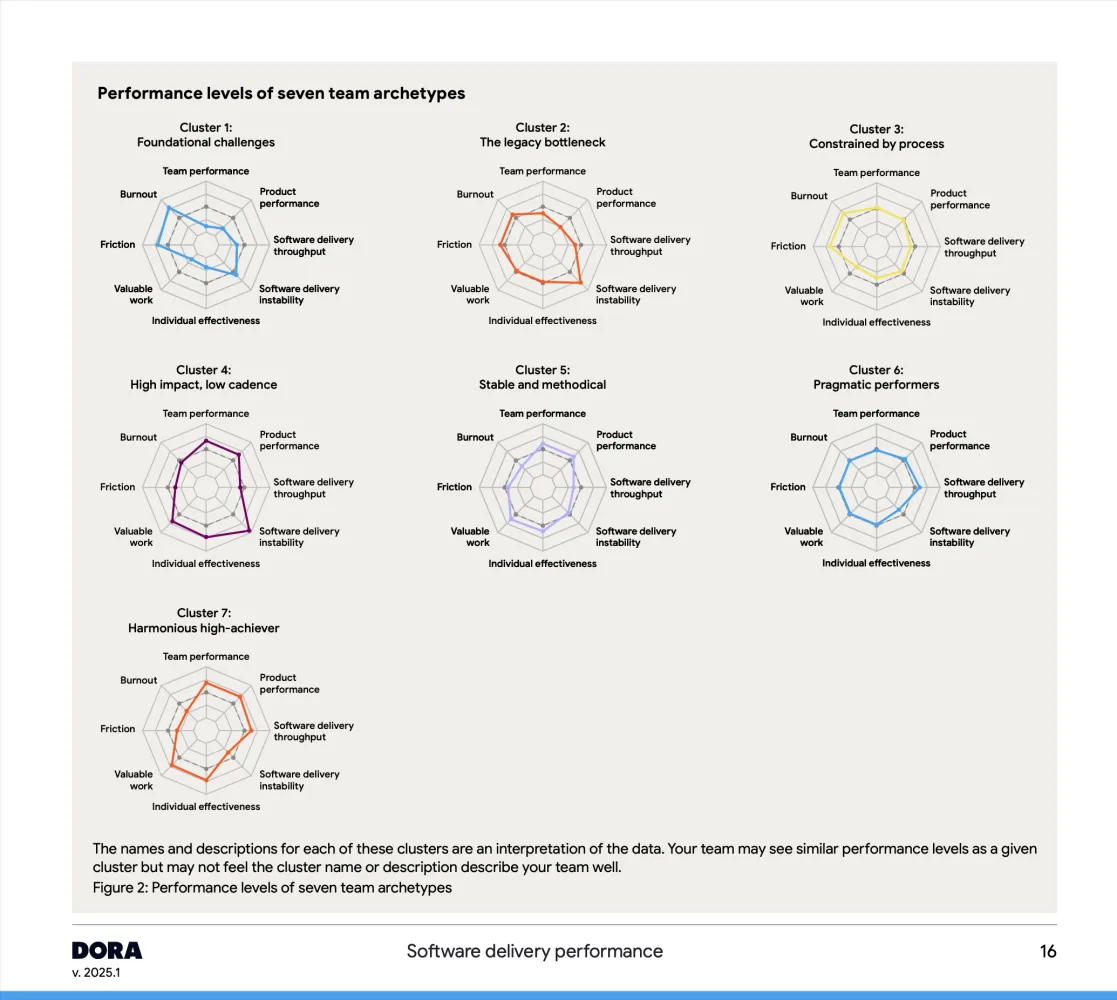
AI cannot repair broken processes or erase toxic cultures. It exposes them: biased hiring, despotic control, command-driven organizations. And this is the hidden bill of mediocrity amplified 📣:
- Burnout as the KPI of dysfunction.
- Friction as the daily drag.
- Talent loss as the final invoice. Top engineers won’t stay in environments where chaos scales faster than mastery. They disengage. Or they leave. And you’re left with tools, noise, and empty chairs.
Without technical excellence, leaders aren’t just failing at delivery. They are designing burnout into their organizations.
And the sad truth? Most DevX programs still answer with free snacks, soccer tables, and façade fixes instead of structural, holistic programs that help people embrace AI while repairing the gaps between the chair and the keyboard.
How long can IT leaders keep pretending these band-aids are enough, and what will be the true cost to our people, and to humanity itself, if we don’t act holistically?
Path Forward: Engineering Excellence 🥇 or Extinction 🪦
So what’s the way out?
Let’s be brutally honest: technical excellence is not optional anymore. It’s survival.
Look at the numbers:
- Fewer than 5% of teams practice TDD and XP; the truest proxy for elite behavior.
- Only 3% of candidates can complete a basic TDD kata.
And yet leaders expect AI to deliver transformation just because investors poured another round of cash into the AI bandwagon? That’s not strategy. That’s denial. It’s blind gambling ignoring three decades of IT failures and the countless books written on how to avoid them.
So let me state this loud and clear:
👉 Without professional software engineering, you are only amplifying failures!
You’re amplifying dysfunction, chaos, burnout, and talent flight. Exactly the opposite of what you were hoping for. For years, impostor leadership could hide behind the old mantra: “Fix something, take the glory, and leave the mess for the next one.”
But now that caviat is broken. AI forces every leader to face the mirror. The old trick of fixing fast, cashing out, and running won’t work anymore. This time you can’t leap away, because what you’ll leap into is a bigger, louder, more public disaster. For the first time, you have no exit ramp. You must stay. You must fix. Not with consultants slapping plaster on a broken leg, but with a real cure, because the harsh truth of AI’s impact is this down below. No magic leap, only amplification of what you have in place.
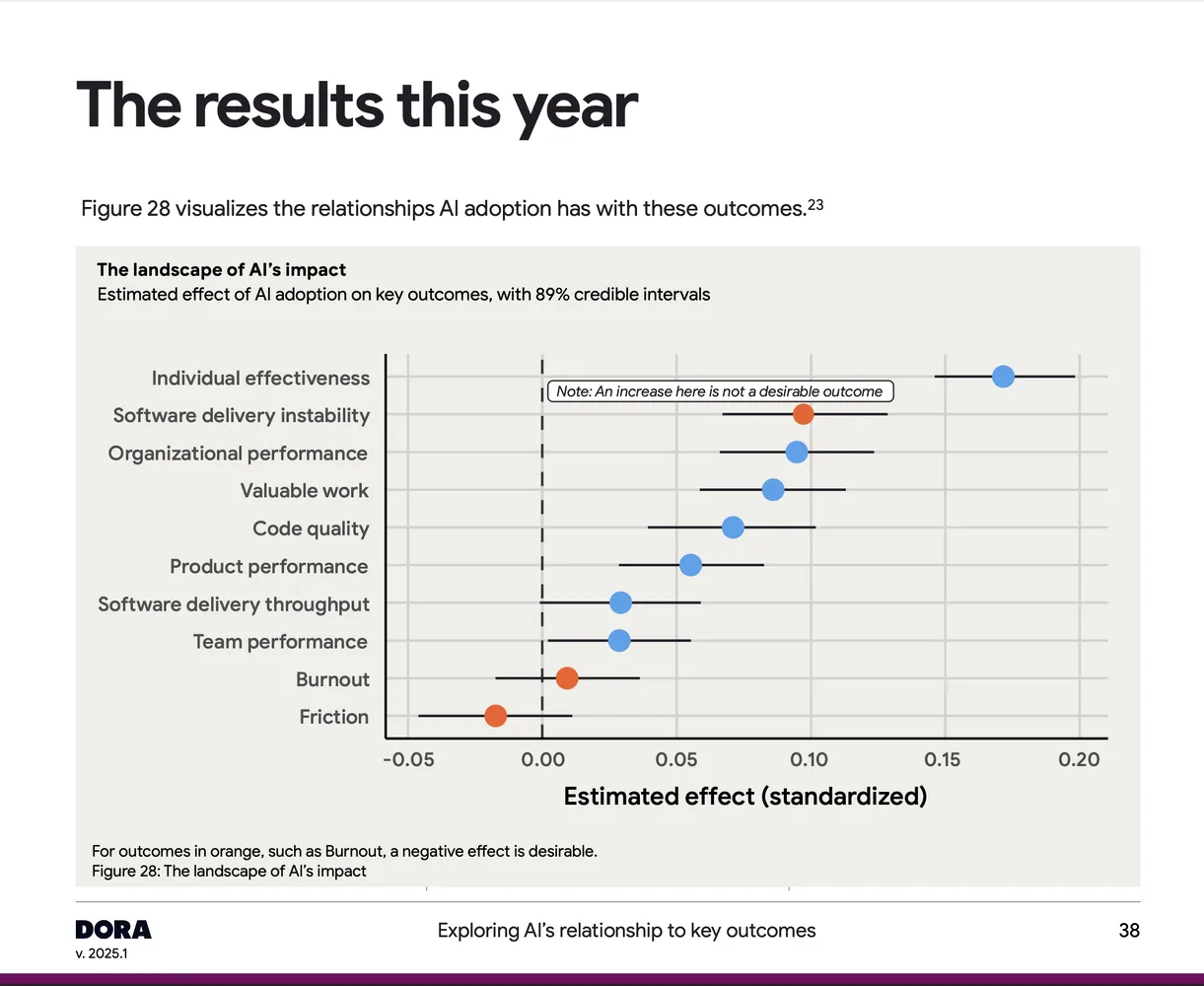
So buckle up and lean in for the next two minutes, because what comes next could change how you lead, how you invest, and whether your company thrives 📈 or collapses 📉.
Excellence can be designed.
It can be taught.
It must be practiced.
And yes, it can be scaled in a predictable way. How? 🤨
- Inject technical behavioral excellence with asystemlike the SW Craftsmanship Dojo® → a neuroscience-driven program to re/up-skill and evolve people technically and socially, building product people and engineers equipped with the behaviors of elite performers. Amplify excellence; goodbye mediocracy!
- A modern strategy execution framework aligning vision to measurable behavioral outcomes like BOKaRy → the behavioral-OKR system every modern organization needs, aligning boards, teams, and investors on measurable purpose and outcomes. A unique way for engineer ethic-human-centric organizations obsessed with customers and people. Ready to amplify engagement: goodbye burnout!
- Holistic AI and Human feedback loop with neuro-coaching & active-mentoring → pairing leaders, product people, and engineers to rediscover creativity, discipline, and the craft of working with AI as true engineers, not passive dumb prompt operators. Forget hallucinations: welcome behavioral engineering applied to LLMs to create a self-hallucination prevention loop!
This is an AI survival model, the outcome of two decades of research on top of all these giants, designed for leaders who want to thrive in the AI era instead of burning out in it. This is the Unicorns’ Ecosystem, the research stretching from investors to customers, covering the very essence of the software industry. The neglected discipline we rediscovered in true engineering, forged in high-stakes environments where every decision and millisecond matters.
🌱 When you stop wasting money amplifying chaos and start investing in modern software engineering mastery, paired with the creativity only true crafters bring, AI becomes what it should be: a multiplier of excellence.
Closing Reflection
So here’s the final question, CEOs and leaders:
When AI amplifies your teams, what will it reveal? Excellence or mediocracy?
The contrast is stark.
When the mirror of AI shows you the truth, you don’t have to feel overwhelmed! A lot of people, real researchers as showcased here, can help you amplify the excellence that is inside your company! Being supported by science and data isn’t a failure; it’s a smart decision. Don’t feel alone, contact those who have demonstrated in the last decades how to build human-centric software organizations like us and all the other crafters out there in the field.
Fuel for the Forge 🔥 - Who Made This Possible
Before wrapping up, I want to forward my deepest gratitude to:
- Stéphan D.onze, for being an outstanding guest and a true geek at heart, diving with me into delicate topics only a few dare to tackle.
- IT Revolution& Gene Kim, for their relentless work in reminding us what disciplined software should look like.
- DORA & Nathen Harvey, for a decade of rigorous research that keeps holding the mirror to our industry.
- Gallup, Infinite Potential, and countless other researchers, with more than 40 papers have guided my thinking through these turbulent years of the AI tsunami in software.
Without all of you, this conversation and the insights it triggered wouldn’t have been possible. 🙏