🎙️ EP71 - Why Running a Company on Science Prevents Software's Wild West
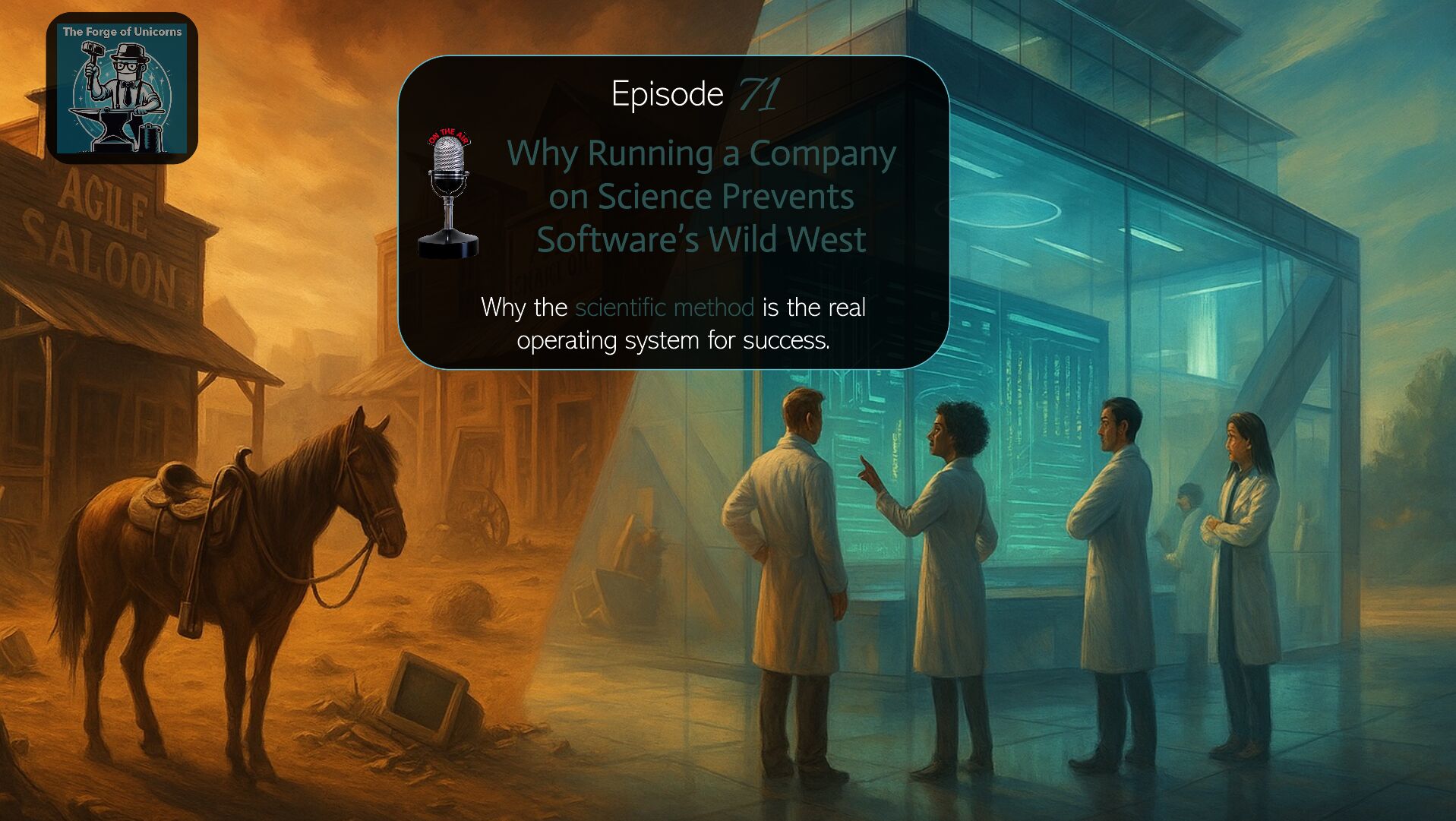
Noël Bauza reveals why the scientific method —not Agile frameworks or AI buzzwords— is the real operating system for success.
Hey there, digital warriors! ⚔️
SubscribeLast week, we showcased the venture studio recipe and the camel startup model—organizations engineered to survive harsh times thanks to their ability to use data to 360° improve.
This week, the dilemma sharpens: where are the data in the software industry? If aerospace, food, and healthcare all demand rigorous standards, why is software—the backbone of every modern company—still left without them? And what does that mean for leaders trying to steer their organizations through Agile hype and AI noise?
In today’s episode of Forge of Unicorns, 🎙️ we have another “in the head of a CEO” conversation with Noël Bauza and his company Zei, focused on ESG (Environmental, Social, and Governance—a framework for measuring a company’s environmental footprint, its social impact, and the way it is governed)—where data are at the center of everything.
Noël reveals:
-
☝️ why companies collapse without data, and why the scientific method is more than a tool
-
✌️ it’s the only operating system for leaders who want to evolve with clarity and confidence
🕵️ Exposing the Chaos
When you build a bridge 🌉, there are safety codes 👷🏻.
When you design a car 🚗, there are crash tests 💥.
When you serve food 🍲, there are health inspections ⚕️.
But when you launch software, the very infrastructure that runs our banks, hospitals, transport, and communication, there are no universal quality standards. None that truly ensure product quality. In fact, most of us click “I agree” on terms and conditions that openly admit the product may be faulty.
Noël shook his head at the absurdity, then dropped a thought‑provoking line:
“Without data, we are not an intelligent species.”
Think about that for a moment… 😱
In software, we’re not as smart as we like to believe. Despite pouring billions into Agile frameworks, DevOps pipelines, and now AI systems, 90%+ of these digital initiatives still fail or deliver close to zero impact.
Why? Because the industry keeps swapping data & science for subjective ratings, vanity metrics, and gut feelings.These serve providers more than customers; and they rarely move the needle.
Software escapes accountability because there are no enforced quality benchmarks in engineering. The result? Organizations are building on hope and sand. CEOs, boards, and investors make high-stakes bets on systems they can’t fully validate. Even tech advisors can only go so far before operational cracks expose just how fragile things are.
It’s a hard truth, especially for CEOs who see their company as their baby, but ignoring it isn’t just inefficient. It’s reckless.
So here’s the million-dollar question: how do we shift from biased decisions to data-driven ones?
🔬 Enter the Scientific Method
So what’s the alternative? Noël Bauza argues for something deceptively simple yet radically powerful:
run your company like a scientist.
It’s how he runs Zei, and it’s exactly what our research confirms is the most effective way to withstand digital and social disruptions.
At Zei, the process is clear: 1️⃣ Formulate a hypothesis grounded in real data. 2️⃣ Build a minimal version to test it. 3️⃣ Collect new data from the field. 4️⃣ Iterate based on what the evidence shows.
It’s the same approach any scientist would follow in the lab. It’s the same feedback loop that fuels Extreme Programming, Test‑Driven Development, and other evidence‑driven practices of modern software engineering. Now expanded to the entire organization.
The beauty of the scientific method is that it anchors decisions in reality, not wishful or emotional thinking. No CEO can predict every market shift or customer reaction. But a leader with continuous data gathering, weekly hypotheses, and disciplined iterations isn’t gambling anymore. They’re learning, adapting, and moving forward in the right direction. Protecting their most valuable assets: customers and products.
This isn’t agility as theater 🤡. It’s Agile, DevOps, and AI treated as ingredients, integrated by science to prevent organizational rejection. And unlike a quick fix or a drug masking symptoms, this works only when people embrace it, subscribe to it, and move with it.
I can already sense some of you nodding skeptically, thinking: We tried this and failed. The real question becomes: how do we finally turn this storyline into reality?
🔭 The CEO’s Operating System
Zei itself is living proof of concept. By making ESG data transparent to every employee, even interns, Noël built a culture where anyone can spot issues, propose improvements, and act on them. Transparency stopped being about compliance and instead became empowerment. Data didn’t just measure, it sparked awareness and unleashed creativity.
The more transparent and connected the synapses, the smarter and faster the system becomes. Think of it like neuroplasticity in the human brain, the ability to rewire connections under pressure and learning, which is the very foundation of human intelligence. Organizations follow the same rule: empower the connections, and collective intelligence multiplies.
Noël, passionate like me about neuroscience and behavioral engineering, shared an observation that mirrors our own research:
“Any organization of humans works like a brain. You have the individuals, the neurons, and you have the communications between the individuals; the synapses. The brain isn’t smart because of the neurons, it’s smart because of the interconnectivity of the neurons.”
For CEOs, this isn’t just a shift in leadership style. It’s an entirely new operating system. The scientific method becomes a repeatable way to test, adapt, and evolve across every domain: from ESG compliance to product innovation to company culture. It’s the key to distinguishing whether people align with the mission’s purpose or are only there for the paycheck. It empowers experts to launch hypotheses that, once tested, can become either the bold maneuver that sails a company through a storm, or the reckless bet that would have sunk the ship (if it hadn’t been caught in time as just another experiment).
Now that we’ve seen the recipe for science‑driven organizations is not only possible but powerful, the real dilemma emerges: how do we make it work in practice?
And you know, I won’t leave you with dilemmas… only with thought‑provoking awakenings.
⚙️ The Operating System
But here’s the bigger leap: how do you scale this mindset inside any company? Over the last decade we’ve been experimenting with exactly that question. Researching, prototyping, and stress‑testing in environments that range from fragile startups to giants like IBM. What emerged isn’t another management fad or a shiny new tool. It’s a recipe for embedding the scientific method into governance and leadership, validated again in Noël’s story.
We discovered that most organizations get OKRs wrong. The result? Targets that rarely spark meaningful transformation.
Now imagine OKRs redesigned through a behavioral lens: objectives that nudge people forward instead of boxing them in, key results turned into fertile ground for experiments framed as hypotheses, and weekly cycles that produce evidence instead of empty slogans. Tie this to shared purpose and track it with a predictive social‑behavior model (because every action triggers reactions at scale), and suddenly OKRs stop being hollow theater. They become the compass and map leaders have been missing.
This approach changes the ‘interconnectivity of the neurons’ of a company:
People frame fast‑feedback hypotheses inside their OKR cycles.
Teams test them, and results are seen through anm expert behavioral lens.
Experiments that clash or create dysfunction are openly ditched, while those that spark unity are refined and scaled.
Outcomes align with purpose, values, and ROI. What matters isn’t whether the needle moves by 0.1, 1, or 10. It’s knowing that it moved, understanding why, and learning how to push it further in the right ethical direction.
With every cycle, the organization sheds what doesn’t work, doubles down on what does, and shifts closer to the goal everyone opted into. Making it resilient under pressure.
It’s not a framework or a blueprint. It’s a living system that evolves with each experiment, growing stronger and smarter over time. The proof is there, in our research, in the fieldwork, and in the voices of CEOs like Noël who run their companies like scientists.
The missing compass and map for organizations to stop flying blind.
🗺️ Find your map and the compass to navigate it 🧭
The message from this episode is simple:
Suppose you adopt the scientific method as your company’s operating system. In that case, you stop guessing and start evolving with purpose—hands steady on the helm, steering through the storm with knowledge as your compass and the full crew aligned, fighting with you instead of against the waves.
This is exactly the ground our research has covered for more than a decade, and what we now call BOKARY. A unique platform that unites OKR expertise with advanced tooling and the social‑engineering insights of our KBI (Key Bohavior Indicators) model. It helps organizations know upfront what to measure (over 160 traits), how to read movement in the data, and how to turn experiments into predictable evolution. Born in the software industry yet designed to fit any field, it addresses the universal challenge: transforming human passion into purpose‑driven organizations that navigate storms with data and science. Forget gut feelings and boardroom bets.
We know you’ve invested serious money, time, and energy into OKRs, but are they truly shifting the behavior of your people to hit those ambitious goals?
If you’re not sure, let’s talk…
📺 Enjoy the full interview 🍿🍺
✨ Next week…
Our special with Paul O’Brien, economist and startup ecosystem strategist, will join me in a thrilling discussion around how venture studios can reshape entire economies.
The week later, a new episode of “In the Head of a CEO” featured another successful SaaS company, AODocs, and its CEO, Stéphan Donzé.
To stay in the loop with all our updates, be sure to subscribe to our newsletter 📩 and podcast channels 🎧:
Subscribe on Substack Subscribe on LinkedIn Subscribe on YouTube Subscribe on Spotify Subscribe on Apple Podcasts