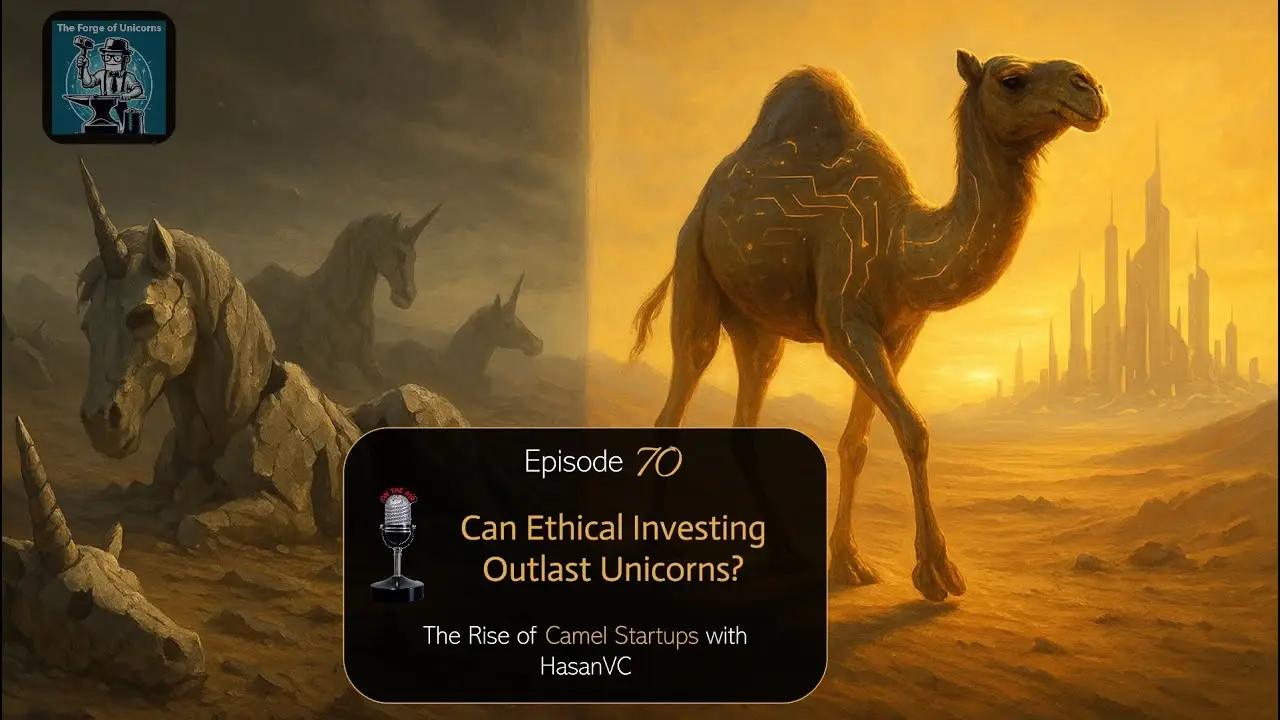
🎙️ EP70 - Can Ethical Investing Outlast Unicorns?
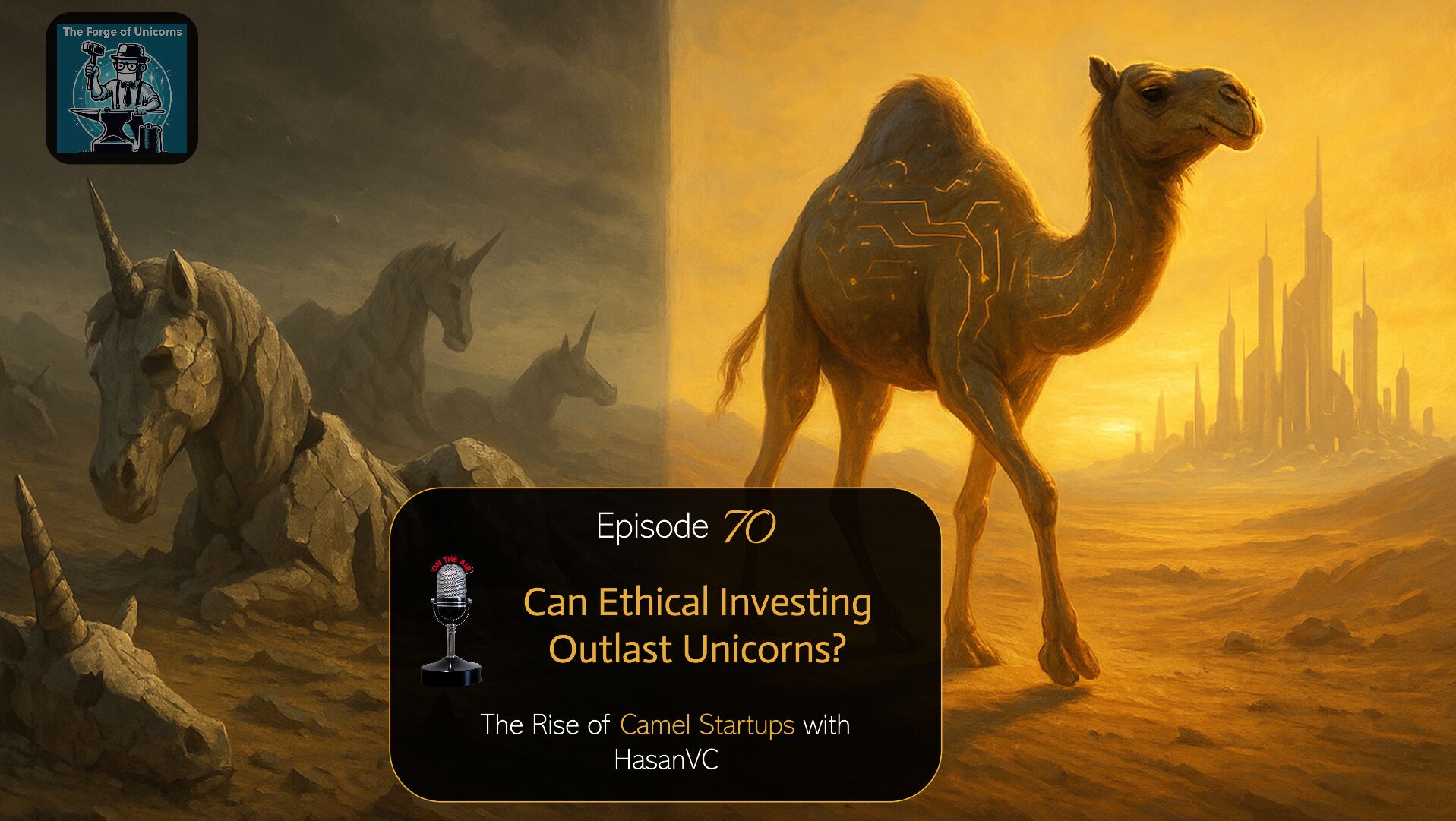
🐪 The Rise of Camel Startups, and the Venture Studio revolution with HasanVC
Hey there, digital warriors! ⚔️
Stay up to date.Last week, we sat with Tyler Robertson, CEO of Diesel Laptops, to uncover how deep domain knowledge and customer obsession can outmaneuver giants. He built a $100M SaaS company with zero investors. A story that exposes how broken today’s funding logic really is. 😱
Because let’s face it: the software industry is sick. For decades, the market chased unicorns. Rare, mythical beasts that promise hypergrowth but leave behind a graveyard of failed ventures. The stats are shocking: 97.5% of startups never reach unicorn status, and only 1.25% manage to hold it for more than a year.
So maybe the problem isn’t just bad execution. Maybe the financial model itself is killing software, and the market is fueling the sickness by sustaining the crazy idea that you can cookie‑cut the unicorn model and hope to become one. But gluing a horn on a donkey doesn’t make it a magical creature.
Thus, we are here with a dilemma.
Why are those unplugging from banks and investors more likely to survive?
Buckle up, because today we enter the camel 🐪 model. An organization engineered to endure harsh markets, adapt when storms hit, and seize opportunity at the right moment. Not magic. Engineered survival.
Together with Umar Munshi, CEO of HasanVC, we explore why camel startups are more than a metaphor. They’re the blueprint for a new investing model. And we ask: can ethical investing rooted in Halal principles outlast unicorns?
Let’s find out! 👇
1. The Myth of Unicorns (and the Graveyard Left Behind)
Unicorns have always been the investor’s dream: the rare startup that explodes into hypergrowth. But here’s the cold truth, they’re mythical for a reason.
Less than 2.5% of startups ever reach unicorn status, and even those that do often collapse under the price of their own hype. The graveyard is filled with once-celebrated names that burned billions, exhausted founders, and left investors holding the ashes, along with thousands of families suddenly fired or laid off, creating social and governmental crises in the wake of dying unicorns or those who only tried to become one.
The narrative sold to boards and Limited Partners (LPs) is seductive:
spread bets across the portfolio, hope one or two wins pay for the rest. 🤑
The question facing investors today is unavoidable: will you keep chasing unicorn myths and tolerating a ~99% failure rate, or start asking what engineered survival really looks like?
And here it’s worth noting: there are indeed two resilient models on the table. Cockroach startups and Camel startups. Both endure, but in very different ways. Cockroaches thrive through extreme frugality, tiny teams, and quick pivots. They survive at any cost. Camels, instead, balance growth with sustainability, maintain reserves, scale only when the environment allows, and put customers and purpose at the center. One model clings to life. The other is engineered to cross deserts and build a future.
2. The Rise of Camel Startups (Engineered Survival)
Enter the camel. 🐪 Unlike unicorns, camels aren’t mythical. They’re built for survival in the harshest conditions on earth. They can endure storms, conserve energy, and move steadily forward until the moment comes to seize opportunity.
As Umar Munshi explained:
“Camels survive in the toughest of environments… that is one of the characteristics we look for in a startup. A company that can go through difficulty, survive the harshest conditions, and catch opportunities when they come.”
A camel startup isn’t a company that burns bright and disappears. It’s an organization engineered to last:
Resilient enough to outlive market crashes.
Disciplined enough to grow when the timing is right.
Purpose-driven enough to create real business value and deliver world impact.
Technically excellent enough to uphold high engineering standards and avoid shortcuts.
Or, as Umar put it:
“It’s not magic. It’s hard work, discipline, cooperation, putting skin in the game together.”
HasanVC’s venture studio model proves the point: starting at zero, validating ideas, co-creating with founders, and only then moving into execution. A hands-on phase where founders are supported across all aspects, from product and technology to governance and culture (as we’ll see in the venture studio concept showcased later).
The message is clear:
Camel startups are not accidents of nature. They’re engineered survivors.
3. Why the VC Power Law is Broken
What if the real winners of the VC Power Law aren’t the investors or the startups at all, but somebody else? 🤔
The so‑called power law tells VCs to spray money across dozens of bets, accept that nearly all will fail, and pray one or two deliver outsized returns. But here’s the twist: the real winners of this model are the markets selling tools to sustain hypergrowth with blueprints like Agile™, DevOps™, and AI, and the monopoly giants of cloud pushing ‘low‑cost’ infrastructure that later strangles the majority of startups in their growth phase. 😳
Both sets of winners have one rule: keep investors and founders ignorant about how software is truly built, creating a dependency on their products that becomes addictive and almost impossible to unplug once implanted.
As Umar warned:
“The VC model… pushes founders to look for shortcuts. It pushes them to focus on hype over substance, growth instead of the business model, revenue instead of profit. And the line between what’s ethical and what’s not becomes blur.”
Layer AI hype on top, and the danger multiplies. AI is a powerful accelerator, but as Umar put it:
“When you have a fast car, it’s dangerous. Especially if you’re not ethical… when you have a supercharged car and you don’t care about other people, it’s going to be even more dangerous.”
This is where HasanVC departs from the mainstream. Their foundation rests on halal ethical principles: fairness, shared prosperity, and intentionality (niyyah). Profit is not pursued at any cost; it must align with purpose and the well-being of people. In that paradigm, investing is not a gamble but a responsibility.
The power law may have built Silicon Valley’s past, but it cannot engineer its future. The next chapter belongs to Camel Startups, and the venture studio model that transforms ethical investment into a disciplined way of building resilient companies.
4. The Venture Studio as a New Model
In the past, numerous attempts were made to patch or improve the broken power law, aiming to raise the success ratio, but these efforts still revolved around the same flawed premise. The result? Even the most celebrated initiatives ended up exposing their limits:
Incubators are like nurseries, nurturing raw ideas, often through R&D, before they even become products.
Accelerators take startups with some traction and apply a rapid, “cookie-cutter” program to push for scale. But here’s the paradox: a startup by design is supposed to be a disruptive organization, challenging the status quo. By forcing them through standardized playbooks, accelerators strangle out-of-the-box thinking and seriously limit their success ratio.
This scenario paves the way for a new model: the venture studio. It doesn’t just mentor or fund: it builds from the ground up. Studios create companies in-house, supply the founding team, validate ideas, and provide the resources to move systematically from zero to one.
As Umar explained:
“In a venture studio, we start at zero. From zero to one, we co-create with founders — doing research together, validating ideas, solutions, and only then starting to build.”
Instead of gambling on hype, venture studios provide a systematic environment where resilience is engineered from day one. Founders are guided and supported, not abandoned. Growth matches timing and capability. Purpose anchors every decision.
For investors, the takeaway is clear: a venture studio isn’t an incubator or an accelerator. It’s an operating system for building organizations. A disciplined framework where survival, success, and scalability are engineered, not left to chance.
5. The Unicorns’ Ecosystem: The Operating System for Studios
Camel startups prove that survival isn’t magic: it’s engineered. Venture studios are where we build them. But how do you systematically design success so it doesn’t rely on luck, charisma, or heroics?
That’s where the Unicorns’ Ecosystem comes in. It is not just a research model, but a full operating system for venture studios: the discipline behind building software companies that last.
The system works in two layers:
1️⃣ The Governance Layer (BOKaRy)Resilience without vision and governance is just stubbornness. BOKaRy brings together three essential components: OKRs (Objectives & Key Results), KBIs (Key Behavioral Indicators), and the ShuHaRi practice mastery model:
-
OKRs: keep strategy visible and aligned.
-
KBIs: track behaviors — how teams actually act under pressure.
-
ShuHaRi: a discipline and practice mastery model that kills ego and bias, grounding growth in experiments, data, and continuous improvement.
Together, they create a needs-scape: a governance room grounded in over 2 decades of research around the KBI model of what good looks like in software. It makes every organizational need visible, measurable, and data-driven (more predictable and actionable) from the ground level of humans and teams, to the organizational layer, and up to the board and investor level, cutting through market hype with factual insight.
2️⃣ The Habitat LayerStartups need environments where people thrive. The Ecosystem creates this habitat through:
-
Dojos: continuous active learning rooted in neuroscience and behavioral psychology.
-
Communities of practice: mastery, empathy, and social contracts.
-
Human-centric culture: fulfillment over burnout, intention over blind blueprints.
The result? Investors don’t just see financial outputs; they see and correlate the behavioral patterns that drive outcomes, and they can act before dysfunction spirals into collapse.
For boards and PE/VC leaders, this is more than a venture studio. It’s how you align your portfolio and investment strategy with predictability, purpose, and profit, and finally stop betting on unicorn myths like gamblers at the track.
Now you know. And now you must act
You’ve seen how the unicorn myth fails, how the power law drains billions, and how camels build in venture studios endure. The question is no longer if you should act: it’s how fast. Every month of delay compounds dysfunction, erodes ROI, and puts your teams at risk.
Here’s how to fix it right now:
-
Open https://bokary.dev/.
-
Fill out the form; it takes less than 30 seconds.
-
Send it.
-
We’ll take care of the rest.
It’s that simple. Four steps to move from gambling on myths to engineering resilience with data, purpose, and discipline.
👉 Don’t wait. You’ll finally have the operating system your organization deserves.
✨ Next week
In the Head of a CEO returns.
And the week after 🥁… a special with Paul O’Brien, economist and startup ecosystem strategist, diving deeper into how venture studios can reshape entire economies
📺 Enojy the interview 🍿🍺
To stay in the loop with all our updates, be sure to subscribe to our newsletter 📩 and podcast channels 🎧:
Subscribe on LinkedIn Subscribe on YouTube Subscribe on Spotify Subscribe on Apple Podcasts