🎙️EP 56 - Professionalism Isn't Optional: How Human-Centered Leadership Powers Elite Growth
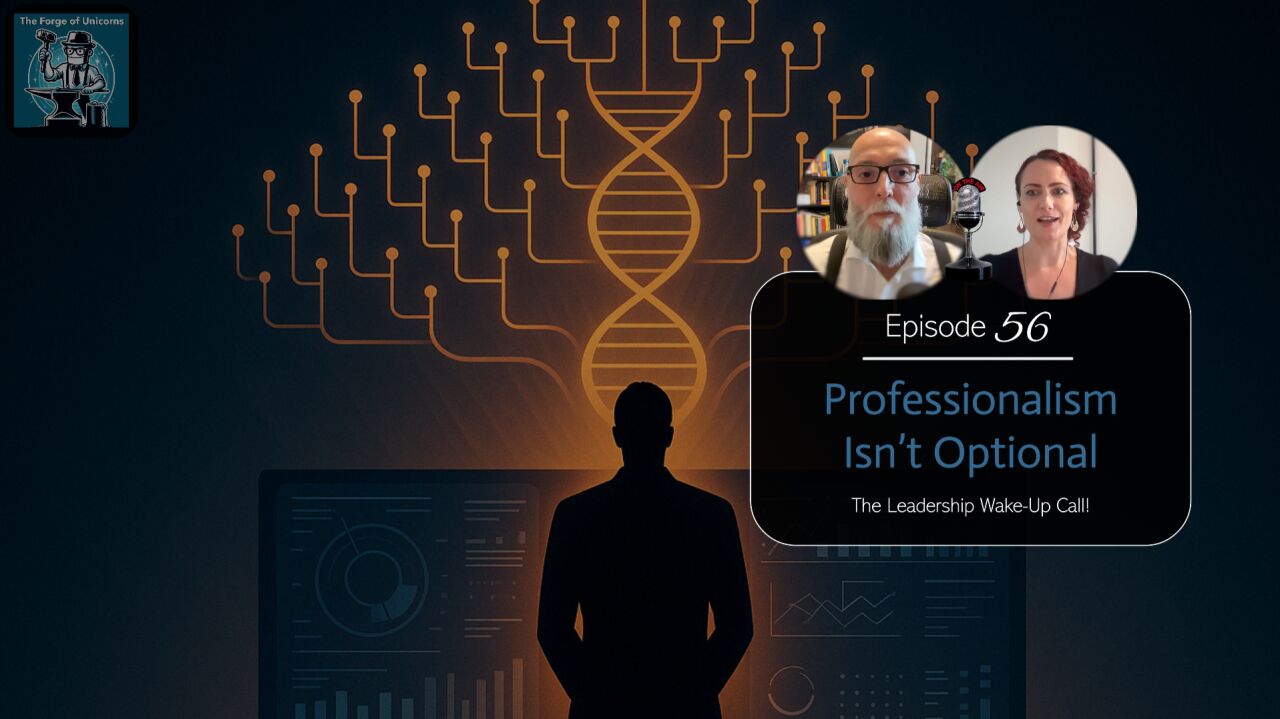
Hey there, digital warriors! ⚔️ Two weeks ago, in Article 54, we dropped a bombshell: mediocrity is a leadership choice. Then, last week, in Episode 55, we uncovered how stewardship and coaching are the antidotes to the root cause of that mediocrity. This week, we go even deeper with none other than Bryony Cooper, one of Europe’s top women in VCs and a powerhouse advocate for human-centered investment. This isn’t just another investor episode. It’s a battle cry for every CEO, CTO, investor, and board member still stuck chasing unicorns instead of building them.
So what’s the Deep Dive about?
We unpack the very real tension between venture ambition and organizational stagnation. And the message is loud and clear:
“Professionalism isn’t optional if you want to build an elite organization.”
Let’s break down why.
🎯 1. Investing in People: Stop Chasing Vanity
Bryony said it best:
“Every type of business is about people first. It doesn’t matter whether it’s tech or startups or a corporation.”
Forget foosball tables and beanbags. Culture is not a vibe—it’s behavioral gravity. When boards ignore the real feedback from employees and customers and chase only vanity metrics, they risk destroying the very thing they’re trying to scale.
“Vanity metrics are a massive issue in the startup ecosystem. You want three projections: best case, worst case, and reality. Show your investors the realistic one.”
And when you skip that realism? You end up with inflated slides, disappointed investors, and burned-out founders clinging to “hustle” culture like a broken flotation device.
🧠 2. Behavioral Engineering: The Essential Tool For Modern Leadership
Here’s the uncomfortable truth:
“If you’ve got executives in your company who are behaving badly… it really negatively impacts the entire organization.”
Boards often intervene too late. They confuse firefighting for leadership, and more critically, they are often unequipped to recognize or measure dysfunctional leadership behaviors before they metastasize.
Bryony called it out:
“Rather than cdridsis intervention, prevention is better. You need healthy culture from the beginning.”
This is exactly where neuroscience and behavioral psychology provide critical scaffolding. Without monitoring systems in place, behavioral traits that appear harmless—especially when reinforced socially—can compound into deeply embedded dysfunctions. These patterns, left unchecked, become silent drivers of mediocrity. This is why, after more than two decades of applied research, we’ve developed an integrated system that combines behavioral prompts, coaching frameworks, and neuroscience-informed leadership Dojos—designed to rewire culture across cognitive, emotional, and social layers in the organization.
🔁 3. Culture by Design, Not by Accident
You don’t scale elite organizations with ego and chaos. You scale with engineered culture. Through role models (leadership), repeatable rituals (social contracts), and intentional behavioral systems (coaching). In a scaling organization, the risk of diluting the founder’s original unicorn traits is dangerously real. And while most organizations miss this entirely, investors and boards often lack the tools to detect it… until it’s too late. Bryony warns:
“It’s not a family. It’s a company. People need to feel seen, heard, and have a path for progression (personal growth).”
Most organizations miss the mark by treating culture like an afterthought.
“If you don’t establish company culture right from the start, you lose control very quickly.”
That’s why we begin with our initial organizational assessment. Designed to capture a multidimensional view across technical, behavioral, cognitive, and emotional dimensions. Much like telemetry in Formula 1, this system fuses performance data with social feedback loops to provide a dynamic, real-time picture of organizational health. Because at the heart of every system is not just machinery or KPIs; it’s people.
As organizations scale, they must protect the original DNA of their founding team: the obsession with quality, customer centricity, and engineering mastery. Without a deliberate strategy, each new hire, team expansion, or added communication layer risks weakening these essential traits. Culture doesn’t scale on its own; it drifts. And without behavioral architecture in place, even the most promising cultures unravel.
Yet most boards and investors still lack the tools to spot these shifts early. That’s why we’ve engineered a system that empowers organizations to scale with intent: leveraging our Key Behavioral Indicator (KBI) frameworks and neuroscience-for-coaching leadership program to prevent dysfunction before it metastasizes. Because scaling must be engineered—not improvised.
🌱 4. In-House Upskilling: The True Engine of Unicorn Creation
Here’s the reality check: if people truly are the most precious asset, as Bryony emphasized, why are organizations still prioritizing tools over talent?
- 📈 According to the 2024 Training Industry Report, spending on external tech and products surged by 23%
- 📉 While investment in training fell by 3.7%, with the average company spends just $954 per learner per year.
- 📉 Leadership development? It’s shrunk to just 12% of the overall training budget.
This isn’t just ironic—it’s a strategic failure. It’s a quiet endorsement of mediocrity. And it’s precisely where elite organizations break from the pack. As Bryony put it:
“The most impressive entrepreneurs are those who never think they know it all—they’re always learning.”
This isn’t just a belief, it’s the foundation of how she invests:
“Every type of business is about people first.”
Elite organizations are built on people. Founders, engineers, designers, and teams who are given the right cultural instruments to grow, evolve, and thrive. Not just as workers, but as humans, and leaders. When you build a dedicated in-house platform for continuous development, one like our research that blends neuroscience, behavioral design, and leadership coaching, you don’t just improve performance. You transform it.
These are not optional perks. They are foundational systems. A true in-house growth mindset platform is what separates scalable, elite organizations from those still running on hope and hustle. Without it, you’re not building a unicorn. You’re slowly burning one out.
That’s why we built our Dojos-Ecosystem: to scale true unicorn leadership in tandem with your product. To embed behavioral excellence from day zero. To ensure that as your systems evolve, your people grow with them; not behind them. And to protect, not dilute, the founder’s original unicorn DNA. The cultural code that made the company special in the first place.
Because without this internal excellence engine, the slow erosion of trust, talent, and traction will hit your board hard before you can realise it.
💡 The Call to Action
This episode isn’t just a podcast—it’s a mirror. If you’re a leader, investor, or board member, ask yourself:
🧠 Are we building the conditions for human greatness? 📊 Are we measuring what actually matters beyond financial indicators? 🎯 Are we upgrading our leadership, or are we stuck in a boardroom silent war?
Because let’s face it: professionalism in this age of AI hype isn’t optional.
It’s the foundation of every elite organization.
It’s the new standard for investors who genuinely care about long-term value.
It’s the only path forward in a world where burnout is normalized, AI is misunderstood, and mediocrity is the silent killer.
What truly separates exceptional organizations from average ones isn’t just access to tools; it’s how they’re used. Companies that overspend on tech while underinvesting in people consistently fall short. But those that invest in their people, and choose the right tools to amplify their talent, don’t just succeed.
They build something extraordinary.
📽️ Professionalism Isn’t Optional the Human-Centered Leadership
To stay in the loop with all our updates, be sure to subscribe to our newsletter 📩 and podcast channels 🎧:
🎥 YouTube
📻 Spotify