

Sustainable Refactoring
Balancing Code Health and Feature Delivery

In the fast-paced world of software development, maintaining code health while delivering new features is a constant challenge. One strategy that has emerged as a crucial practice is refactoring. However, the traditional approach to refactoring often clashes with project timelines and stakeholder expectations.
In this post, we’ll explore how sustainable refactoring techniques can help strike a balance between code health and feature delivery.
Benefits of Refactoring
Refactoring is the process of restructuring existing code without altering its external behavior. It offers numerous advantages:
- Improved Code Quality: Refactoring eliminates code smells, improves design patterns, and enhances readability, making the codebase easier to understand
- Reduced Technical Debt: By addressing legacy issues, refactoring helps reduce technical debt, leading to long-term cost savings and improved project sustainability
- Enhanced Maintainability: Refactored code is easier to maintain and extend, reducing the time and effort required for future updates and modifications
- Increased Developer Productivity: Developers can work more efficiently on clean, well-structured code, leading to faster development cycles, fewer bugs, and higher-quality software
- Enables Further Changes: Refactoring isn’t just about improving existing code quality; it also enables future changes and feature additions by restructuring the code to be more modular, flexible, and extensible
Challenges: Time Concerns for Managers and Customers
Despite its benefits, refactoring can be perceived as time-consuming by managers and customers. The notion of developers spending significant time refactoring without delivering new features can raise concerns about project timelines and return on investment. This mindset often leads to resistance towards dedicating resources to refactoring efforts.
While we could try to persuade stakeholders with arguments about long-term benefits and reduced technical debt, a more practical approach exists.
The Refactoring Anti-Patterns
Before we look at the sustainable approach, it’s worth understanding how refactoring goes wrong. Most resistance to refactoring comes from teams that have been burned by one of these patterns.
The Big-Bang Rewrite
The most dangerous anti-pattern is the full rewrite. The team stops feature development for weeks (or months), locks themselves in a room, and rewrites a subsystem from scratch. The reasoning is usually: “This code is so bad that fixing it incrementally is harder than starting over.”
It rarely works. The old system had years of edge cases baked in - edge cases nobody documented. The rewrite starts clean, gets messy handling those same cases, and the team ends up in a worse position: behind on features and maintaining two half-finished systems.
Refactoring Without Tests
Refactoring means changing the structure without changing the behavior. But if we have no tests to verify the behavior stayed the same, we’re not refactoring - we’re just editing code and hoping for the best. This is why Michael Feathers defined legacy code as “code without tests”1.
There’s another definition I like even more: legacy code is code you are afraid to change. The two are related - the fear usually comes from not having tests to catch what breaks. Without tests, every structural change is a gamble.
Gold-Plating
Sometimes developers start a refactoring and keep going. The method got cleaner, but why stop there? The class could use some work. Actually, this whole module could benefit from a redesign. Three days later, the PR has 47 changed files, and the reviewer has no idea what happened.
Gold-plating turns a focused improvement into an unbounded exploration. It makes refactoring look expensive, which fuels exactly the kind of resistance we’re trying to avoid.
Solution: Parallel Refactoring with Feature Development
A more sustainable way to refactor is to parallelize it with feature development to address time constraints. Instead of treating refactoring as a separate, standalone task, it can be integrated into the development workflow in small, incremental steps.
Consider how single-core processors handle multitasking through time-division multiplexing. Despite having only one core, these processors can execute multiple tasks concurrently by switching between them rapidly.
But there’s a catch: every context switch has a cost. The processor needs to save the current state, load the new one, and warm up the caches. If it switches too often, more time is spent switching than doing actual work.
The same applies to refactoring. If we treat it as a completely separate track - switching between “feature mode” and “refactoring mode” - the overhead adds up. We lose context, we create separate PRs that conflict with feature branches, and we give managers a visible line item to cut when the schedule gets tight.
The trick is to avoid the context switch entirely. Don’t put refactoring on a separate track. Weave it into the feature work itself.
Three Techniques That Work
1. Preparatory Refactoring
Kent Beck put it simply: “Make the change easy, then make the easy change.”
The idea is straightforward. When we pick up a feature or bug fix, we first look at the code we need to change. If the current structure makes the change awkward, we refactor first - but only the minimum needed to make the change clean.
Let’s see what this looks like. Suppose we need to add email notifications to an order service:
class OrderService {

  void placeOrder(Order order) {
    // validate
    if (order.getItems().isEmpty()) {
      throw new IllegalArgumentException("Order must have items");
    }
    if (order.getCustomer() == null) {
      throw new IllegalArgumentException("Order must have a customer");
    }

    // calculate total
    double total = 0;   // double for money? 😱 I know. I'd use BigDecimal in a real system, but double is simpler to understand in an example
    for (Item item : order.getItems()) {
      total += item.getPrice() * item.getQuantity();
      if (item.getDiscount() > 0) {
        total -= item.getPrice() * item.getQuantity() * item.getDiscount();
      }
    }
    order.setTotal(total);

    // save
    database.save(order);

    // log
    logger.info("Order placed: " + order.getId());
  }
}
We could just add the email sending at the end. But this method is already doing four things: validation, calculation, persistence, and logging. Adding a fifth responsibility won’t make things better.
Instead, we first refactor - extract the distinct responsibilities2:
class OrderService {

  void placeOrder(Order order) {
    validate(order);
    calculateTotal(order);
    database.save(order);
    logger.info("Order placed: " + order.getId());
  }

  private void validate(Order order) {
    if (order.getItems().isEmpty()) {
      throw new IllegalArgumentException("Order must have items");
    }
    if (order.getCustomer() == null) {
      throw new IllegalArgumentException("Order must have a customer");
    }
  }

  private void calculateTotal(Order order) {
    double total = 0;
    for (Item item : order.getItems()) {
      double itemTotal = item.getPrice() * item.getQuantity();
      if (item.getDiscount() > 0) {
        itemTotal -= itemTotal * item.getDiscount();
      }
      total += itemTotal;
    }
    order.setTotal(total);
  }
}
Now placeOrder reads like a recipe. Adding email notification is trivial:
void placeOrder(Order order) {
  validate(order);
  calculateTotal(order);
  database.save(order);
  notifyCustomer(order);
  logger.info("Order placed: " + order.getId());
}
The refactoring and the feature land in the same PR. Separately, neither would justify a ticket. Together, they make the codebase better and the feature cleaner3.
2. The Boy Scout Rule
We don’t necessarily have to do large-scale restructuring. It’s a good start if we apply the Boy Scout Rule: leave the code better than we found it. Using this principle, we can ensure that each code modification includes a small refactor to improve the quality of the surrounding code. Over time, these incremental improvements accumulate, leading to a healthier and more maintainable codebase.

What does “a small refactor” actually mean in practice? Here are a few examples of things we can do every time we touch a file:
- Rename a variable or method to better express its intent
- Extract a confusing condition into a well-named boolean or function
- Remove a dead code path or an unused import
- Replace a magic number with a named constant
- Inline a variable that’s used only once and adds no clarity
None of these takes more than a minute. None of them requires a separate PR or a discussion in the standup. But over weeks and months, they compound. A codebase where every developer follows the Boy Scout Rule gets measurably better with every commit.
3. The Strangler Fig Pattern
Sometimes, a piece of code is too far gone for small improvements. A module grew organically over the years, nobody fully understands it, and every change introduces unexpected side effects. The Boy Scout Rule won’t save it, and a big-bang rewrite is too risky.
The Strangler Fig pattern - named after the tropical plants that grow around a tree until they replace it entirely - offers a middle ground. The idea is simple: build the replacement alongside the original, redirect traffic piece by piece, and remove the old code only when nothing depends on it anymore.
In practice, this usually means:
- Introduce a new implementation for one specific behavior, behind the same interface
- Route new calls (or a subset of existing ones) to the new code
- Verify the new code handles those cases correctly
- Repeat until the old implementation handles nothing
- Remove the old code
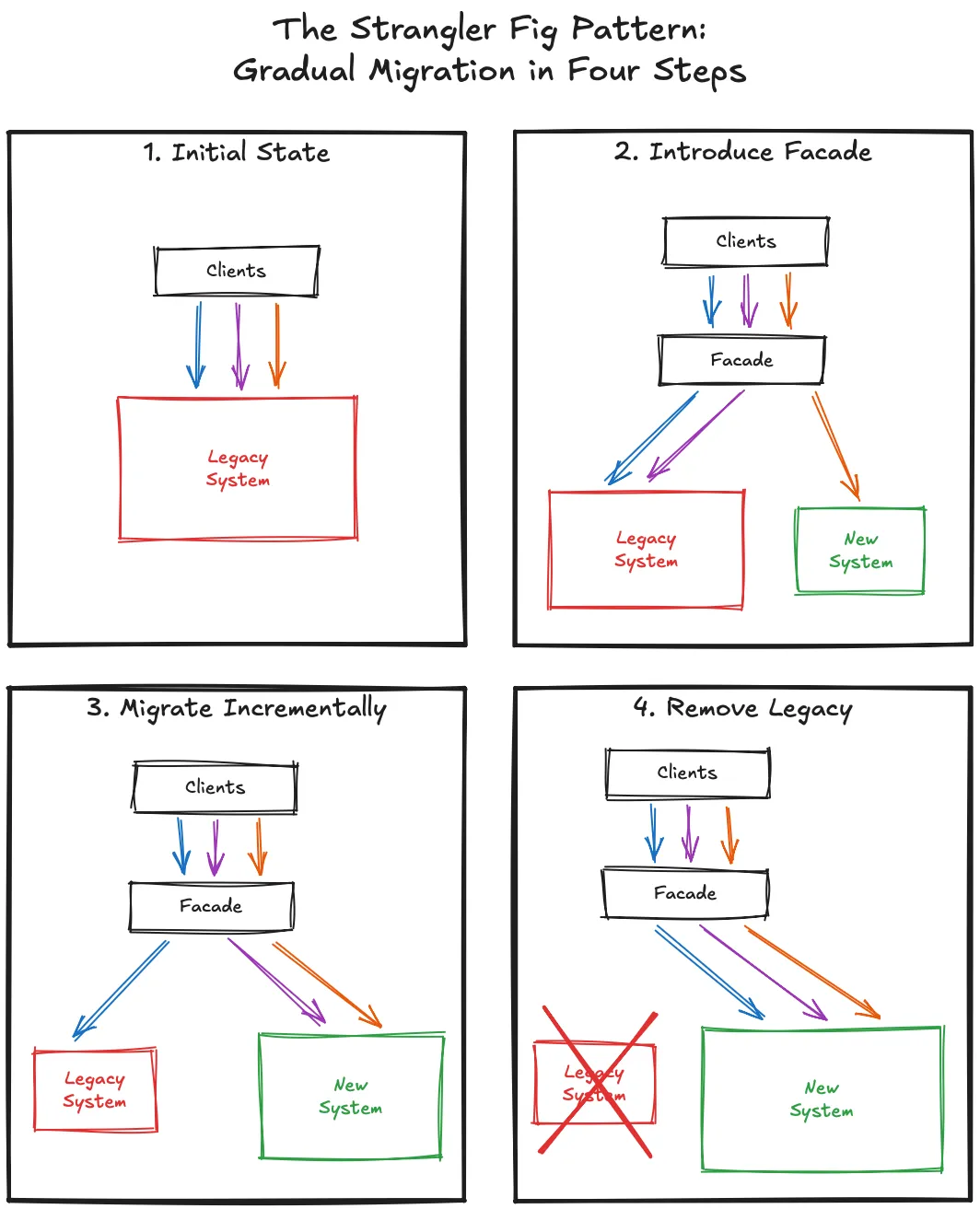
This works well for replacing legacy services, rewriting data access layers, or migrating from one framework to another. The key property is that the system works at every step. We never have a “migration weekend” where everything breaks.
The Strangler Fig is slower than a rewrite. But it ships. And it ships continuously, which means stakeholders see progress, not a black hole of effort with a promise at the end.
Making It Visible Without Asking Permission
Here’s a pragmatic observation: if refactoring needs approval, it won’t happen. Schedules are always tight, and “improve code quality” will always lose to “ship the next feature” in a prioritization meeting.
The techniques above work precisely because they don’t require separate approval. Preparatory refactoring and the Boy Scout Rule happen inside feature work. The Strangler Fig can be framed as a gradual migration, which is easier to sell than “we need to stop and rewrite.”
A few tactics that help in practice:
- Include refactoring in estimates. If a feature touches messy code, the estimate should reflect the cost of improving that code. Don’t pad it secretly - explain that the area needs cleanup to support the change. This is honest, and it sets realistic expectations.
- Separate commits, same PR. Keep refactoring in its own commits so reviewers can verify the behavior didn’t change. But keep it in the feature PR so it doesn’t become a separate line item that can be deprioritized.
- Track trends, not tasks. Instead of creating refactoring tickets (which get deprioritized), track code health metrics over time: test coverage, cyclomatic complexity, and build times. When these trend in the right direction, nobody asks how it happened. When they trend wrong, you have data to justify focused cleanup.
Will this impact development speed? Certainly. But not the way we think. By keeping the code in a healthier state, future changes will be much faster to make. In other words, we slow down to go faster.
The Compound Effect
Martin Fowler describes this well in his concept of the “design stamina hypothesis.” Without good design, feature delivery starts fast but slows down as the codebase deteriorates. With sustained refactoring, the initial pace is slightly slower, but the curve stays flat - or even improves - over time.
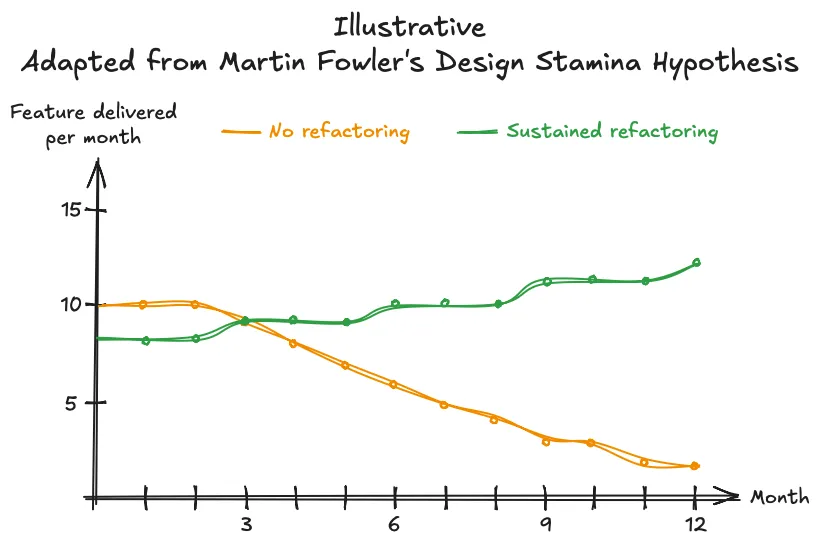
Think of it as compound interest. A 1% improvement per week doesn’t feel like much. But after a year, the codebase is unrecognizable compared to a team that stopped investing in code health. The teams I’ve worked with that consistently applied these techniques didn’t just have cleaner code - they shipped faster than the teams that “didn’t have time” to refactor.
Conclusion
Sustainable refactoring is not about sacrificing feature delivery for code health or vice versa. Instead, it’s about finding a balance that allows continuous improvement while meeting project requirements. Teams can effectively achieve code health and feature delivery goals by integrating refactoring into the development process and adopting parallelization strategies.
The key principles:
- Don’t ask for permission to refactor. Weave it into feature work.
- Don’t do big-bang rewrites. They fail more often than they succeed.
- Don’t refactor without tests. If there are no tests, write them first.
- Prepare the code for the change, then make the change.
- Leave every file better than you found it.
- Replace big legacy systems gradually, not all at once.
Refactoring is not a phase. It’s a habit. The best time to start was months ago. The second-best time is with the next feature you pick up.
Try this week: pick the next feature on your board. Before writing new code, spend 15 minutes improving the structure of the code you’ll touch - extract a method, rename a variable, remove dead code. Commit the cleanup separately, then build the feature on top. Do this for every PR this week. You’ll be surprised how quickly the habit sticks.
Media attributions:
- Cover photo by Patrick Fore on Unsplash
- Boy Scout photo by Andrea Sánchez on Unsplash
- Strangler Fig diagram by the author
- Design Stamina graph by the author, adapted from Martin Fowler’s Design Stamina Hypothesis
Footnotes
-
Michael Feathers, Working Effectively with Legacy Code. His definition is deliberately provocative, but the point stands: without tests, safe structural changes are nearly impossible. ↩
-
Note how the comments have marked what needs to be extracted. That is a common sign. ↩
-
A good practice is to put the refactoring in one commit and the feature in the next. This way, the reviewer can verify the refactoring didn’t change behavior before looking at the new functionality. ↩