Visionary Digital Evolution Strategist
Rooted in Formula 1 excellence, with over 30 years in IT starting as a child in the 1980s, …
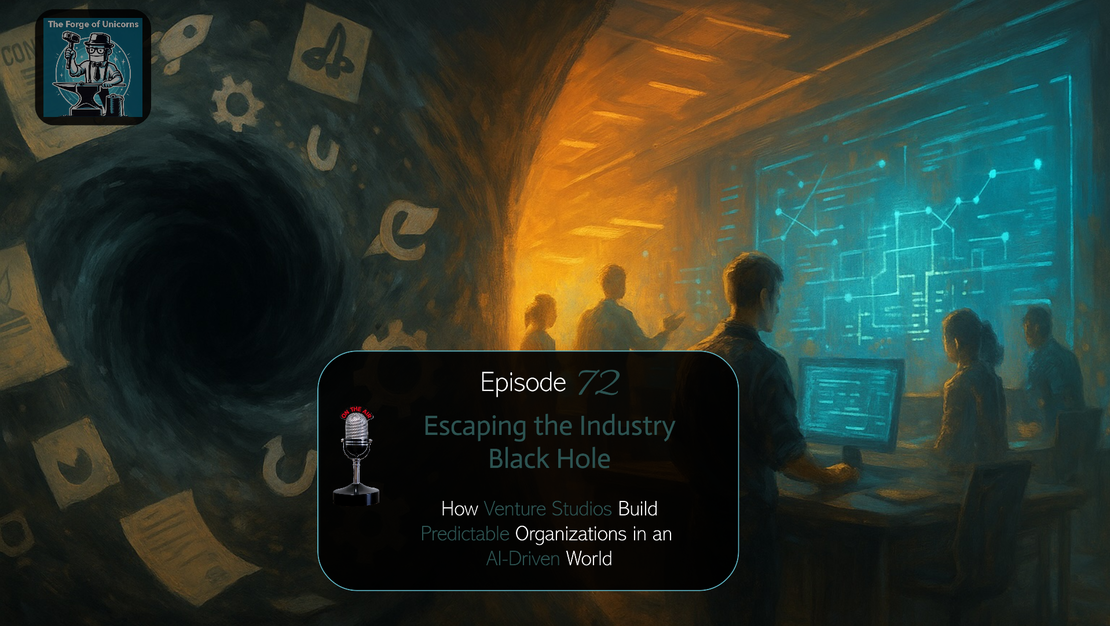

How Venture Studios Build Predictable Organizations in an AI-Driven World
Hey there, digital warriors! ⚔️
SubscribeLast week, Noel BAUZA 🌳 reminded us that the future of business is scientific. Decisions should flow like experiments: transparent, measurable, and data-driven. Embracing micro failures as the path to macro learning. But here’s the gut punch: even with AI, incubators, accelerators, and mountains of capital, 90% of startups still fail. Only 1.25% ever become unicorns and survive their first year.
So why do we keep funding the same broken model? Buckle up, because this week we sat down with Paul O’Brien, one of the sharpest minds in venture capital and startup ecosystems.
This article is meant as a follow‑up to Paul O’Brien’s own post‑production analysis in his newsletter, where he laid out why accelerators fail:
because the venture world has focused too much on blueprints instead of behaviors.
Here, I’ll unpack the lessons from our conversation, taking Paul’s point on behaviors and layering it with our 25 years in behavioral science. Out of that came our behavioral heat map for modern software engineering, the one inspired by Formula 1 and MotoGP, where precision engineering meets the art of craftsmanship. Why does it matter? Because in the AI era, it’s the only way to engineer predictable success.
So buckle up! This isn’t theory, it’s the research forged in the pits and proven in the boardroom.
For 15 years, accelerators sold the dream of speed and scale. Glossy decks, unicorn promises. But as Paul O’Brien put it:
“Most accelerators haven’t been delivering results; because they’re run like business programs, not like engines of entrepreneurship.”
They measure activity, not outcomes. They push playbooks built for Silicon Valley circa 2007, not today’s world. Since then, three waves of digital disruption have rewritten the rules.
Results? When 9 out of 10 still crash, that’s not bad luck. It’s failure by design.
Let’s focus on the latest disruption: AI. It isn’t just hype; it’s a black hole sucking in 80% of global capital. Pitch decks tack on “AI” just to get funded while whole industries starve. As Paul said, AI will change everything, likely more than the internet itself.
Here’s the paradox: AI is real, but the money flow is broken. Capital pours into accelerators and incubators unfit for the paradigm shift. The market moves faster than these structures, so odds of success shrink further.
And yet, even with 10% odds, in the last century, humanity leapt from candles to LEDs, from horses to self‑driving cars, from silence to the moon. Imagine doubling the odds to 20%. That’s innovation at lightning speed, and that’s why the venture studio model comes in.
Here’s where, with Paul, we dropped the real bomb: the solution is venture studios.
Unlike accelerators, venture studios don’t “coach” from the sidelines. They’re owner-operators who:
Build shoulder to shoulder with carefully chosen founders, shaping the company from day one. Where accelerators hand out playbooks, studios surface dysfunctional behaviors early and adapt them into strengths.
Provide hands-on engineering, marketing, product, and governance support, not rigid blueprints that ignore context and behavioural and culture gaps.
Bring sector-specific mastery (healthtech, fintech, media, or software, like our Unicorns’ Ecosystem model) so founders benefit from deep domain insight instead of generic templates.
Run on a mindset of continuous experiments: embracing micro-failures for macro-learning, adapting to market signals, and forging cultures where innovation reshapes behaviors into sustainable advantage. Think less like a chaotic “cockroach startup,” more like a resilient camel equipped to thrive long-term.
This isn’t a promise of the moon if you blindly follow a pristine blueprint. It’s co-creation from zero. A venture studio doesn’t just help you survive; it works side-by-side with you to engineer the DNA for success, while rewiring dysfunctional patterns into data-driven and adaptive, high-performance behaviors that can scale to unicorn.
When applied to software, the beating heart of every modern business, the impact is transformative. Software doesn’t just need capital, generic toolkits, or fancy certifications. It demands disciplined engineering, passionate craftsmanship, and behavioral scaffolding. Venture studios blend these elements into an adaptive system of micro-failures and macro-learning. Contrast that with today’s AI-powered “vibe coding,” which accelerates technical debt and collapse despite the blueprints and mountains of capital. That’s why venture studios stand apart: they don’t just reject rigid outdated blueprints. They turn disruption into engineered success by properly reshaping behaviors at the core.
I read your mind. Thus, the real question now becomes: can the Venture Studio step in as the operating system of success even for organizations that started on the wrong foot? ⚠️ TL;DR: Yes. 👇How…
Think of it this way: mediocre software teams buy into test‑automation because it looks easy. Tools vendors get rich, while developers burn out shipping buggy code. High‑performance teams embrace test‑first engineering (TDD). Painful? Yes, and indeed only ~3% of the market knows how to do it, but that set of behaviors makes results predictable, just like in real engineering (simulate first, then design, then prototype and stress test).
This is what behavioral engineering means in practice: it bridges the gap from today’s dysfunctions to tomorrow’s properly field-tested standards. Instead of chasing seductive “junk food” solutions like automation tools that sugar‑coat problems, behavioral engineering designs adaptive programs that guide people step by step, with zero trauma and no production loss, until they can work in the right way. That’s how we rewire organizations for sustainable performance.
Thus, we understood entire enterprises, not just startups, collapse under the behavioral gaps of outdated playbooks, shiny tools that overpromise, and certifications that change nothing. Now do you see the real problem? People stuck in patterns forced by the playbooks that breed silos, disengagement, and low performance.
Paul O’Brien captured the essence of behaviors perfectly when he said:
“A startup is intrinsically designed for disruption. You can’t create disruption by following a canonical process blindly.”
That’s where behavioral engineering changes the game over time. Just like cars became safer model after model, organizations become stronger when the right behaviors are built into the system. Right now, our software industry lacks those standards: we accept buggy enterprise software as normal, while no one would buy a car that comes with a disclaimer it may not run.
This is the result of having translated two decades of experimentation, from Formula 1 and MotoGP to neuroscience and behavioral science, into a model that makes any organization more predictable. Not just the formula for high performance, but how any team finds the path to follow, even when they’re not yet ready to run at full speed.
An adaptive operating system, not junk‑food shortcuts but a true “doctor" for organizations.Behavioral engineering provides the steady weekly check-up that rebuilds strength and resilience. It steadily re‑evolves dysfunctional organizations into functional ones. It wires the right behaviors, validates results with data‑driven governance, and proves that success can be engineered in any organization.
This is why as we discussed with Paul, governments and investors should redirect capital toward venture studios: they’re designed from the ground up to apply this model and turn disruption into lasting growth.
Accelerators are the past. Venture studios are the future.
The only question left is: why keep funding a model we know fails 90% of the time?
If we push that failure rate even to 80%, we double the number of successes. Imagine what that means for innovation, jobs, and the global economy.
The next unicorn won’t come from a cookie-cutter accelerator. It will be engineered inside a sector‑specific venture studio, with behavioral science at its core.
👉 If you’re an investor or policymaker, the call is clear: establish your software venture studio based on the Unicorns’ Ecosystem model. The proven research for building predictable, software‑driven organizations.
👉 And if you’re a CXO, let’s talk. Not because you’re failing, but because markets shift faster than any playbook. Pivoting at high speed without the right data is dangerous. With the Unicorns’ Ecosystem, we help you evolve safely toward the future. And with BOKaRy, we give you the leap you need right now to get all the data you need to make factual decisions.
To stay in the loop with all our updates, be sure to subscribe to our newsletter 📩 and podcast channels 🎧:
Subscribe on Substack Subscribe on LinkedIn Subscribe on YouTube Subscribe on Spotify Subscribe on Apple Podcasts
Visionary Digital Evolution Strategist
Rooted in Formula 1 excellence, with over 30 years in IT starting as a child in the 1980s, …