Visionary Digital Evolution Strategist
Rooted in Formula 1 excellence, with over 30 years in IT starting as a child in the 1980s, …
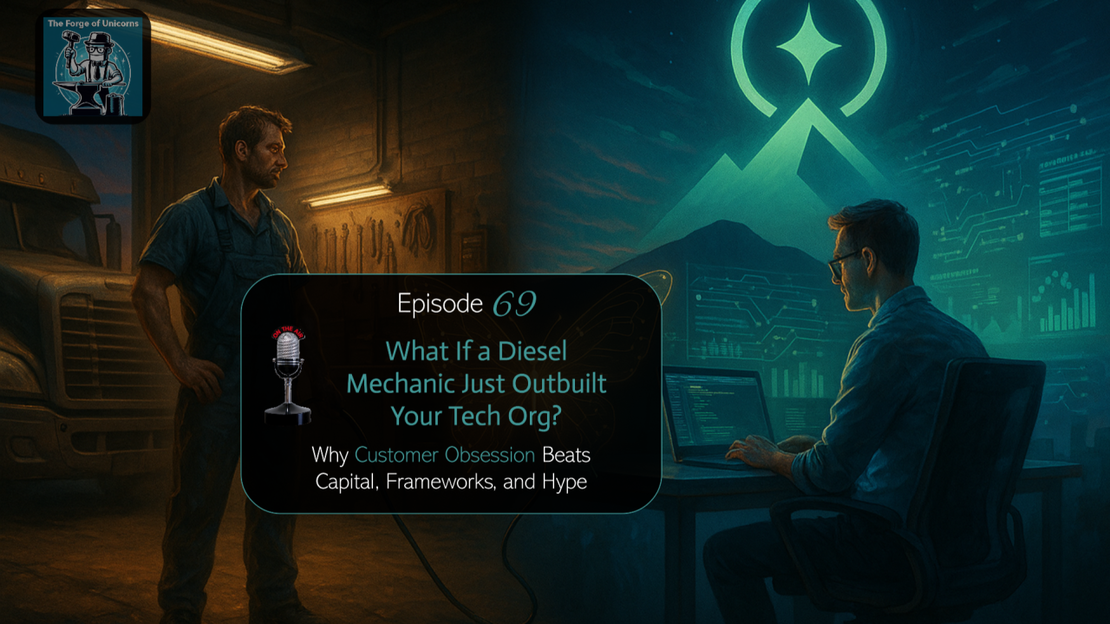

Why Customer Obsession Beats Capital, Frameworks, and Hype
Hey there, digital warriors! ⚔️
Stay up to date.We’re back. Season 3 kicks off 🍾 not with a whisper, but with a $100M roar 🦁!
This week, we go deep into the story of a founder who built a software company that defied every convention. No investors. No coding background. No ScaledAgile or Jira theater. Just pure obsession with one thing:
Solving a real customer pain.
Because here’s the truth:
Only 1 in 25 SaaS companies ever reach sustainable status. 🙀
Why? Because they chase frameworks, funding, and useless or buggy features. Not outcomes like user satisfaction and operational excellence!
But Tyler Robertson did the opposite. He built Diesel Laptops into a $100M success by doing what most CIOs and CTOs can’t: he made software that actually worked, by listening harder than anyone else to the customers’ pain points.
Twenty-five years ago, Tyler was standing in a truck dealership bay with his now-COO, Dan, when he looked at a broken truck and said:
“Wouldn’t it be nice if you could just plug in a computer, and it told you what was wrong and how to fix it?”
He didn’t know it yet, but that sentence was the seed of a $100M empire.
Tyler spent a decade in the dirt: working with truck techs, shop managers, and fleet owners. He didn’t run customer interviews; he was the customer. His knowledge wasn’t theoretical. It was lived.
Instead of jumping to code or chasing investors with a flashy pitch deck, he began by reselling existing diagnostic tools; far from perfect, but good enough to run real-world experiments. This let him test the waters, gather honest feedback, and see firsthand how customers reacted to imperfect solutions. He watched what frustrated them, what delighted them, and where the market had failed to deliver. He packaged it better. Supported it better. Listened better. Then, and only then, did he start to build, with a level of clarity most organizations never reach despite their shining product management teams.
And when customers told him, “Stop building new stuff. Fix what you already gave us,” he listened again and reacted to this tough feedback. This was the inflection point where most organizations plateau. They ignore signals, pile on features, and drift further from what customers actually need, blindly following their agile processes without any critical thinking 🤦🏻.
Tyler didn’t. He course-corrected toward stability and trust before leaping to a new growth phase.
This is the moment every scaling company faces: internal failure.
“We had 50 developers and couldn’t get anything out the door. So we blew it all up. We kept eight people. Started from scratch.” - Tyler Robertson
This marked the beginning of a Kaikaku phase—a radical leap forward—triggered by the realization that Kaizen-style incremental improvements were no longer working. Progress had stalled because the organization, like so many others, was building the wrong things: solutions customers didn’t value, plagued by complexity and bugs. They had reached a plateau. One that only a bold change could break.
Most organizations never make this leap. They get stuck on the plateau. Addicted to marginal gains, confined within the boundaries of top-down-imposed Agile frameworks. They follow certificate-driven dogma, clinging to rituals that no longer generate value. Instead of evolving, they keep performing ceremonies anchored to outdated assumptions, hoping for different outcomes while watching customer trust erode. It’s not agility. It’s stagnation disguised as process.
Tyler did what few dare to do: He stepped into the leadership cocoon and re-emerged with a completely new delivery culture. One rooted in performance, clarity, and radical customer-centricity. The kind of leap more than 80% of organizations avoid, not because they don’t want to, but because they’re paralyzed by emotional risk.
If your customers lead the product roadmap, what’s left for middle management to control? If you dismantle old processes, how does a CXO justify their authority? This is where organizational fear kicks in.
Behavioral inertia isn’t just about process; it’s about identity. People fear irrelevance. Leadership fears losing power. Teams fear disruption. So instead of evolving, they preserve rituals that keep everyone “safe” (somehow) but ultimately stall progress.
It’s not about bad people. It’s about the social psychology of fear and loss aversion. As Daniel Kahneman documented:
We’re twice as motivated to avoid loss than to pursue gain.
And in orgs, the loss often feels existential: loss of control, clarity, or role. Because beneath the charts and KPIs, we’re human. And humans have families to support. When change threatens not just your title, but your ability to provide, the stakes feel life-altering. It’s no wonder self-preservation kicks in. Resistance to evolution isn’t about stubbornness; it’s about survival.
And so the real blocker becomes cultural hesitation: the invisible, emotionally-charged pause that stops even the best leaders from taking bold action. It’s the social contract that whispers, “Don’t challenge this, or you’ll make things worse.”
That’s the trap. Tyler broke it ⛓️💥
Most orgs fall straight into the arms of polished frameworks and the illusion of progress. They choose off-the-shelf Agile playbooks and wrap them in certificates to hang on the wall; proof of motion, not mastery.
These frameworks rarely teach how product teams should co-create with users. They don’t show how to validate real needs, prototype collaboratively, or discover the behaviors that drive customer satisfaction. And without those skills, poorly understood features are pushed into development. Where lies the most deadly trap: crappy software.
Then the real nightmare begins.
Developers are dragged into chaos. With no time to refactor, no shared definition of done, and no behavioral culture of quality, they drown in a quicksand of technical debt. Speed kills clarity. Fragility replaces flow. What survives is not software; it’s the process.
The theater where sloppy products are forced into delivery cycles, reporting sanitized progress to boards. Meanwhile, the only user feedback that truly matters, the one saying this product is shit 💩, never makes it upstream.
It’s the same illusion Ford CEO Alan Mulally shattered when asked:
“Why are we saying everything’s green when sales are bleeding red?”
This is the real reason boards and CXOs remain blind: not because they don’t care, but because cultural hesitation ensures that uncomfortable truths never rise to the surface.
Labor protections prevent direct enforcement of new behaviors. But even more than that, nobody knows how to design a system that evolves behaviorally at scale.
This is where BOKARY was born. [Note: In the next episodes, we’ll reveal why it’s called BOKARY, and how it was designed to evolve the very nature of software organizations.]
A model for the organizations stuck on a plateau of fake progress. A system to:
Because meaningful evolution demands clarity. Without real, behavioral data that connects what people do with what customers feel, no boardroom strategy can succeed. It’s not enough to measure delivery speed or burn-down charts.
BOKARY bridges that gap. It gives boards the hard data they’ve been dreaming of for decades. Mapping internal behaviors to customer outcomes, delivery performance, and financial results. Because true growth only happens when your culture, your code, and your customers are all moving in the same direction.
That’s the path out of the zombie swamp of shitty software products.
If you’re a CEO or CFO still hoping that Jira or AzureDevOps dashboards will reveal the truth behind stalled growth, please stop chasing voodoo metrics 🔮.
Your capital is bleeding. And the data you’re trusting was never built to connect product delivery with real customer outcomes.
BOKARY is designed to give decision-makers the clarity they’ve been seeking for decades.
We’ll show you how to turn silence into signals and cost into value.
To stay in the loop with all our updates, be sure to subscribe to our newsletter 📩 and podcast channels 🎧:
🎥 YouTube
📻 Spotify

Visionary Digital Evolution Strategist
Rooted in Formula 1 excellence, with over 30 years in IT starting as a child in the 1980s, …