Visionary Digital Evolution Strategist
Rooted in Formula 1 excellence, with over 30 years in IT starting as a child in the 1980s, …
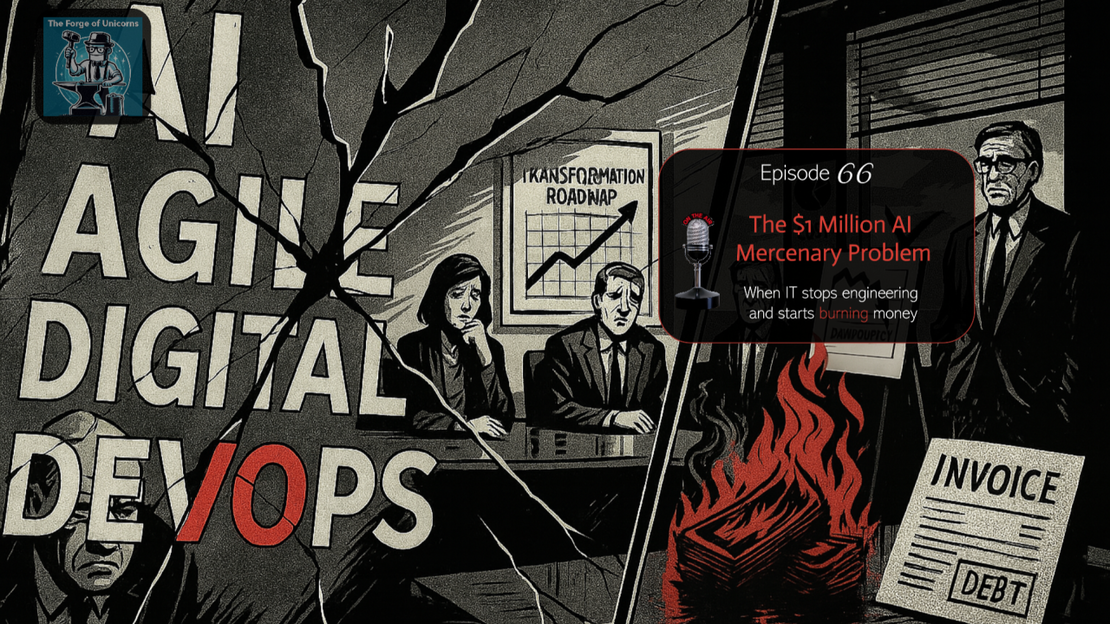

Why buying hype talent backfires, and what F1 can teach us about building mastery.
Hey there, digital warriors! ⚔️ Last week’s episode cracked open a tough truth: AI can accelerate delivery, but it can also quietly kill engineering culture, product thinking, and mastery. If you missed that story, go check it out. Because this week, we’re taking it further into the madness.
Sean Smith started with one missing word: apprenticeship.
That sacred space where knowledge is transferred, trust is built, and mastery is earned. And yet, in 2025, most tech companies would rather burn $1M on a hype-hire than invest in a learning culture.
“If you pay an AI engineer one million to bring their brain into your company, are they a scientist or a mercenary?” - Mike, Forge of Unicorns EP66
That’s not fiction. That’s happening. Right now. Across companies who laid off thousands just to afford the mercenaries they hope will hallucinate value.
But tech per se does nothing. And behavior, once again, explains everything.
In 2025, over 510 tech workers are laid off every single day. That’s one person losing their job every 3 minutes. And while engineers with 10+ years of experience are refreshing LinkedIn, getting rejection after rejection, companies are paying $1M salaries to hype-fueled AI profiles.
They’re not hiring mastery. They’re buying hope.
“The average org hires hype-driven profiles from the market, providing them a lot of cash, hoping they will bring their skills to the company. Unfortunately, this toxic mercenary business model is a silent company killer.”
This is the AI mercenary model: hire brilliant individuals, drop them into collapsing companies, and expect magic. No context. No alignment. No continuity. Just compensation packages and chaos, until the next leap for a greater bonus package.
And this time, it’s burning billions. But more importantly, it’s funding a tsunami of layoffs to sustain the hallucination. Meta alone, with their Superintelligence team, is reporting investing $60B in AI. $400–450M per year is reserved just for talent compensation. The same company laid off over 25,000 people to fuel this so-called performance-based hiring directive.
Meanwhile, the gold rush for AGI is driving costs through the roof: $80B at Microsoft, $75B at Google, $100B at Amazon. All while the old workforce is gutted, training frozen, and internal excellence ignored.
Welcome to capitalism in 2025: fire your 🦵crafters, hire your 🤑 hype.
Let’s start with the punchline from one of the latest reports:
Certified Scrum Masters now outnumber Scrum Developers 10 to 1.
It’s not funny at all; it’s a deep sign of market dysfunction.
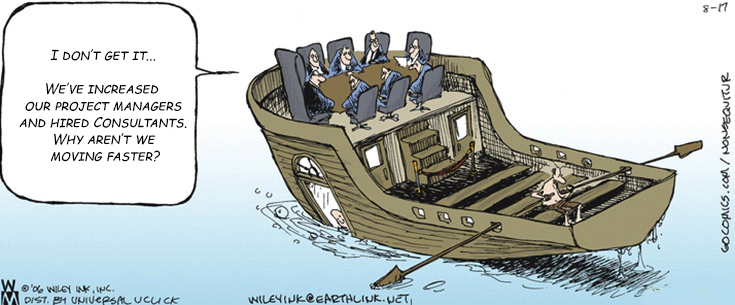
We’ve memed ourselves into absurdity: “Ten Scrum Masters with megaphones shouting at the unique guy paddling.”
The frameworks ate the engineers. The market erased critical thinking. Leadership? Buried under slide decks and certifications. Agile™ became Theranos in a hoodie. A subscription model for false hope. And the outcome?
Culture theater. Millions spent. Nothing delivered. Our best people burned out or gone.
So, when companies today say, “AI will transform everything…”, shall we stop for a second and ask ourselves if we learn anything from the punches in the faces organizations got from Agile, DevOps, and Scaled Agile?
What I’m showing in this deep dive isn’t just bad hiring anymore. Or lack of awareness, or worse, CXO incompetence. It’s way bigger. It’s industrialized incompetence: marketed, monetized, and scaled.
And now we’re throwing billions at a neurological black box, pretending it’s just a matter of compute power. Sam Altman recently said:
“A significant fraction of Earth’s total electricity should go to running AI.”
😳 Read that again.
Instead of decoding consciousness through science, we’re brute-forcing it with servers led by teams of computer science grads trying to simulate something neuroscience hasn’t even explained.
Let’s be real: We can’t recreate what we haven’t even defined.
We still don’t understand how trauma rewires memory. We don’t know why neuroplasticity degenerates. We haven’t decoded consciousness; let alone encoded it. Yet somehow we believe that a few billion dollars and Python scripts will do what Nobel-level neuroscience can’t?
You can’t simulate emotional logic with token prediction. You can’t code fear, desire, or rage into an LLM prompt.
What are we actually building?
A fragile, hallucination-prone system. Good enough to automate chores. Useful for low-stakes tasks. But still too incompetent to truly reshape how humans work at scale. And if we force it anyway? The outcome is already visible.
According to recent MIT studies, heavy dependence on AI tools leads to measurable cognitive decline, decision-making worsens, reasoning weakens, judgment erodes.
Even in traditional industry, after 40 years of robotics, we’ve never reached full automation. We didn’t replace humans. We designed hybrid systems, where people still handle the most complex, mission-critical tasks.
So why should digital be different? It won’t.
Just like Agile™, the AI transformation bubble will burst. Because transformation isn’t technical. It’s behavioral.
🤔 So what does work?
This is where Sean Smith dropped the hammer: Apprenticeship. Social fit. Mastery over time.
“You don’t scale transformation by importing genius. You scale it by creating a system that builds mastery from the INSIDE.”
It’s not a skill gap. It’s a leadership failure: a failure to train, to mentor, to evolve.
And it starts inside the building… before you buy your next miracle tool.
In our conversation, Sean was brutally clear: Real ROI isn’t purchased. It’s practiced.
Apprenticeship is the missing link in modern tech. We over-index on credentials. We underinvest in guided, in-context learning; where behavior changes, not just job titles. He shared real world examplesfrom his portfolio companies:
“That’s how we aligned behavior. Not by buying software, but by changing how people used it… daily.”
Small steps. Habits. Incentives. Evolution, not disruption.
And yes, we unpacked where AI actually adds value in that process… as well as where it becomes a silent killer of autonomy, team trust, and long-term capability.
“AI without culture is just noise. A distraction. Sometimes worse than useless.” Transformation wasn’t sold. It was engineered with human care and a bias for upskilling.
The real gold? It’s already inside your walls. You don’t need a million-dollar tool to dig it out. Just empathy-driven leadership to bring it to life.
So the question is… Are you extracting hype? Or unlocking your in-house human potential… like the F1 and MotoGP do?
Let’s be blunt: F1 doesn’t pay $1M for hype. They invest in mastery. Two-second pit stops aren’t magic. They’re the byproduct of obsession, precision, and relentless systems thinking. Every move is engineered, trained, and every failure is examined. Drivers earn their salaries through pain, repetition, and elite performance under pressure.
Now contrast that with today’s AI hiring spree.
Coders, brilliant, maybe, but with zero background in neuroscience, behavioral science, or organizational dynamics, earning $1M not because they built anything enduring, but because they might hallucinate value faster than the next team.
Are we serious?
These aren’t scientists. They’re mercenaries. Trained in syntax, dropped into boardrooms, entrusted to architect the future while the very teams that built the present are being laid off to fund their salaries.
It’s a toxic paradox:
“F1 and MotoGP performance doesn’t happen by accident. It’s not achievable with casual leadership. It demands daily, deliberate improvement. And an operating system of human-centric, behavioral evolution.”
That’s what modern software organizations have forgotten.
They cut training to zero. They outsourced thinking to frameworks and vendors. They traded sustainability for shortcuts and stunts.
And the result?
$1M AI mercenary won’t save you. They’ll expose your rot.
It’s time to shift:
Evolution isn’t hype. It’s discipline. And right now, your competitors are already evolving.
💡 Still burning millions on tools and frameworks with zero ROI?
That’s not a tech problem.
That’s your CFO culture working against you.
Evolution doesn’t happen in Excel.
It happens through engineered programs like the Unicorns’ Ecosystem. The operating system that venture builders are opting for in their studios to build their future portfolio.
You’ve got two choices:
It’s fast. Surgical. Brutally clarifying. And it might just save your company before the AI bubble bursts.
To stay in the loop with all our updates, be sure to subscribe to our newsletter 📩 and podcast channels 🎧:
🎥 YouTube
📻 Spotify

Visionary Digital Evolution Strategist
Rooted in Formula 1 excellence, with over 30 years in IT starting as a child in the 1980s, …