Visionary Digital Evolution Strategist
Rooted in Formula 1 excellence, with over 30 years in IT starting as a child in the 1980s, …
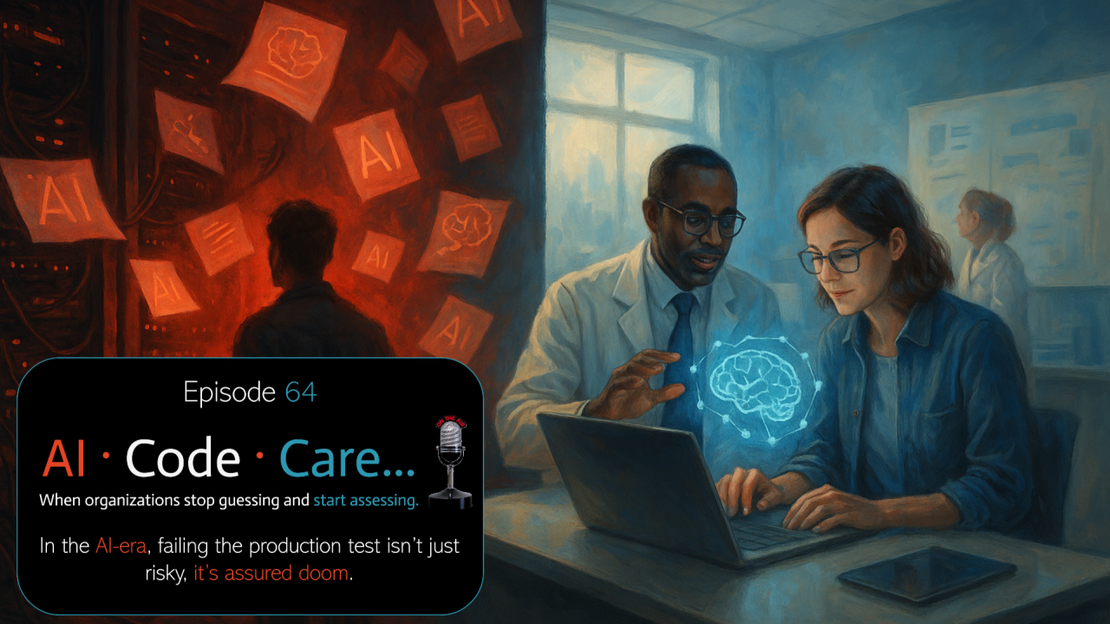

In the AI era, failing the production test isn’t just risky, it’s assured doom.
Hey there, digital warriors! ⚔️
Last week, in episode 🎙️ EP63 with Maria de la Puente, we asked:
Is the AI bubble coming? And if so, who do you trust to deal with it?
We exposed how modern organizations can’t rely solely on their C-executives anymore. They need technical advisors at board level, and tech NEDs embedded in leadership to keep up with AI-era decisions.
This week? We go straight to the battlefield where it hurts most: When AI-generated code sneaks into healthcare without scrutiny.
Dr. Jeremy Krell, former dentist and now Managing Partner at Revere Partners, joins the Forge of Unicorns to show us what real IT due diligence looks like. His team doesn’t just assess founders. They assess code 😻.
Because when 40% of your portfolio is software, junk code isn’t just a bug, it’s a systemic risk.
And yet most organizations and investors never look past the deck.
Jeremy and his team don’t just walk the talk. They dissect the stack. In a market drunk on demos and hype, they’re one of the few still doing deep, real engineering due diligence. And that’s exactly why their results are turning heads.
Jeremy distilled Revere’s investment thesis with clarity:
“Due to our clinical background, applying to Revere means you’re talking to an investor who deeply understands the technology in the space you’re trying to innovate.”
He doesn’t chase AI hype. Revere has a CTO, a former developer with real-world AI and ML experience, who audits every codebase with surgical precision. They can spot vibe-coded prototypes from a mile away. And in healthcare, there are no second chances. If your code breaks, people don’t just lose money; they lose trust. Or worse 🪦.
This is where we draw the line:
AI is an assistant. Not a replacement.
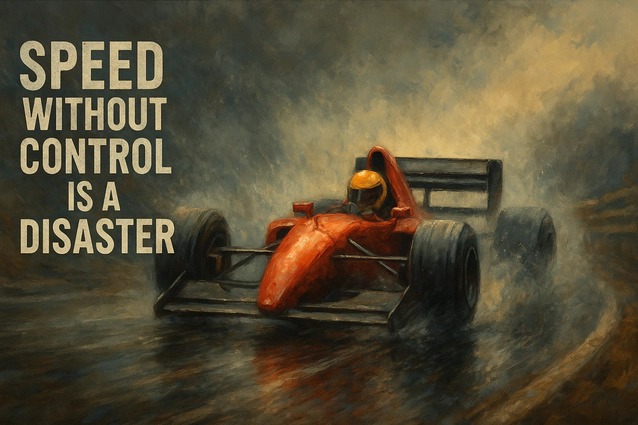
Boom 💥 In both healthcare and software, AI should support the expert, not replace the expert. Yet we keep seeing teams ship poor code into production, blindly believing that speed equals innovation. It doesn’t. Speed without control is a disaster. Like the Pirelli ad from the 90s: Power is nothing without control.
Why? Scalability 📈. Unlike hardware or therapeutics, software can scale faster, reach markets sooner, and generate returns more efficiently. But only if it’s built right.
Revere’s due diligence goes far beyond surface-level checks:
And here’s what most startups still don’t get:
“If your software isn’t grounded in a user-centric philosophy, and doesn’t reflect engineering practices rooted in craftsmanship, it doesn’t matter how smart or sexy it looks. It won’t survive the market.”
That’s why Jeremy’s team treats code as more than tech. It’s a behavioral signal. A cultural artifact. A risk surface.
Jeremy doesn’t sugarcoat it:
“AI today writes code like a high school student. Useful as an assistant. Dangerous as an unskilled engineer.”
Their CTO can instantly spot AI-generated code. Not because AI is inherently bad, but because unchecked AI output lacks mastery, creativity, contextual intelligence, and human problem-solving. If your startup relies on unvetted AI code and a charismatic pitch, you might pass the demo. But you’ll fail the production test. And in the AI era, failing production is assured doom. Something every organization should equip itself with: a tech advisory and a tech NED.
Jeremy echoes a deeper warning that’s gaining traction among the world’s most credible voices:
So what happens when the illusion of capability is handed the keys to real systems? Exactly what Jeremy is trying to prevent with their strict IT & SW due diligence: clinical risk, degraded products, and organizational collapse.
AI isn’t the villain. But treating it like a senior developer, or worse, as your CTO? That’s the real threat.
Too often, organizations chase the latest trends, obsess over metrics, or audit every technical detail, yet overlook the real differentiator: the human factor in high-stakes decisions. Just as Ferrari’s 2010 Formula 1 title slipped away not because of a mechanical failure or a lengthy pit stop, but due to a strategic misjudgment under pressure, the fate of unicorns is determined in the crucible of real-world choices.
Unicorns aren’t born from pitch decks or hype; they’re forged in production. Decision after decision, habit after habit, where every move counts and the true standard is set by the ability to integrate human insight with technical excellence.
How much of your strategy is based on data-driven behavior? How much is still guessing?
Stop guessing. Only for Forge of Unicorns subscribers:
👉 Get a free organizational assessment powered by the Unicorns’ Ecosystem. Let’s evaluate what’s under the hood, before it breaks at full speed.
To stay in the loop with all our updates, be sure to subscribe to our newsletter 📩 and podcast channels 🎧:
🎥 YouTube
📻 Spotify

Visionary Digital Evolution Strategist
Rooted in Formula 1 excellence, with over 30 years in IT starting as a child in the 1980s, …