Visionary Digital Evolution Strategist
Rooted in Formula 1 excellence, with over 30 years in IT starting as a child in the 1980s, …


Hey there, digital warriors! ⚔️
In Episode 42, we explored a hard truth: most failures in IT start at the board level. Leadership decisions—or lack thereof—create ripple effects that can derail entire organizations.
Building on that foundation, today marks a significant shift in our journey. After years of working deeply with CXOs and corporate leadership, we realized something critical:
mid-sized companies often provide easier access to the boardroom, where the dynamics between financial investors and operational leaders come into sharp focus.
Too often, we’ve observed fractures in these boards—a divide between those who financially contributed to the company’s foundation and those brought in as directors to lead operations. This divide weakens decision-making and erodes organizational cohesion, as conflicting priorities and misaligned incentives create power struggles. Instead of fostering collaboration, the boardroom becomes a battleground, where strategic clarity and unified action are sacrificed to internal discord. When performance falters, this divide frequently escalates into a cycle of collusion, as described in the Arbinger Institute’s The Anatomy of Peace.
Understanding collusion through this lens 🔎 reveals it as a cycle 🔁 of blame and justification where individuals reinforce each other’s distorted perspectives, failing to recognize their role in the dynamic. This loop perpetuated dysfunction, delaying decision-making and eroding trust across the board. The storming phase that follows—marked by heightened tension and disruption—further derails decision-making and amplifies organizational dysfunction.
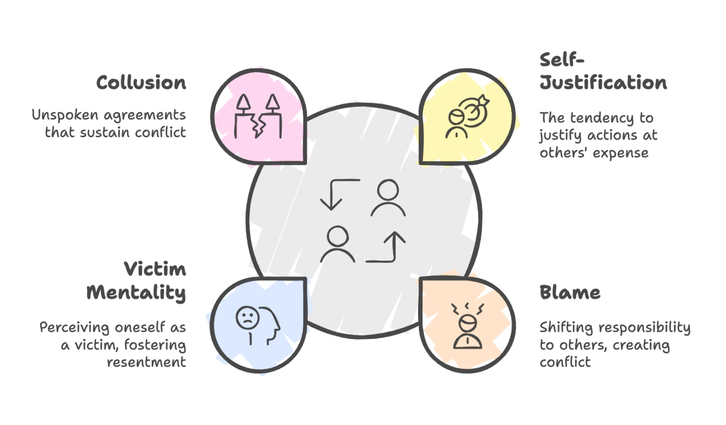
This insight, backed by years of data collection and discussions with CXOs and boards across tech and traditional industries, led us to expand our focus. We’re now actively engaging Private Equity and Venture Capital professionals, alongside leadership teams, to bridge these gaps and
transform IT from a liability into a strategic asset.
Organizations stuck in a ‘desert 🌵’ of disengagement and mediocracy must evolve into a ‘forest 🌳’—a thriving, interconnected ecosystem where collaboration, innovation, and growth are the norm. An Unicorns 🦄 Ecosystem 🌱 that provides the tools and methodologies to cultivate this transformation, turning arid, unproductive environments into flourishing landscapes of value creation.
Before we dive into the discussion, let me share a bit of history about why we became so fascinated with Unicorns 🦄. My journey began in the early 2000s in the fast-paced worlds of Formula 1 🏎️ and MotoGP 🏍️, where every millisecond ⏱️ can mean the difference between a championship victory and crushing defeat. Witnessing firsthand the level of precision, teamwork, and innovation required to dominate these arenas deeply influenced my perspective.
That mindset—the relentless pursuit of excellence 🥇—is something investors often have, but it’s rarely found in the broader market. This gap inspired me to become “obsessed” with Unicorns: those extraordinary companies that, through disruptive ideas and unconventional use of technology, transformed from garage startups into Fortune 500 titans. Our latest research, outlined in the whitepaper “Unlocking Value in the Digital Era - Transforming IT Liabilities into Strategic Assets,” identifies six key factors why IT so often struggles to replicate this success and instead remains perceived as a liability:





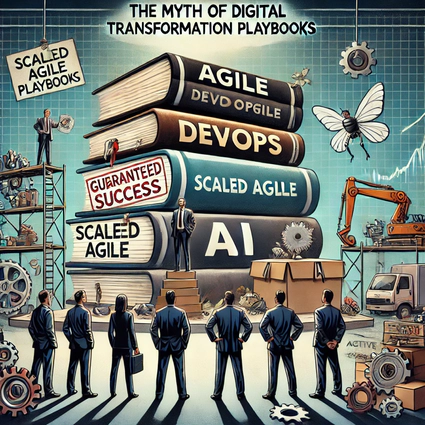
Over the past decade, we’ve meticulously studied the six critical issues outlined above, observing these phenomena across diverse industries. For example, we saw how fractured leadership consistently correlated with an 87% higher likelihood of disengaged teams, while organizations failing to align behavioral and technical strategies experienced chronic underperformance. Our intention has always been to make these observations data-driven—to translate feelings into measurable data points, providing a foundation to ground emotions in solid facts. By doing so, we created leverage to frame hypotheses, conduct experiments, and make decisions anchored in reality. Along the way, we incorporated tools not traditionally associated with IT, drawing from disciplines like neuroscience, social engineering, and behavioral science. These unconventional insights provided a lens through which we could decode why so many organizations struggle to thrive in a digitally driven world.
The result? A holistic perspective that doesn’t just fix what’s broken but empowers organizations to craft their own solutions. Over the years, our research has revealed a fascinating insight:
creating the right conditions 🌱 can enable organizations to thrive like Unicorns 🦄.
This isn’t about copying and pasting market trends or blindly following frameworks. Instead, it’s about fostering environments where collaboration, innovation, and sustainable growth flourish naturally. By leveraging behavioral engineering and a deep understanding of socio-technical dynamics, we’ve built an ecosystem designed to nurture high-performing teams and transformative results. This journey is not about cutting corners or downsizing—it’s about helping organizations discover their own path to excellence by addressing their unique challenges and opportunities.
Let’s dive into a story that underscores how transformation happens when organizations evolve instead of react. In 2019, a huge development center stuck in operational mode was teetering on the brink of closure. Productivity had plummeted, morale was at an all-time low, and senior leadership was preparing to cut their losses.
This could have been the end of the story, but what happened next was a turning point. Through a systematic approach rooted in behavioral engineering, I guided the organization to uncover and address its core dysfunctions.
The results? By the year’s end, this development center emerged as the organization’s most efficient hub. The lessons from this transformation reverberate even today, showing how reengineering culture and behaviors can unlock extraordinary potential.
For Private Equity and Venture Capital professionals, this research offers an opportunity to transform how you view IT investments. By nurturing a unicorn ecosystem that addresses behavioral inefficiencies, IT is transformed from a liability into a strategic asset, fostering measurable outcomes such as:
The potential here isn’t just incremental—it’s transformative. Are you ready to explore how these insights could revolutionize your portfolio’s value creation?
Are you ready to unlock the full potential of your portfolio 💼?
Imagine a world where your IT investments not only perform but redefine your competitive edge. Let’s explore how this ecosystem of innovation and behavioral engineering can breathe new life into struggling assets while helping you identify and nurture the next wave of game-changing opportunities.
Book an exploratory session today to see how behavioral engineering can deliver measurable outcomes for your investments. Or better yet, join the conversation! Be a guest on our upcoming podcast or contribute to our ongoing whitepaper research to share your unique perspective. This is your chance to shape the future of IT investments while showcasing your insights to a broader audience.
⏭️ Next week, we’ll take you behind the curtain of a bold digital excellence journey: Behind the Curtain: A Bold Digital Excellence Journey Begins. Don’t miss the chance to discover how one organization turned chaos into clarity and laid the foundation for transformative success.
Until then, keep evolving! ✨
📩 Ready to start your organization’s evolution?
Contact us 📬 to explore our research and discover how the Unicorns’ Ecosystem can evolve your IT into a thriving, high-performing asset.
To stay in the loop with all our updates, be sure to subscribe to our newsletter 📩 and podcast channels 🎧:
🎥 YouTube
📻 Spotify

Visionary Digital Evolution Strategist
Rooted in Formula 1 excellence, with over 30 years in IT starting as a child in the 1980s, …